Split Short Exact Sequences .... Bland, Proposition 3.2.6 ....

3 replies · 2K views · last reply
Math Amateur
Gold Member
MHB
Messages
3,920
Reaction score
48
I am reading Paul E. Bland's book "Rings and Their Modules" ...

Currently I am focused on Section 3.2 Exact Sequences in ##\text{Mod}_R##... ...

I need some help in order to fully understand the proof of Proposition 3.2.6 ...

Proposition 3.2.6 and its proof read as follows:
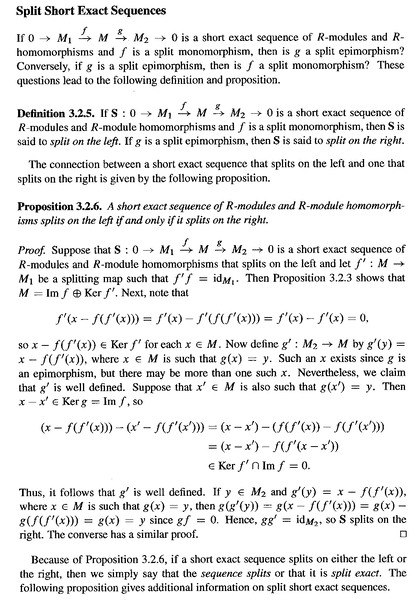
Printed textbook page titled Split Short Exact Sequences, with Definition 3.2.5 and Proposition 3.2.6 and its proof, concerning splitting of short exact sequences of R-modules.

In the above proof of Proposition 3.2.6 we read the following:"... ... Then ##x - x'\in \text{Ker } g = \text{Im } f##, so##(x - f( f' (x))) - (x' - f( f' (x'))) = ( x - x') - ( f ( f'(x) ) - f ( f'(x') ) )##

##= ( x - x') - f ( f' ( x - x') )##

##\in \text{Ker } f' \cap \text{Im } f = 0 ## ... ...

Thus it follows that ##g'## is well-defined ... ... "Can someone please explain exactly why/how ##( x - x') - f ( f' ( x - x') ) \in \text{Ker } f' \cap \text{Im } f = 0## ... ...Further, can someone please explain in some detail how the above working shows that ##g'## is well-defined ...
Help will be much appreciated ...

Peter
 
Attachments
  • Printed textbook page titled Split Short Exact Sequences, with Definition 3.2.5 and Proposition 3.2.6 and its proof, concerning splitting of short exact sequences of R-modules.
    Bland - Prposition 3.2.6 ... .....png
    44.8 KB · Views: 615
I am reading Paul E. Bland's book "Rings and Their Modules" ...

Currently I am focused on Section 3.2 Exact Sequences in ##\text{Mod}_R## ... ...

I need some further help in order to fully understand the proof of Proposition 3.2.6 ...

Proposition 3.2.6 and its proof read as follows:
Printed textbook page titled Split Short Exact Sequences, with Definition 3.2.5, Proposition 3.2.6 and its proof in algebraic notation about split monomorphisms and split epimorphisms of R-modules.

In the above proof of Proposition 3.2.6 we read the following:"... ... now define ##g' \ : \ M_2 \longrightarrow M## by ##g'(y) = x - f(f'(x))##, where ##x \in M## is such that ##g(x) = y## ... ... ... ...

... ... Suppose that ##x' \in M## is also such that ##g(x') = y## ... ... Does the above text imply that ##g'(y) = x' - f( f'(x') )## ... ... ?

Peter
 
Attachments
  • Printed textbook page titled Split Short Exact Sequences, with Definition 3.2.5, Proposition 3.2.6 and its proof in algebraic notation about split monomorphisms and split epimorphisms of R-modules.
    Bland - Prposition 3.2.6 ... .....png
    44.8 KB · Views: 523
Math Amateur said:
"... ... Then ##x - x'\in \text{Ker } g = \text{Im } f##, so##(x - f( f' (x))) - (x' - f( f' (x'))) = ( x - x') - ( f ( f'(x) ) - f ( f'(x') ) )##

##= ( x - x') - f ( f' ( x - x') )##

##\in \text{Ker } f' \cap \text{Im } f = 0 ## ... ...
The LHS of the first line has two terms, ##(x - f( f' (x)))## and ## (x' - f( f' (x')))## with ##x,x'\in M##. The 6th line of the proof of Proposition 3.2.6 concludes that terms of that form are in Ker ##f'##. Since the kernel of a linear map is a subspace, that means the LHS of that line, which is a linear comb of the two terms, is also in the kernel.

Now look at the last equality: ##= ( x - x') - f ( f' ( x - x') )##. The second term is in I am ##f##, and the first term was shown to be in I am ##f## in the extract's line immediately before that series of equalities you quoted. Again, since Images of linear maps are subspaces, the linear combination of the two terms must be in the image. So the item is both in I am ##f## and in Ker ##f'##, hence in their intersection.
Further, can someone please explain in some detail how the above working shows that ##g'## is well-defined ...
##g'## was defined as ##g'(y) = x-f(f'(x))## where ##g(x)=y##, ie where ##x\in g^{-1}(y)##. There may be more than one ##x## such that ##g(x)=y##. That doesn't matter, ie does not make the definition 'not well-defined', as long as changing the ##x## doesn't change the value of ##g'(y)##, ie of ##x-f(f'(x))##. So what is needed is to prove that if there is another such ##x##, call it ##x'##, such that ##g(x')=y=g(x)##, we will have ##x-f(f'(x))=x'-f(f'(x'))##, ie ##(x-f(f'(x))-(x'-f(f'(x'))=0##.

And that is what has just been proved by that series of equalities.
To be absolutely formal, what was proved was:
$$(x-f(f'(x))-(x'-f(f'(x')) \in \mathrm{Ker }f'\cap \mathrm{Im }f=\{0\}$$
from which it follows that
$$(x-f(f'(x))-(x'-f(f'(x'))=0$$
 
  • Like
Likes   Reactions: Math Amateur
Well! That was extremely helpful!

Thanks Andrew ...

Peter