Spring and block on incline with friction

1 reply · 3K views · last reply
jjmont17
Messages
1
Reaction score
0
So we took a quiz in class, no one got it right so now its take home and I am lost.
Homework Statement


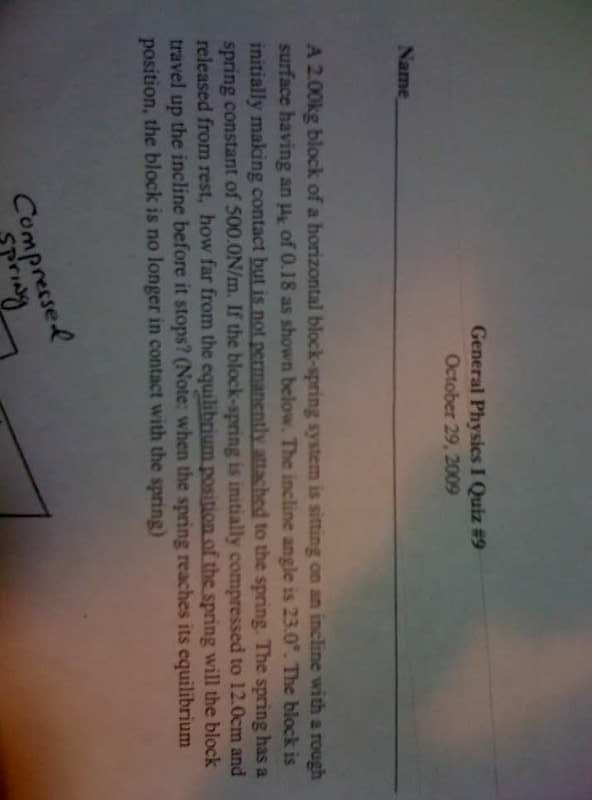
Photo of a printed physics quiz sheet rotated sideways, with handwritten label 'Compressed spring' and a sketch of an incline; text describes a 2.00 kg block on an incline of 23.0 degrees with friction coefficient 0.18 and a spring of constant 500.0 N/m compressed 12.0 cm.

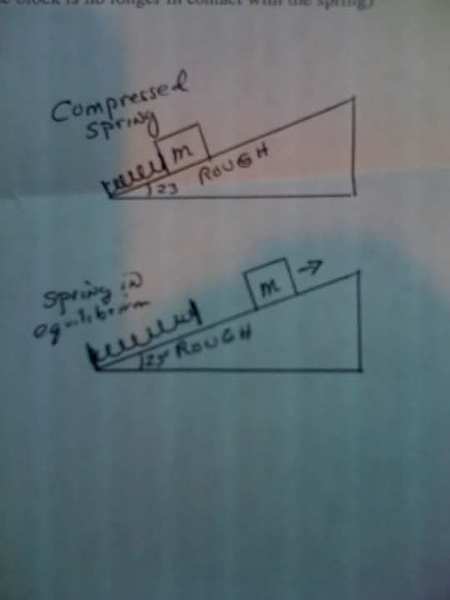
Hand-drawn diagram of a block of mass m on a rough incline with a spring at the bottom, shown twice: top labelled Compressed spring, bottom labelled Spring in equilibrium, with an arrow showing the block moving up the slope.


Homework Equations


.5kxi -Fkd= .5MVf^2
h=dsin(tht)
umgh=fk
fk=ukN


The Attempt at a Solution


I really do not know where to start i tried
(1/2)(500n/m)(12.0)-(3.25)(500n/m)(d)=.5(2)(vf^2)


Unless the question was meant to say "the block-spring system is initially compressed by 12.0 cm" rather than "the block-spring system is initially compressed to 12.0 cm", this problem is unsolvable. Without knowing the spring's equilibrium length, it's impossible to find how high it travels; if the equilibrium length is 12.1 cm, that's obviously going to give a different result than if it's 54 cm.

If we assume the spring's compressed 12 cm from equilibrium, conservation of energy is the best way to solve this problem. The spring has no kinetic energy at the bottom and none at the top, but it turned elastic potential energy into gravitational potential energy and heat. Express this as an equation, then solve for the distance travelled.