Philip
- 19
- 3
I came across this strange relationship when deriving the degree-4 equation for a torus. First thing that comes to mind is the 'Freshman's Dream'. Apparently, it was pure coincidence that they are equal. But, I don't believe in coincidences when it comes to a math expression. There is something about this one.
I found it when thinking about the 1D intercepts of a torus, along x,y, and z. Defined implicitly,
(sqrt(x^2 + y^2) - a)^2 +z^2 -b^2 = 0
The major diameter 'a' lays flat in the xy plane. This means the X and Y axes intercept as four points along a line, and have the four solutions x = ± a ± b , and y = ± a ± b . These two can be seen the implicit function, by canceling out two dimensions, and observing the result:
(sqrt(x^2) - a)^2 -b^2 = 0
x = ± b ± a
(sqrt(y^2) - a)^2 -b^2 = 0
y = ± b ± a
( - a)^2 +z^2 -b^2 = 0
z = ± b ± ai
The X and Y axes are fairly straightforward. The Z axis is what really interested me. I was thinking of how to express the Z-cut which threads right through the hole, making no intercepts at all. Graphing the plane equation XZ or YZ will give us two circles in a row. The Z axis will go right through the middle of the two circles, with no contact.
This reminds me of a parabola that sits above the x-axis in the +y region, which makes complex solutions when we solve for x. Borrowing a little intuition there, I felt that perhaps the Z-cut can be expressed as four complex solutions of ± b ± ai , where the 'complex intercept region' is the hole of the torus, and the 'real intercept region' is the ring around it. If we move the torus by +ai (relative to Z), we bring two of the four solutions into the real plane, making z = ± b and ± b + 2ai . The two real solutions ± b are the Z-axis skewering the ring top to bottom, The two complex solutions ± b + 2ai are now twice as far away in the complex plane, as the other 2 potential reals, on the other side of the empty hole. Using Z-intercepts to represent a torus will only give us half of all possible real solutions, unlike X or Y, which go through the side.
When I combined these 1D intercepts into a single equation, there were some extra repeated terms that needed to be removed, by use of a consolidation compliment , 2(a^4 + b^4). But, just the 1D intercepts and compliment weren't enough, since the oblique regions are not defined as a circular ring, but come out as blobs. Comparing the fully expanded degree-4 to what I ended up with needed the oblique compliment , 2((xy)^2 + (xz)^2 + (yz)^2). These terms define all possible oblique angles of a 1D intercept into a circular ring.
The final result, which graphs a perfect torus using complex conjugates for the Z-intercept:
(x ± b ± a)^4 + (y ± b ± a)^4 + (z ± b ± ai)^4 + 2((xy)^2 + (xz)^2 + (yz)^2) - 2(a^4 + b^4) = 0
expands into
(x-b-a)(x+b-a)(x-b+a)(x+b+a) + (y-b-a)(y+b-a)(y-b+a)(y+b+a) + (z-b-ai)(z+b-ai)(z-b+ai)(z+b+ai) + 2((xy)^2 + (xz)^2 + (yz)^2) - 2(a^4 + b^4) = 0
setting a = 3 , b = 1
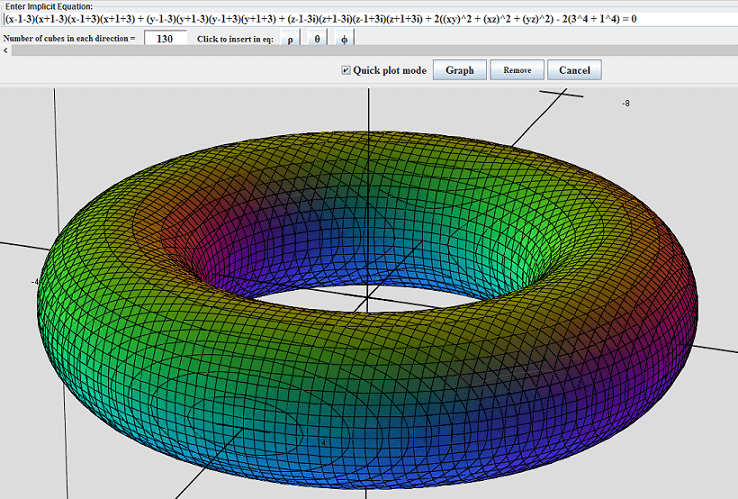
(x-1-3)(x+1-3)(x-1+3)(x+1+3) + (y-1-3)(y+1-3)(y-1+3)(y+1+3) + (z-1-3i)(z+1-3i)(z-1+3i)(z+1+3i) + 2((xy)^2 + (xz)^2 + (yz)^2) - 2(3^4 + 1^4) = 0which will graph into a perfect torus:
 But, the question still remains, in the case of
z = ± sqrt(b^2 - a^2) = ± b ± ai
The z-intercepts can also be written this way, and also graphs the identical torus.
Perhaps what's really going on is that this is a product of solutions,
z = (-sqrt(b^2 - a^2)(+sqrt(b^2 - a^2) = (z - b - ai)(z + b - ai)(z - b + ai)(z + b + ai)
The above method of complex conjugate intercepts also works for defining holes of a 4D toroidal shape as well. So far, I tested it with two other degree-4 equations in 4D, and it functions perfectly. However, in 4D there are two more toroidal shapes that are degree-8, with TWO such holes. One of them makes all complex intercepts in 1D. I have not yet derived their oblique angle terms, since a degree-8 surface is significantly more complex. They do make the proper, albeit blobby, intercepts of two degree-4 tori in 3D, though.
Let me know what you all think.
--Philip
I found it when thinking about the 1D intercepts of a torus, along x,y, and z. Defined implicitly,
(sqrt(x^2 + y^2) - a)^2 +z^2 -b^2 = 0
The major diameter 'a' lays flat in the xy plane. This means the X and Y axes intercept as four points along a line, and have the four solutions x = ± a ± b , and y = ± a ± b . These two can be seen the implicit function, by canceling out two dimensions, and observing the result:
(sqrt(x^2) - a)^2 -b^2 = 0
x = ± b ± a
(sqrt(y^2) - a)^2 -b^2 = 0
y = ± b ± a
( - a)^2 +z^2 -b^2 = 0
z = ± b ± ai
The X and Y axes are fairly straightforward. The Z axis is what really interested me. I was thinking of how to express the Z-cut which threads right through the hole, making no intercepts at all. Graphing the plane equation XZ or YZ will give us two circles in a row. The Z axis will go right through the middle of the two circles, with no contact.
This reminds me of a parabola that sits above the x-axis in the +y region, which makes complex solutions when we solve for x. Borrowing a little intuition there, I felt that perhaps the Z-cut can be expressed as four complex solutions of ± b ± ai , where the 'complex intercept region' is the hole of the torus, and the 'real intercept region' is the ring around it. If we move the torus by +ai (relative to Z), we bring two of the four solutions into the real plane, making z = ± b and ± b + 2ai . The two real solutions ± b are the Z-axis skewering the ring top to bottom, The two complex solutions ± b + 2ai are now twice as far away in the complex plane, as the other 2 potential reals, on the other side of the empty hole. Using Z-intercepts to represent a torus will only give us half of all possible real solutions, unlike X or Y, which go through the side.
When I combined these 1D intercepts into a single equation, there were some extra repeated terms that needed to be removed, by use of a consolidation compliment , 2(a^4 + b^4). But, just the 1D intercepts and compliment weren't enough, since the oblique regions are not defined as a circular ring, but come out as blobs. Comparing the fully expanded degree-4 to what I ended up with needed the oblique compliment , 2((xy)^2 + (xz)^2 + (yz)^2). These terms define all possible oblique angles of a 1D intercept into a circular ring.
The final result, which graphs a perfect torus using complex conjugates for the Z-intercept:
(x ± b ± a)^4 + (y ± b ± a)^4 + (z ± b ± ai)^4 + 2((xy)^2 + (xz)^2 + (yz)^2) - 2(a^4 + b^4) = 0
expands into
(x-b-a)(x+b-a)(x-b+a)(x+b+a) + (y-b-a)(y+b-a)(y-b+a)(y+b+a) + (z-b-ai)(z+b-ai)(z-b+ai)(z+b+ai) + 2((xy)^2 + (xz)^2 + (yz)^2) - 2(a^4 + b^4) = 0
setting a = 3 , b = 1
(x-1-3)(x+1-3)(x-1+3)(x+1+3) + (y-1-3)(y+1-3)(y-1+3)(y+1+3) + (z-1-3i)(z+1-3i)(z-1+3i)(z+1+3i) + 2((xy)^2 + (xz)^2 + (yz)^2) - 2(3^4 + 1^4) = 0which will graph into a perfect torus:
z = ± sqrt(b^2 - a^2) = ± b ± ai
The z-intercepts can also be written this way, and also graphs the identical torus.
Perhaps what's really going on is that this is a product of solutions,
z = (-sqrt(b^2 - a^2)(+sqrt(b^2 - a^2) = (z - b - ai)(z + b - ai)(z - b + ai)(z + b + ai)
The above method of complex conjugate intercepts also works for defining holes of a 4D toroidal shape as well. So far, I tested it with two other degree-4 equations in 4D, and it functions perfectly. However, in 4D there are two more toroidal shapes that are degree-8, with TWO such holes. One of them makes all complex intercepts in 1D. I have not yet derived their oblique angle terms, since a degree-8 surface is significantly more complex. They do make the proper, albeit blobby, intercepts of two degree-4 tori in 3D, though.
Let me know what you all think.
--Philip
Last edited: