High School Can a Square be Dissected into a Cube with Fewer Pieces?

  • Thread starter Thread starter Helios
  • Start date Start date
  • Tags Tags
    Cube Square
Click For Summary
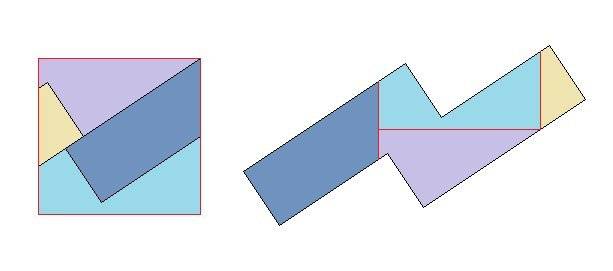
A geometric dissection was successfully created by slicing a square into four pieces to form an unfolded net for a cube. The original creator rediscovered and reconstructed this drawing after many years. The discussion raises the question of whether this dissection can be achieved with fewer pieces. Participants express interest in exploring the possibility of a more efficient dissection. The conversation centers on the challenge of minimizing the number of pieces while maintaining the integrity of the geometric transformation.
Helios
Messages
267
Reaction score
63
TL;DR
A Square to Unfolded Cube Geometric Dissection
Dear Recreational Geometry People,
I recovered a thing I did very long ago from a drawing of mine that I fortunately just found again. With some effort I was able reconstruct what I did and redraw it. It is a geometric dissection. The task is to slice up a square and use those pieces to make a unfolded "net" for a cube. I did it in just 4 pieces!
cubenet.jpg
 
  • Like
Likes bob012345, mfb and Ibix
Mathematics news on Phys.org
Helios said:
Summary:: A Square to Unfolded Cube Geometric Dissection

Dear Recreational Geometry People,
I recovered a thing I did very long ago from a drawing of mine that I fortunately just found again. With some effort I was able reconstruct what I did and redraw it. It is a geometric dissection. The task is to slice up a square and use those pieces to make a unfolded "net" for a cube. I did it in just 4 pieces!

View attachment 268201
Very nice! Can it be done in less?
 
Last edited:
Here is a little puzzle from the book 100 Geometric Games by Pierre Berloquin. The side of a small square is one meter long and the side of a larger square one and a half meters long. One vertex of the large square is at the center of the small square. The side of the large square cuts two sides of the small square into one- third parts and two-thirds parts. What is the area where the squares overlap?

Similar threads

Replies
7
Views
2K
  • · Replies 1 ·
Replies
1
Views
3K
  • · Replies 5 ·
Replies
5
Views
4K
Replies
8
Views
4K
  • · Replies 2 ·
Replies
2
Views
4K
  • · Replies 5 ·
Replies
5
Views
5K
  • · Replies 1 ·
Replies
1
Views
2K
  • · Replies 110 ·
4
Replies
110
Views
24K
  • · Replies 1 ·
Replies
1
Views
4K
  • · Replies 5 ·
Replies
5
Views
4K