fog37
- 1,566
- 108
Hello,
I am review some key linear algebra concepts. Let's keep the discussing to 2D.
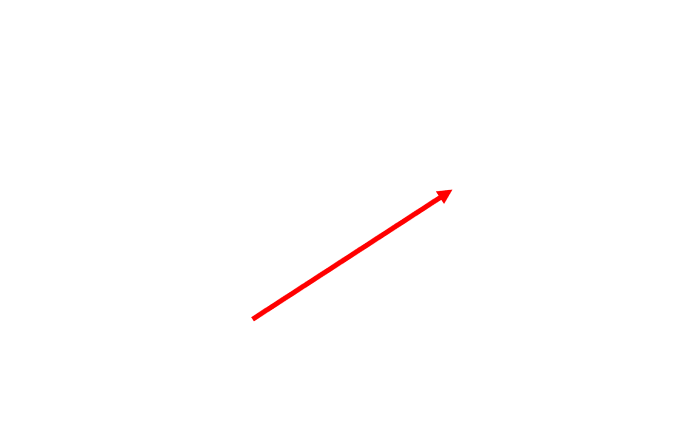
Vectors in the 2D space can be simplistically visualized as arrows with a certain length and direction. Let's draw a single red arrow on the page representing vector ##X##, an entity that is independent of the basis choice:
We then can choose ANY pair of not collinear vectors to form a basis. Basis 1 has two basis vectors with coordinates ##a=(1,0)## and ##b=(0,1)##. The basis vectors ##a## and ##b## have coordinates....Their coordinates are exactly ##(1,0)## and ##(0,1)## ONLY under the implicit assumptions that the two vectors are the basis vectors or a specific basis, basis 1 in this case.
If we consider the different basis 2, the basis vector ##c## and ##d## will also have coordinates ##c=(1,0)## and ##d=(0,1)## as long as we are under the assumption that the are themselves the basis vectors of a specific basis.
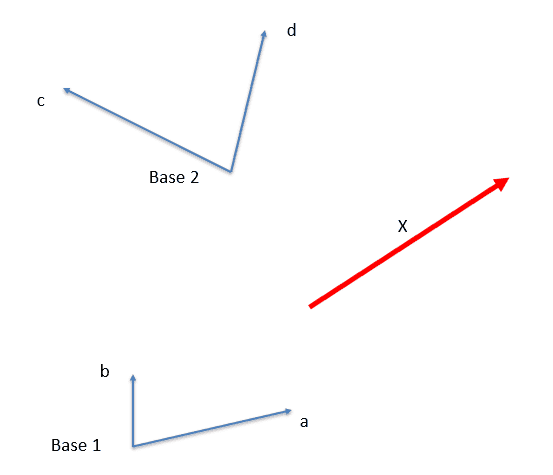
So the coordinates of a vector are always relative (to the basis we choose): if we arbitrarily decide that the basis we want to use is basis 1, then vectors ##a## and ##b## will be the basis vectors themselves with coordinates ##(1,0)## and ##(0,1)## and vectors ##c##and ##d## will have different coordinates...Basis vectors always have coordinates ##(1,0)## and ##(0,1)## in their OWN basis and different coordinates in a different basis... This may seem obvious but I needed to flush it out to make sure I am indeed thinking correctly about it.
Orthogonal bases give concise representations of vectors in the vector space: every basis vector encodes a specific and independent piece of information about the vector. Some orthogonal bases provide more sparse representations that others...
Non-orthogonal bases can also be useful. To find the coefficients associated to a certain basis vector we need the vector itself, the basis vector, but also the other basis vectors....I am confused about that. In the case of orthogonal bases, we simply perform the dot product between the vector and the specific basis vector without involving other basis vectors....Involving them in what sense?
Thank YOU!
I am review some key linear algebra concepts. Let's keep the discussing to 2D.
Vectors in the 2D space can be simplistically visualized as arrows with a certain length and direction. Let's draw a single red arrow on the page representing vector ##X##, an entity that is independent of the basis choice:
We then can choose ANY pair of not collinear vectors to form a basis. Basis 1 has two basis vectors with coordinates ##a=(1,0)## and ##b=(0,1)##. The basis vectors ##a## and ##b## have coordinates....Their coordinates are exactly ##(1,0)## and ##(0,1)## ONLY under the implicit assumptions that the two vectors are the basis vectors or a specific basis, basis 1 in this case.
If we consider the different basis 2, the basis vector ##c## and ##d## will also have coordinates ##c=(1,0)## and ##d=(0,1)## as long as we are under the assumption that the are themselves the basis vectors of a specific basis.
So the coordinates of a vector are always relative (to the basis we choose): if we arbitrarily decide that the basis we want to use is basis 1, then vectors ##a## and ##b## will be the basis vectors themselves with coordinates ##(1,0)## and ##(0,1)## and vectors ##c##and ##d## will have different coordinates...Basis vectors always have coordinates ##(1,0)## and ##(0,1)## in their OWN basis and different coordinates in a different basis... This may seem obvious but I needed to flush it out to make sure I am indeed thinking correctly about it.
Orthogonal bases give concise representations of vectors in the vector space: every basis vector encodes a specific and independent piece of information about the vector. Some orthogonal bases provide more sparse representations that others...
Non-orthogonal bases can also be useful. To find the coefficients associated to a certain basis vector we need the vector itself, the basis vector, but also the other basis vectors....I am confused about that. In the case of orthogonal bases, we simply perform the dot product between the vector and the specific basis vector without involving other basis vectors....Involving them in what sense?
Thank YOU!