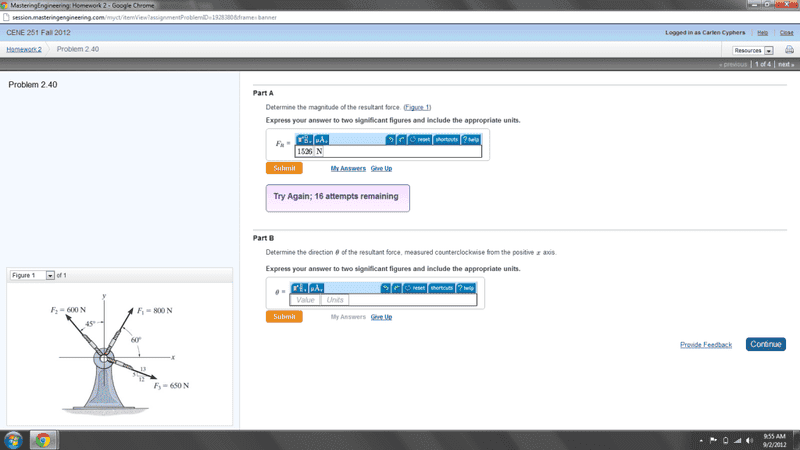
Statics: Determine the magnitude of the resultant force

Click For Summary

Discussion Overview

The discussion revolves around a statics problem involving the determination of the magnitude of the resultant force from multiple force vectors. Participants are attempting to resolve the problem by calculating the x and y components of the forces and then combining them to find the resultant magnitude.

Discussion Character

  • Homework-related
  • Mathematical reasoning
  • Debate/contested

Main Points Raised

  • One participant presents initial calculations for the x and y components of three forces but struggles to arrive at the correct resultant magnitude.
  • Another participant corrects the first participant's calculation of the x-component for F1, indicating it should be 400 N instead of 150 N.
  • Further attempts to solve the problem yield different resultant magnitudes, with one participant reporting an answer of 1697 and another of 1526, indicating confusion and potential errors in calculations.
  • Suggestions are made to ensure the correct angles are used for each force and to check for sign errors in the calculations.
  • A participant expresses frustration over the simplicity of the problem and their inability to solve it, despite having split the components correctly.
  • Eventually, one participant identifies that they had neglected to include negative signs where necessary, which affected their resultant calculations.
  • Another participant emphasizes the importance of direction in vector calculations, noting that the sign of the components is crucial.
  • A different approach is suggested, involving the use of force triangles to simplify the resolution of forces and minimize mistakes.

Areas of Agreement / Disagreement

Participants express varying levels of understanding and progress, with some agreeing on the importance of correctly determining force components and angles, while others remain uncertain about their calculations. The discussion does not reach a consensus on a single correct method or answer.

Contextual Notes

Participants mention potential errors in determining force components and the importance of considering the direction of forces, but do not resolve these issues fully. There are indications of confusion regarding the angles used for the forces, and the discussion reflects a lack of clarity in the calculations presented.

C268
Messages
26
Reaction score
0
1. Homework Statement :

Untitled-2.png


The Attempt at a Solution


I keep attempting this problem and so far I have got this:

F1x: 150
F1y:260
F2x:424
F2y:424
F3x:600
F3y:250

Then I add the x's together and y's together, square both and take the square root for magnitude, but can't seem to get the right answer
 
Physics news on Phys.org
F1= 800 N at 60 degrees, so F1x = 800cos(60) = 400 N. You have it as 150.
 
rock.freak667 said:
F1= 800 N at 60 degrees, so F1x = 800cos(60) = 400 N. You have it as 150.

alright so I get 1697 in the end...still didn't work, and I noticed it says to 2 significant digits...I am completely stuck...I have no idea what else would be wrong
 
Have you gotten any more progress? I have gotten an answer but nowhere near 1697 or 1526. I would recommend splitting up the equation into the x and y components. As you probably have already done. Also when doing it make sure that you are using the correct angle.
 
No, I kinda gave up for now...as seen in my post I already split up the components into x and y, so not sure what else to do..its such a simple problem I am not sure why I am having trouble with it
 
Please show your workings so we can better assist in finding your errors. Might be due to an error in detremining force components ( as has been pointed out), or might be an error in the pesty plus or minus sign,...or both.
 
C268 said:
No, I kinda gave up for now...as seen in my post I already split up the components into x and y, so not sure what else to do..its such a simple problem I am not sure why I am having trouble with it

Well, if you decide to try the problem again we will be here to help you if you still cannot figure it out.
 
It looks like I have made some small mistakes, I am going to attempt it again this afternoon and hopefully it should work now.
 
Well I tried again and I am running out of time..but here is my work:

F1x: 400
F1y:693
F2x:424
F2y:424
F3x:600
F3y:250

Fx's:1424
Fy's:1367

(1424^2+1367^2)^(1/2)

As far as how I found the x and y components I simply used the magnitude of the vector times cosine of the angle for x's and sine for y's...

I am very frustrated because this is such a simple problem and I don't see what else I would be doing wrong
 
  • #10
What angles are you using for each force? Primarily F3?

Check the angle that you are using for F2. Are you sure you want to use 45 degrees?
 
Last edited:
  • #11
Figured it out...and of course it was something stupid...I forgot to add the negatives to the numbers that needed it...I just figured I didn't need them since I was finding the magnitude anyways, but of course that affects the x and y resultant that you square
 
  • #12
Exactly! Force is a vector so its direction matters ergo the sign also matters. I'm glad that you figured it out! :smile:
 
  • #13
I find it quite easy to always use force triangles when given problems like this since its always easy to make mistakes when resolving( you have more equations obviously high chances of sign mistakes)... wherez you could pplug all the values in one geometric equation and instantly find the magnitude and direction! :)
 

Similar threads

  • · Replies 4 ·
Replies
4
Views
2K
Replies
12
Views
2K
  • · Replies 5 ·
Replies
5
Views
2K
  • · Replies 2 ·
Replies
2
Views
3K
  • · Replies 1 ·
Replies
1
Views
6K
  • · Replies 3 ·
Replies
3
Views
2K
  • · Replies 1 ·
Replies
1
Views
4K
  • · Replies 4 ·
Replies
4
Views
6K
  • · Replies 13 ·
Replies
13
Views
5K
  • · Replies 3 ·
Replies
3
Views
10K