"Statics of Rigid Bodies: 2 Questions

Click For Summary
SUMMARY

This discussion focuses on solving two problems related to the statics of rigid bodies, specifically involving a cable tension and free body diagrams (FBD). The first problem involves a cable of length 8.5 m supporting a 1000 kg crate, resulting in a tension force of 5622.13 N, with x and y components calculated as 2756.5 N and 4900.5 N, respectively. The second problem discusses pressure distribution and the use of integrals to find constants C1 and C2, emphasizing the importance of correctly drawing FBDs to analyze forces acting on the system.

PREREQUISITES
  • Understanding of statics and equilibrium in rigid body mechanics
  • Proficiency in calculating tension forces and components in cables
  • Familiarity with free body diagrams (FBD) and their application in problem-solving
  • Knowledge of integral calculus for pressure distribution analysis
NEXT STEPS
  • Study the principles of tension in cables and how to resolve forces into components
  • Learn how to effectively draw and analyze free body diagrams (FBDs) for complex systems
  • Explore the application of double integrals in calculating pressure distributions
  • Investigate the relationship between bending moment diagrams and cable deflection shapes
USEFUL FOR

Students and professionals in mechanical engineering, civil engineering, and physics who are dealing with statics, tension analysis, and free body diagram applications in rigid body mechanics.

hqjb
Messages
38
Reaction score
0
2 Questions about statics of rigid bodies

Homework Statement


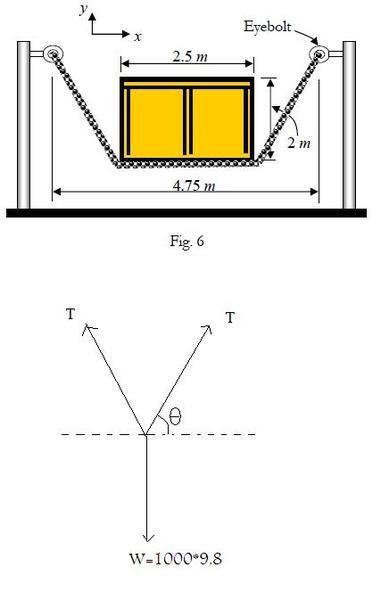
A cable of length 8.5 m is attached to the two posts as shown in Fig. 6. The crate has a mass of 1000 kg. Find the x and y components of the forces exerted by the cable on the eyebolts and find the tension force in the cable.
attachment.php?attachmentid=55087&stc=1&d=1359302033.jpg


The Attempt at a Solution


\theta = \arctan\frac{2}{1.125}
\theta = 60.64
2T\sin 60.64 = 1000 * 9.8
T = 5622.13N
T_x = 5622.13\cos 60.64 = 2756.5N
T_y = 5622.13\sin 60.64 = 4900.5N

My question is regarding my free body diagram, I didn't exactly know how to draw it since the box acted its weight not at a point but along a stretch of wire.
So I drew the FBD according to an imaginary point along the centre of gravity concurrent with the cable's tension, is this correct?
Homework Statement


attachment.php?attachmentid=55089&stc=1&d=1359302384.jpg


The Attempt at a Solution


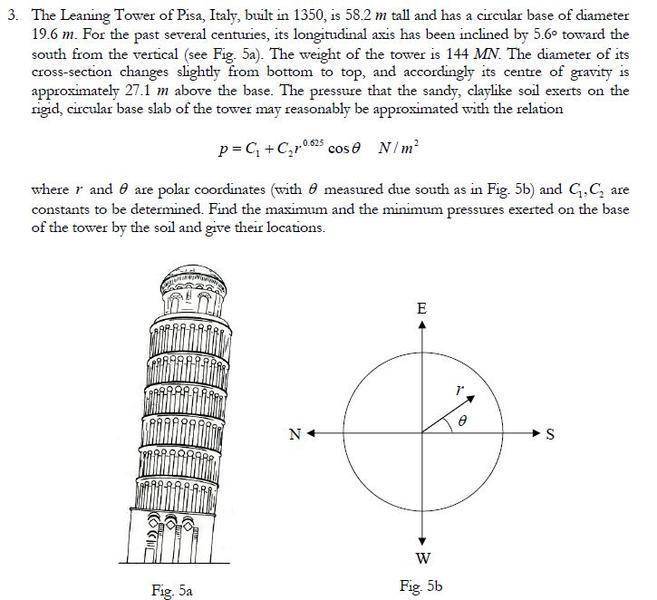
This one is really tough, I just need a hint on this problem. All I got was that the pressure would be minimum at r=0m(the centre) and maximum where r=19.6m and theta=0(at the south perimeter).
Not sure how I could find the constants C1 and C2.

Thanks for reading.
 

Attachments

  • FBD.jpg
    FBD.jpg
    16.3 KB · Views: 865
  • FBD2.jpg
    FBD2.jpg
    51 KB · Views: 789
Physics news on Phys.org
hqjb said:
My question is regarding my free body diagram, I didn't exactly know how to draw it since the box acted its weight not at a point but along a stretch of wire.
So I drew the FBD according to an imaginary point along the centre of gravity concurrent with the cable's tension, is this correct?
It works. Alternatively, you could draw two diagrams, and let 1/2 of the total force act on both sides.

All I got was that the pressure would be minimum at r=0m(the centre) and maximum where r=19.6m and theta=0(at the south perimeter).
What about the northern side, with negative cos(θ)?
Can you calculate the total force on the ground, based on C1 and C2? You have another value to compare it to, this allows to determine C1.
The center of mass has to be supported without net angular momentum. This gives a second equation which allows to determine C2.
 
mfb said:
It works. Alternatively, you could draw two diagrams, and let 1/2 of the total force act on both sides.What about the northern side, with negative cos(θ)?
Can you calculate the total force on the ground, based on C1 and C2? You have another value to compare it to, this allows to determine C1.
The center of mass has to be supported without net angular momentum. This gives a second equation which allows to determine C2.

-Wow thanks, didnt expect such a quick reply.
I don't understand what you mean by "let 1/2 of the total force act on both sides."
Do you mean drawing FBD of the 2 points at the edges of the crates?

-Right! Pressure is minimum at the northern side and maximum at the southern side.
So the total force would be to that the area integral of function p
i.e. F = \int\int pdA = \int^{2\pi}_0\int^{19.6}_0 C_1 + C_2 r^{0.625}\cos\theta
1206.87 C_1
For vertical equilibrium, C_1 = 144/1206.87 MN
Am I going in the right direction?
 
hqjb said:
-Wow thanks, didnt expect such a quick reply.
I don't understand what you mean by "let 1/2 of the total force act on both sides."
Do you mean drawing FBD of the 2 points at the edges of the crates?
What is FBD?
Right, I meant the edges of the crate.

Am I going in the right direction?
Yes
 
mfb said:
What is FBD?
Right, I meant the edges of the crate.


Yes
Oh, its a shorthand term for freebody diagram.
A question, if I were to draw the FBD for the points at the edges it'd look like this
attachment.php?attachmentid=55096&stc=1&d=1359306987.jpg

which doesn't really make sense since Tcosθ wouldn't equals T
It seems like I'm making some fundamental mistakes, forgive me if it looks stupid :shy:
Anyway, going to sleep won't reply till tomorrow.
 

Attachments

  • FBD.jpg
    FBD.jpg
    4.3 KB · Views: 701
The force to the right can be different from T - the difference is a compressive force transported by the rigid box.
In other words, ignore the horizontal component here, it does not give anything new for your problem.
 
mfb said:
The force to the right can be different from T - the difference is a compressive force transported by the rigid box.
In other words, ignore the horizontal component here, it does not give anything new for your problem.

I think I understand both problems already, the area integral I did above had some mistakes(namely I took diameter instead of radius and didnt multiply by the jacobian).

For the second part I took the same double integral but this time multiplied by rcosθ to get the x-component of the moments, equate this with the weight*distance and I got what hopefully is the correct answer.
Thanks.
 
For the first problem I think you are missing a useful property - that the shape of the deflected cable is the same shape (to some scale) as the bending moment diagram on a beam with two point loads 2,5 m apart. What are the components in the sloping part of the cable? The vertical component must balance ... what? You know the gradient of the cable from the information given. hence you can solve for the cable force
 

Similar threads

Replies
1
Views
4K
  • · Replies 12 ·
Replies
12
Views
2K
  • · Replies 9 ·
Replies
9
Views
3K
  • · Replies 20 ·
Replies
20
Views
3K
Replies
25
Views
6K
  • · Replies 10 ·
Replies
10
Views
3K
  • · Replies 1 ·
Replies
1
Views
2K
  • · Replies 4 ·
Replies
4
Views
2K
  • · Replies 7 ·
Replies
7
Views
3K
  • · Replies 2 ·
Replies
2
Views
2K