Statics of Rigid Bodies - Why is the normal force not considered?

Click For Summary

Discussion Overview

The discussion revolves around the treatment of normal forces in free body diagrams (FBDs) within the context of statics of rigid bodies, specifically addressing why the normal force from a roller is not included in a given problem from Hibeller's book on Mechanics: Statics. The scope includes conceptual clarification and technical reasoning related to frames and machines.

Discussion Character

  • Conceptual clarification
  • Technical explanation
  • Debate/contested

Main Points Raised

  • One participant questions why the normal force from the roller is not included in the FBD, suggesting a possible misunderstanding of the concept.
  • Another participant explains that a free body diagram considers only external forces acting on the body.
  • A different participant references the concept of overdetermined systems and discusses how internal forces can be calculated from external forces and moments.
  • One participant proposes that the normal force from the roller can be considered an internal force of the mechanism, depending on how the system is defined.
  • Another participant seeks clarification on the distinction between internal and external forces, using an analogy involving a box and a surface to illustrate their understanding.
  • Responses affirm that the normal force exerted by the surface on the box is indeed considered an external force, while the normal force from the roller is treated differently.

Areas of Agreement / Disagreement

Participants express differing views on whether the normal force from the roller should be considered an internal or external force, indicating a lack of consensus on this aspect of free body diagrams.

Contextual Notes

Participants highlight the importance of defining the system correctly to determine the classification of forces, but there are unresolved nuances regarding the treatment of forces in different contexts.

Nova_Chr0n0
Messages
16
Reaction score
3
Homework Statement
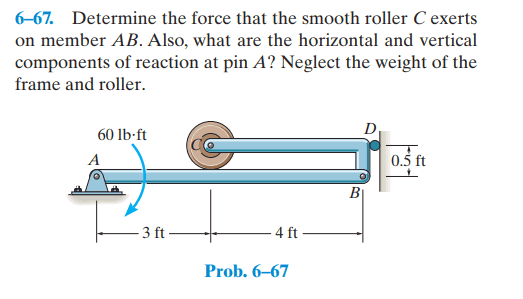
6–67. Determine the force that the smooth roller C exerts
on member AB. Also, what are the horizontal and vertical
components of reaction at pin A? Neglect the weight of the
frame and roller.
Relevant Equations
Equilibrium Equations
The problem is from Hibeller's book, Mechanics: Statics and attached below is the picture of the problem:
1700821107597.png


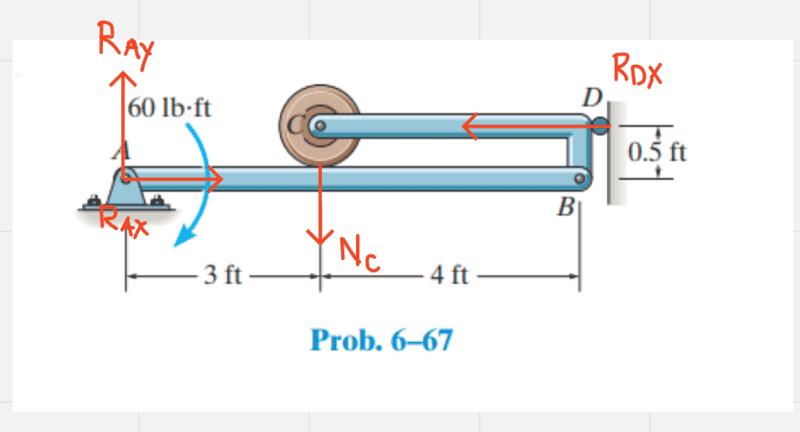
My question about this problem is about the FBD of the reactions. Here is how I drew it:
1700821364702.png


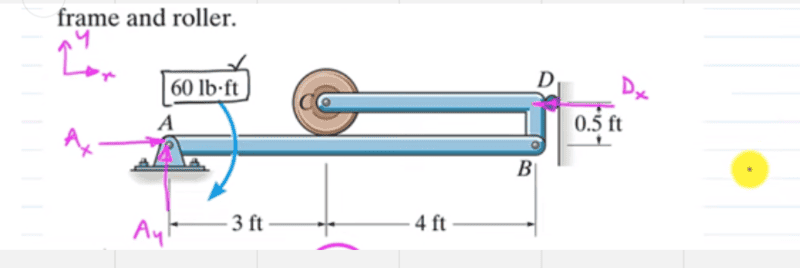
But when I tried checking the solution for the problem, they have this as their FBD:
1700821514445.png


My question is, why did they not include the Normal force created by the roller? Is it not considered as a reaction for the whole figure? I think I'm missing an important concept here and it confuses me. This topic is Frames and Machines.
 
Physics news on Phys.org
  • Like
Likes   Reactions: Nova_Chr0n0, Lnewqban and erobz
Please, see:
https://en.m.wikipedia.org/wiki/Overdetermined_system

Resolving external forces with three available equations (summation of external forces and moments) is the first step.
With those values, you can calculate the internal forces and moments in any armature, frame, truss or mechanism.

For practical purpose, you could weld that roller to member AB, and both members at pin B, without modifying the shown conditions.
Its normal force can be considered an internal force of the whole mechanism.

Note that a Dy reactive force is needed to keep the static equilibrium.
You could simplify the "body" to a single member being wedged against the vertical surface by the applied clockwise moment (like shown below).
Dy is preventing the body from rotating about pivot A.

Dx will induce a moment on member BDC about pin B, which will translate into the roller normal force that you have mentioned (which will be a bending load on member AB).

As you can see, we need to calculate the chain reaction step by step, beginning with reaction forces at B and D.

4274BBF9-0A0A-4B68-A171-284D21BCC142.jpeg
 
Last edited:
  • Like
Likes   Reactions: Nova_Chr0n0 and DeBangis21
Sorry, I am really slow to catch up, so I need more clarification. My current understanding, based on the explanation, is that:

The normal force produced by the roller is considered an internal force and not an external force. Is it because the roller is part of the whole figure and therefore its normal force is not considered an external one? Here is what I'm thinking right now: Consider a box and a surface:
1700895154043.png


Here, the box is the figure and is experiencing a normal force. This normal force is exerted by the surface (which is a different figure that is not being examined) and not the box, so is it considered an external force?

In the figure I've shown, the red colors are an external object to the figure (highlighted as yellow) and are therefore considered an external force?

1700895393957.png
 
  • Like
Likes   Reactions: Lnewqban
Nova_Chr0n0 said:
This normal force is exerted by the surface (which is a different figure that is not being examined) and not the box, so is it considered an external force?
Yes

Nova_Chr0n0 said:
In the figure I've shown, the red colors are an external object to the figure (highlighted as yellow) and are therefore considered an external force?
Yes
 
  • Informative
Likes   Reactions: Nova_Chr0n0

Similar threads

  • · Replies 13 ·
Replies
13
Views
3K
  • · Replies 7 ·
Replies
7
Views
3K
  • · Replies 27 ·
Replies
27
Views
3K
  • · Replies 2 ·
Replies
2
Views
3K
  • · Replies 3 ·
Replies
3
Views
2K
  • · Replies 5 ·
Replies
5
Views
2K
  • · Replies 9 ·
Replies
9
Views
3K
  • · Replies 2 ·
Replies
2
Views
2K
  • · Replies 7 ·
Replies
7
Views
4K
  • · Replies 6 ·
Replies
6
Views
4K