Stationary circuit: can current pass THROUGH a battery?

Join the discussion
Ask a follow-up here, or get your own question answered by working scientists, mathematicians and engineers — people, not an autocomplete.
Real named experts · corrections over time · the nuance an AI answer skips
9 replies · 4K views
libelec
Messages
173
Reaction score
0
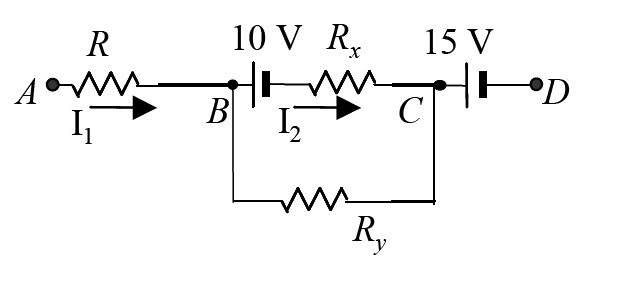
This is a piece of circuit:

10dh2ko.jpg
.


I2 = 2A, I1 = 4A, R = 10[tex]\Omega[/tex], VB - VC = 12V. Find Iy (that goes over Ry), Rx, Ry and VA - VD


The Attempt at a Solution


I can find Rx pretty easily, using that VB - VC = 12V, then, since V= IR, VB - 10 V - I2*Rx - VC = 0.

I also find, using the same fact, that Iy*Ry = VB - VC = 12V (going through the lower branch that joins B and C).

But I can't see how I can get Iy. I know that in B (node), there's I1 and Iy AND another current (be it I3) that should go towards the 10V battery next to B. I also believe that I2 = I3 + I4, where I4 is current generated by the 10 V battery.

Now, I know the last sentence must have something wrong with it, because in the exercise the first thing they ask to find is Iy, so it should come out fast. My problem is that I have been having trouble with the currents and their directions (how to predict this).

My question is: can part of the current I1 go through the battery and aid forming I2? What am I missing?

Thanks
 
Physics news on Phys.org
Yeah, stupid me. Then is this sentence OK: I know that in B (node), there's I1 and Iy AND another current (be it I3) that should go towards the 10V battery next to B. I also believe that I2 = I3 + I4, where I4 is current generated by the 10 V battery.
? What do I have to do to find Iy?
 
I don't understand how your definition of I4 is distinct from I3 (or I2, for that matter). As near as I can tell, the branch between nodes B and C has a 10 V battery and a resistor Rx in it. These two are in series, which means the current through them must be the same (i.e. it is I2).

Therefore, using KCL for node B:

I1 = I2 + Iy
 
Why I2? Doesn't I2 move towards C?

An how about the 15V battery? Doesn't it give some current to the lower BC branch too?
 
libelec said:
This is a piece of circuit:

10dh2ko.jpg
.

My question is: can part of the current I1 go through the battery and aid forming I2? What am I missing?

Thanks


You miss Kirchhoff''s Current Law.

The electric current is flowing charge- it can not accumulate or lost, like water in a pipe: the amount of water flowing in at one end of a pipe should flow out at the other end, the electric current, too, is the same along a branch of circuit, between two nodal points.
.

"The principle of conservation of electric charge implies that:

At any node (junction) in an electrical circuit, the sum of currents flowing into that node is equal to the sum of currents flowing out of that node. "

Applying this law at node B, I1=I2+Iy.

ehild
 
libelec said:
Why I2? Doesn't I2 move towards C?

Exactly. I2 is the current flowing between node B and node C across the branch with the 10 V battery and the resistor Rx in it.

libelec said:
An how about the 15V battery? Doesn't it give some current to the lower BC branch too?

Maybe. Probably. What is your point though? Iy IS the current flowing through the branch with the resistor Ry in it, by definition. Sure, many different things could be contributing to it.
 
But why do you say that there's current I2 in B, if I2 goes towards C after the 10V battery?

Besides, shouldn't I2 go towards the negative borne of the 10V battery? I mean, isn't current born in the positive borne and goes all the way towards the negative borne?
 
libelec said:
But why do you say that there's current I2 in B, if I2 goes towards C after the 10V battery?

I'm not saying that there is a current I2 "in" B, because that doesn't make any sense. I'm saying that I2 is flowing out of node B. As explained by ehild, in accordance with conservation of charge, Kirchoff's Current Law (KCL) states that the current flowing out of node B must be equal to the current flowing into it.

current into node B = current out of node B

Since the current flowing into node B is I1 and the currents flowing out of node B are I2 and Iy, it must be true that:

I1 = I2 + Iy


libelec said:
Besides, shouldn't I2 go towards the negative borne of the 10V battery? I mean, isn't current born in the positive borne and goes all the way towards the negative borne?

I've never come across this word "borne", but I am assuming from the context that you mean "terminal." The point is that IN SPITE OF the presence of the 10 V battery, the potential at node B is still higher than the potential at node C (you know this because the information is given in the problem). THAT's why the current is flowing from left to right across that branch. Yes, the current is flowing in the opposite direction compared to the direction the 10 V battery wants to drive it.
 
Sorry, I thought "borne" was an Spanization of an English word... Thanks, now I understand why I2 goes towards C. And I finally realize what you mean with that it doesn't matter if there's a current generated by the 10V battery and stuff.

Thanks.