Sterman's QFT - 2.7b (on functional derivatives)

Click For Summary
SUMMARY

The discussion centers around the interpretation of functional derivatives as presented in Sterman's QFT - 2.7b. The confusion arises from the notation and indices used in the functional derivative, particularly the presence of indices i and j. Participants clarify that the j in the numerator is likely a typo and emphasize the distinction between the physicist's and mathematician's definitions of functional derivatives. They recommend consulting the Wikipedia entry on functional derivatives and classical texts by Courant, Hilbert, and Gel'fand for a deeper understanding.

PREREQUISITES
  • Understanding of functional analysis concepts
  • Familiarity with the notation of functional derivatives
  • Basic knowledge of quantum field theory (QFT)
  • Experience with integration by parts and the chain rule in calculus
NEXT STEPS
  • Study the Wikipedia entry on "functional derivative" for formal definitions
  • Read Courant and Hilbert's texts on functional analysis for comprehensive insights
  • Explore the derivation of Euler-Lagrange equations in the context of functional derivatives
  • Investigate the differences between physicist and mathematician approaches to functional derivatives
USEFUL FOR

Physicists, mathematicians, and students of quantum field theory seeking clarity on functional derivatives and their applications in theoretical physics.

ddd123
Messages
481
Reaction score
55
I've been trying to fill in my mathematical blanks of things I just took as dogma before. Especially, not having a background in functional analysis, the functional derivatives often seem to me mumbo jumbo whenever things go beyond the "definition for physicists".

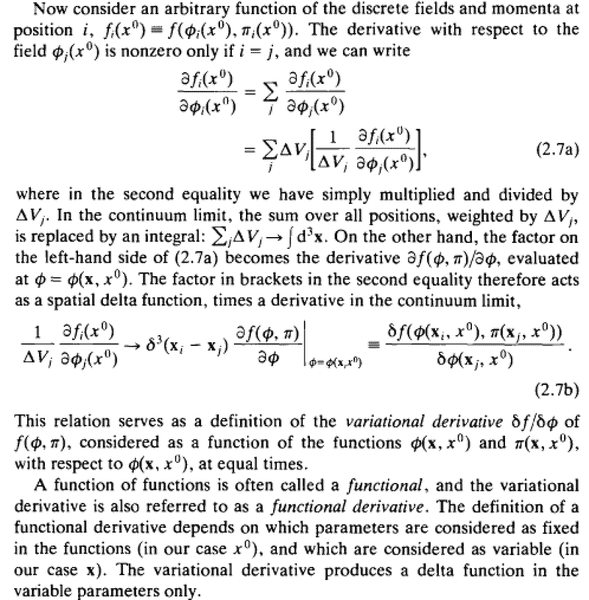
In particular I tried looking everywhere to make sense of this passage from Sterman's:
F9HElhJ.png


I understand everything here but that last ##\equiv## . Especially what makes it look total whatever-y to me is the indices i, j on the RHS. Why does the momentum operator have j and the field i on the numerator, and the field j on the denominator? This could've been totally different and I would've equally said "mmh okay I suppose", something which worries me every time it happens.

If you think it would be beneficial, on top on the answer to this specific part, a primer of functional analysis / derivatives / ? would be appreciated.

Thanks.
 
Physics news on Phys.org
The ##j## in the numerator is probably just a typo given that ##f_i(x^0)## was defined before to have ##i## on both arguments. As far as references, the wikipedia entry on "functional derivative" gives the formal mathematical definition of the derivative and develops it briefly. If you really need a longer discussion you might consult the references by Courant and Hilbert and Gel'fand that are listed there.
 
fzero said:
The ##j## in the numerator is probably just a typo given that ##f_i(x^0)## was defined before to have ##i## on both arguments. As far as references, the wikipedia entry on "functional derivative" gives the formal mathematical definition of the derivative and develops it briefly. If you really need a longer discussion you might consult the references by Courant and Hilbert and Gel'fand that are listed there.

Apart from the supposed typo, why is that a functional derivative? I only see a delta * a derivative, and the wiki page says nothing about this form.
 
ddd123 said:
Apart from the supposed typo, why is that a functional derivative? I only see a delta * a derivative, and the wiki page says nothing about this form.

Yes, I should have said a bit more. The physicist version of the functional derivative is slightly different, but I think consistent with the mathematician's version. In the formal definition one introduces a test function ##\phi(x)## that defines the "direction" in which the functional derivative is taken. In the physicist's definition this test function is morally almost always a delta distribution. I can't give a rigorous derivation, so I do not want to claim too much about it.

Instead, you can derive the physicist's version as a formal process where you can compute the derivative of functionals,
$$
F[\phi_i] = \int f(\phi_i(\mathbf{x}), \nabla \phi_i(\mathbf{x}) ) d \mathbf{x},
$$
by a process in which we use the chain rule (and integration by parts) in order to reduce operations to a fundamental definition
$$ \frac{\delta \phi_i(\mathbf{x})}{\delta \phi_j(\mathbf{y})} = \delta^j_i \delta(\mathbf{x}-\mathbf{y}).$$
The presence of the delta distribution also means that, while the functional expression includes an integral over the domain of the functions ##\phi_i##, in the physicist's functional derivative, the integral is gone, having been taken care of by the delta.

Sterman is trying to justify the form of the functional derivative in a slightly different way, which I suppose would be more clearly related to the mathematician's definition. You should be able to verify that the rule I suggested above is completely consistent with Sterman's treatment and leads to the Euler-Lagrange equations, etc.
 
  • Like
Likes   Reactions: ddd123

Similar threads

  • · Replies 1 ·
Replies
1
Views
2K
  • · Replies 1 ·
Replies
1
Views
2K
  • · Replies 113 ·
4
Replies
113
Views
10K
  • · Replies 34 ·
2
Replies
34
Views
5K
  • · Replies 1 ·
Replies
1
Views
1K
  • · Replies 2 ·
Replies
2
Views
2K
  • · Replies 0 ·
Replies
0
Views
1K
  • · Replies 10 ·
Replies
10
Views
2K
  • · Replies 2 ·
Replies
2
Views
4K
  • · Replies 1 ·
Replies
1
Views
2K