jaychay
- 58
- 0
Can you help me with this two questions
I am really struggle on how to do it
Please help me
Thank you in advance
This discussion focuses on solving complex number functions, specifically the factorization of \(4z^2 + 1\) and evaluating limits at \(z = \frac{1}{2}i\). The factorization is confirmed as \((2z+i)(2z-i)\). Participants discuss how to find values \(a\) and \(b\) to ensure continuity at the limit point, with the correct limit evaluated as \(2i\). The final consensus is that \( (a,b) \) can be \( (0,2) \) to maintain continuity.
PREREQUISITESStudents and professionals in mathematics, particularly those focusing on complex analysis, as well as educators teaching advanced algebra and calculus concepts.
How can I solve the limitDaalChawal said:Factorize $(4z^2 + 1) = (4z^2 - i^2)= (2z+i)(2z-i)$
Substitute the hint DaalChawal gave into the function definition of $f(z)$ and simplify it.jaychay said:How can I solve the limit
On question 2Klaas van Aarsen said:Substitute the hint DaalChawal gave into the function definition of $f(z)$ and simplify it.
Then substitute the limit value $z=\frac 12 i$ for $f(z)$ with $z\ne \frac 12 i$ and evaluate it.
How far do you get?
Choose $a$ and $b$ such that $a+bi$ is the same as the limit value from question 1.jaychay said:On question 2
Can you tell me on how to find (a,b) that can make it continue at z=1/2i
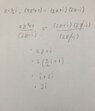
The first substitution is correct, but the parentheses are placed the wrong way in the substitution of $z=\frac 12 i$.jaychay said:Did I do it correct ?
Thank you broDaalChawal said:You made a mistake there bro
$2(\frac{i}{2})+i = 2i$
Can you please check me on my another post on complex graph equation problem on question 2 on how to find ( a, b )Klaas van Aarsen said:Substitute the hint DaalChawal gave into the function definition of $f(z)$ and simplify it.
Then substitute the limit point $z=\frac 12 i$ for $f(z)$ with $z\ne \frac 12 i$ and evaluate it.
How far do you get?
On question 2Klaas van Aarsen said:The first substitution is correct, but the parentheses are placed the wrong way in the substitution of $z=\frac 12 i$.
It should be:
$$\lim_{z\to\frac 12i} f(z) = \lim_{z\to\frac 12i} \frac{4z^2+1}{2z-i} = \ldots = \lim_{z\to\frac 12i} 2z+i = 2\left(\frac 12 i\right) +i=2i$$
Klaas van Aarsen said:The first substitution is correct, but the parentheses are placed the wrong way in the substitution of $z=\frac 12 i$.
It should be:
$$\lim_{z\to\frac 12i} f(z) = \lim_{z\to\frac 12i} \frac{4z^2+1}{2z-i} = \ldots = \lim_{z\to\frac 12i} 2z+i = 2\left(\frac 12 i\right) +i=2i$$
On question 2Klaas van Aarsen said:Substitute the hint DaalChawal gave into the function definition of $f(z)$ and simplify it.
Then substitute the limit point $z=\frac 12 i$ for $f(z)$ with $z\ne \frac 12 i$ and evaluate it.
How far do you get?