Stuck on last part of class derivation (proof) K-G Eqn

Click For Summary

Discussion Overview

The discussion revolves around the derivation of the Klein-Gordon equation (K-G equation) and the relationship between terms in the wave function and the equation itself. Participants are exploring the mathematical connections and transformations involved in this derivation, particularly focusing on the term involving momentum and energy.

Discussion Character

  • Technical explanation
  • Mathematical reasoning

Main Points Raised

  • One participant expresses confusion about equating the term ##\hbar^{2} c^{2}k_{i}k_{i}## with the familiar term ##\rho^{2}c^{2}## in the context of the K-G equation derivation.
  • Another participant suggests that momentum and frequencies are related through the relation ##p = \hbar k##, indicating that dimensional analysis can clarify this relationship.
  • A later reply confirms that the relationship between energy and frequency, as well as momentum and wavenumber, can be expressed using the DeBroglie relations: ##E = \hbar \omega## and ##p = \hbar k##.
  • One participant acknowledges a misunderstanding and expresses gratitude for the clarification provided by others.

Areas of Agreement / Disagreement

Participants appear to have differing levels of understanding regarding the derivation and the relationships between the terms. While some provide clarifications, there is no explicit consensus on the initial confusion raised.

Contextual Notes

The discussion includes references to specific mathematical relationships and transformations that may depend on the definitions of terms used, such as energy, momentum, and their corresponding wave properties. Some assumptions about the familiarity with the K-G equation and related concepts may not be explicitly stated.

rwooduk
Messages
757
Reaction score
59
Mentor note: fixed formulas so they get displayed properly

If we take the K-G eqn and the following term for the wave function

$$( \partial^2 + \frac{m^{2}c^{2}}{\hbar^{2}})\Psi =0
\\\\\Psi = Re^{-i\omega t + i k_{i}x_{i}}$$We worked through to this ##\hbar \omega = \pm \sqrt{\hbar^{2} c^{2}k_{i}k_{i}+ m^{2}c^{4}}## which is fine and recognisable, but I can't get the ##\hbar^{2} c^{2}k_{i}k_{i}## term to equal the familiar ##\rho^{2}c^{2}##. I'm assuming it's obvious and that's why he didnt show it, but I'm a bit stuck.

Any help would be appreciated.

edit

he also did something similar here:
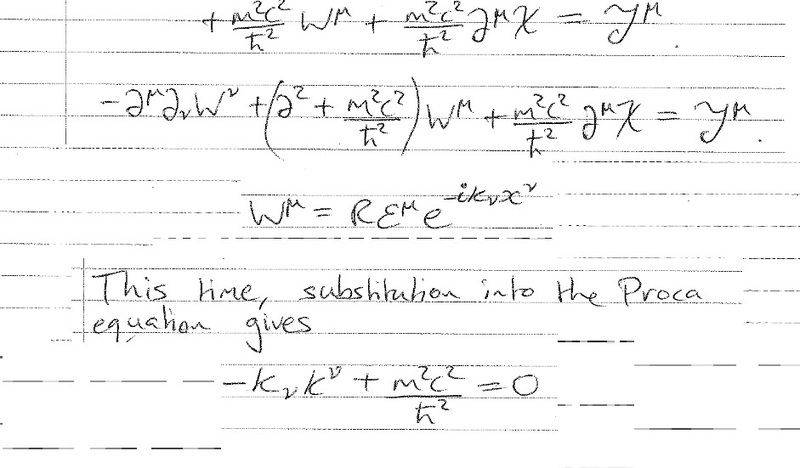
MB063El.jpg
 
Last edited:
Physics news on Phys.org
I don't understand your questions (and I didn't see something similar in the notes you uploaded)
Momentum and frequencies are related via p = \hbar k...you can see this fast with some dimensional analysis.
 
  • Like
Likes   Reactions: rwooduk
ChrisVer said:
I don't understand your questions (and I didn't see something similar in the notes you uploaded)
Momentum and frequencies are related via p = \hbar k

Sorry, I'm trying to show that this $$\hbar \omega = \pm \sqrt{\hbar^{2} c^{2}k_{i}k_{i}+ m^{2}c^{4}} $$ is the same as this:

emcpc.gif


edit which you have just solved, sorry and thanks!
 
Yup it is... use the DeBroglie relations: E= \hbar \omega and p= \hbar k
since your wave function is expressed in terms of frequency/wavenumber instead of energy/momenta.
 
  • Like
Likes   Reactions: rwooduk

Similar threads

  • · Replies 1 ·
Replies
1
Views
2K
  • · Replies 0 ·
Replies
0
Views
3K
  • · Replies 17 ·
Replies
17
Views
3K
  • · Replies 5 ·
Replies
5
Views
2K
  • · Replies 1 ·
Replies
1
Views
2K
  • · Replies 1 ·
Replies
1
Views
3K
  • · Replies 1 ·
Replies
1
Views
2K
  • · Replies 9 ·
Replies
9
Views
2K
  • · Replies 38 ·
2
Replies
38
Views
6K