Stuck on Problem: Need Help Understanding P & Equation

  • Thread starter Thread starter LCSphysicist
  • Start date Start date
  • Tags Tags
    Stuck
Click For Summary
The discussion revolves around confusion regarding a physics problem related to gravitational potential energy. The question involves calculating the potential energy of a final configuration of particles forming a shell or sphere, starting from a state of zero potential energy. Participants clarify that "P" refers to the Greek letter "φ," which denotes gravitational potential, and is related to gravitational acceleration through the equation g = -∇φ. The original poster seeks help in understanding the equation and its application to the problem. Understanding these concepts is essential for solving the homework problem effectively.
LCSphysicist
Messages
644
Reaction score
162
Homework Statement
Find the proper potential energy of gravitational interac-
tion of matter forming
(a) a thin uniform spherical layer of mass m and radius R;
(b) a uniform sphere of mass m and radius R
Relevant Equations
u = dm*p/2
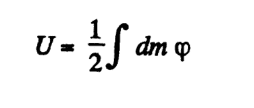
Actually, i don't even started the solution because i am confused, i am not sure what the question is asking, i tried to see the solution, but it was using
1589698967164.png
, i don't know what that equation mean. Can you help me? P is like potential electricity, for gravitational force?
 
Last edited by a moderator:
Physics news on Phys.org
I think the question is:

Imagine a shell or sphere forming from particles that start far away from each other. The potential energy of the initial configuration is taken to be zero. What is the potential energy of the final configuration?
 
LCSphysicist said:
Homework Statement:: Find the proper potential energy of gravitational interac-
tion of matter forming
(a) a thin uniform spherical layer of mass m and radius R;
(b) a uniform sphere of mass m and radius R
Relevant Equations:: u = dm*p/2

Actually, i don't even started the solution because i am confused, i am not sure what the question is asking, i tried to see the solution, but it was using View attachment 262916, i don't know what that equation mean. Can you help me? P is like potential electricity, for gravitational force?
It is not p, it is the Greek letter ##\varphi##. It represents the gravitational potential such that ##\vec g = - \nabla \varphi##, where ##\vec g## is the gravitational acceleration.
 
The book claims the answer is that all the magnitudes are the same because "the gravitational force on the penguin is the same". I'm having trouble understanding this. I thought the buoyant force was equal to the weight of the fluid displaced. Weight depends on mass which depends on density. Therefore, due to the differing densities the buoyant force will be different in each case? Is this incorrect?

Similar threads

Replies
4
Views
910
  • · Replies 4 ·
Replies
4
Views
1K
  • · Replies 1 ·
Replies
1
Views
2K
Replies
8
Views
1K
  • · Replies 1 ·
Replies
1
Views
1K
  • · Replies 5 ·
Replies
5
Views
824
  • · Replies 6 ·
Replies
6
Views
865
  • · Replies 35 ·
2
Replies
35
Views
2K
  • · Replies 4 ·
Replies
4
Views
1K
Replies
14
Views
2K