Discussing the Convergence of a Series: Get My Opinion!

Click For Summary
SUMMARY

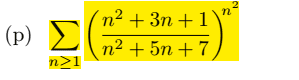
The discussion centers on the convergence of the series defined by the expression \(\frac{n^2 + 3n + 1}{n^2 + 5n + 7}\). Participants clarify that this series does not converge to a geometric series, as it involves a function of \(n\) raised to a power. The limit \(\lim_{n \to \infty}\left( \frac{n^2 + 3n + 1}{n^2 + 5n + 7}\right)^{n^2}\) is critical for determining divergence, particularly when it takes the indeterminate form \([1^\infty]\). The use of logarithms and L'Hopital's Rule is recommended for further analysis.

PREREQUISITES
  • Understanding of series convergence and divergence
  • Familiarity with limits and indeterminate forms
  • Knowledge of logarithmic functions and their properties
  • Experience with L'Hopital's Rule
NEXT STEPS
  • Study the application of L'Hopital's Rule in limit evaluation
  • Learn about geometric series and their convergence criteria
  • Explore the properties of logarithmic functions in calculus
  • Investigate series convergence tests, such as the Ratio Test and Root Test
USEFUL FOR

Mathematicians, students studying calculus, and anyone interested in series convergence analysis will benefit from this discussion.

Amaelle
Messages
309
Reaction score
54
Homework Statement
studying the convergence of a serie (look at the image)
Relevant Equations
geometric serie, convergence
Good day
I want to study the connvergence of this serie
1612182366542.png

I already have the solution but I want to discuss my approach and get your opinion about it
it s clear that n^2+5n+7>n^2+3n+1 so 0<(n^2+3n+1)/(n^2+5n+7)<1 so we can consider this as a geometric serie that converge?
many thanks in advance
 
Last edited by a moderator:
Physics news on Phys.org
You can't compare to a geometric series; you have a function of n raised to a power which depends on n. That is similar to <br /> \left(1 - \frac 1n\right)^{n} \to e^{-1} &gt; 0. For that reason \sum_{n=1}^\infty \left(1 - \frac1n\right)^n does not converge.

I would write <br /> \frac{n^2 + 3n + 1}{n^2 + 5n +7} = 1 - \frac{2n + 6}{n^2 + 5n +7} and take logs.
 
  • Informative
Likes   Reactions: Amaelle
Amaelle said:
Homework Statement:: studying the convergence of a serie (look at the image)
Relevant Equations:: geometric serie, convergence

Good day
I want to study the connvergence of this serie

View attachment 277247
I already have the solution but I want to discuss my approach and get your opinion about it
it s clear that n^2+5n+7>n^2+3n+1 so 0<(n^2+3n+1)/(n^2+5n+7)<1 so we can consider this as a geometric serie that converge?
many thanks in advance
If you can establish the fact that ##\lim_{n \to \infty}\left( \frac{n^2 + 3n + 1}{n^2 + 5n + 7}\right)^{n^2} \ne 0##, then you can conclude that the series diverges. This limit has the indeterminate form ##[1^\infty]##, so the best way of determining the limit is by the use of logarithms, and getting it to a form in which L'Hopital's Rule can be applied.
 
  • Informative
Likes   Reactions: Amaelle
pasmith said:
You can't compare to a geometric series; you have a function of n raised to a power which depends on n. That is similar to <br /> \left(1 - \frac 1n\right)^{n} \to e^{-1} &gt; 0. For that reason \sum_{n=1}^\infty \left(1 - \frac1n\right)^n does not converge.

I would write <br /> \frac{n^2 + 3n + 1}{n^2 + 5n +7} = 1 - \frac{2n + 6}{n^2 + 5n +7} and take logs.
thanks you so much!
 
Mark44 said:
If you can establish the fact that ##\lim_{n \to \infty}\left( \frac{n^2 + 3n + 1}{n^2 + 5n + 7}\right)^{n^2} \ne 0##, then you can conclude that the series diverges. This limit has the indeterminate form ##[1^\infty]##, so the best way of determining the limit is by the use of logarithms, and getting it to a form in which L'Hopital's Rule can be applied.
thanks so much!
 

Similar threads

  • · Replies 5 ·
Replies
5
Views
2K
  • · Replies 3 ·
Replies
3
Views
2K
  • · Replies 5 ·
Replies
5
Views
2K
Replies
29
Views
5K
Replies
8
Views
2K
  • · Replies 1 ·
Replies
1
Views
2K
  • · Replies 7 ·
Replies
7
Views
2K
  • · Replies 2 ·
Replies
2
Views
2K
Replies
7
Views
2K
  • · Replies 2 ·
Replies
2
Views
2K