Subcritical Reactor: An Analysis of Neutron Source Dynamics

  • Thread starter Thread starter oksuz_
  • Start date Start date
  • Tags Tags
    Reactor
Click For Summary

Discussion Overview

The discussion revolves around the dynamics of neutron sources in subcritical reactors, exploring the implications of external neutron sources on fission processes, reactor safety, and the feasibility of various reactor designs. Participants engage in technical reasoning and conceptual clarification regarding the influence of neutron sources on reactor behavior, safety mechanisms, and the potential for hybrid reactor designs.

Discussion Character

  • Exploratory
  • Technical explanation
  • Debate/contested
  • Mathematical reasoning

Main Points Raised

  • Some participants propose that external neutron sources can indeed cause fission and influence the dynamics of a subcritical reactor.
  • Others argue that while external sources may enhance fission, their relevance is typically limited unless the source is particularly strong, as noted with the MYRRHA project.
  • There is a suggestion that fusion reactors could potentially support subcritical fission processes through isotopic neutron sources.
  • Concerns are raised about the practicality and availability of isotopic neutron sources like Am241Be for powering reactors, with some participants noting the high costs and limited supply.
  • Participants discuss the safety implications of source-driven reactors compared to conventional reactors, questioning whether the removal of a neutron source offers any significant safety advantages.
  • Some contributions highlight the need for careful consideration of reactivity feedback mechanisms in both subcritical and critical reactors to ensure safety.
  • There is a debate about the maximum power achievable with source-driven reactors and whether they can effectively burn actinides or produce significant electricity.
  • Participants express differing views on the practicality of source-driven reactors, with some considering them an interesting theoretical concept while others deem them impractical for real-world applications.

Areas of Agreement / Disagreement

Participants exhibit a mix of agreement and disagreement regarding the influence of external neutron sources on reactor dynamics, the safety features of source-driven reactors, and the practicality of various reactor designs. No consensus is reached on the advantages or disadvantages of source-driven reactors compared to conventional designs.

Contextual Notes

Limitations include unresolved questions about the efficiency and longevity of neutron sources, the specific conditions required for safe reactor operation, and the assumptions underlying the proposed models and calculations.

oksuz_
Messages
70
Reaction score
3
Hi,

As some of you may recall,

Subcritical-Multiplication-equation.png


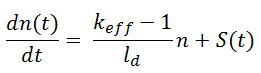
The equation above governs the kinetics of subcritical reactor. it says external neutron source does not influence the dynamics of the system. What I want to know if there is an external neutron source, would they cause more fission as well as contributing neutron population?

thank you in advance.
 

Attachments

  • Subcritical-Multiplication-equation.png
    Subcritical-Multiplication-equation.png
    1.1 KB · Views: 1,404
Engineering news on Phys.org
The external neutrons will cause fission, sure. Typically this is not relevant, but with a strong neutron source you can run a subcritical reactor that way. MYRRHA will test this on a large scale.
 
  • Like
Likes   Reactions: geoelectronics
I'm not sure I understand the equation. I believe "S(t)" is the external source, so from the equation, it will obviously influence the dynamics.

Yes, an external source will cause more fissions. When uranium atoms absorb neutrons, they do not know the source of the neutrons.
 
if I'm not mistaken a fusion reactor that runs on fuels that release neurons in the fusion process like DT and if made sustainable could also run a subcritical fission reactor or simple maybe have some U235 or Th232 fuel blanket used and then use transmutation or otherwise, well I'm sure folks more knowledgeable will comment more on this.
 
That would be a fusion-fission hybrid reactor.
It needs the challenging conditions for fusion to work, apart from that it shares the advantages of subcritical reactors.
 
Other methods of sustaining the fission process is the use of isotopic neutron sources as a Am241Be source.
 
Good luck getting enough of that to power a nuclear reactor. There are some kilograms of americium around. A bit more could be extracted if there would be a larger market for it, but it is quite expensive.
 
gleem said:
Other methods of sustaining the fission process is the use of isotopic neutron sources as a Am241Be source.

Are you just curious, or do you think there is an advantage to doing it that way?
 
Every external neutron source would be interesting. It allows a subcritical reactor with excellent power control, which means you can use fast neutrons and burn transactinides without the danger of a runaway reaction. If Am/Be would be cheaper than an accelerator that would be great. It wouldn't have a reliability issue.
 
  • #10
mfb said:
without the danger of a runaway reaction.

Maybe yes, but such an assertion needs to be carefully checked; it is not necessarily true. Both thermal reactors and fast reactors have possible dangerous power excursion scenarios during startup before criticality.

Safety depends on the magnitude and dynamics of positive and negative reactivity feedbacks. That applies to both subcritical and critical operation.
 
  • #11
anorlunda said:
Are you just curious, or do you think there is an advantage to doing it that way?

Well isotopic sources of neutron are used http://www.iaea.org/inis/collection/NCLCollectionStore/_Public/45/089/45089754.pdf
In this case it is a PuBe source of 0.185 GBq activity really not very strong yielding about 8M n/sec.

mfb said:
Good luck getting enough of that to power a nuclear reactor. There are some kilograms of americium around. A bit more could be extracted if there would be a larger market for it, but it is quite expensive.

The neutron emission rate of a AmBe source is nearly equal to a PuBe source so you don't need a lot. Sources of 666 GBq are available admittedly with neutron yields much less than accelerator based generators .
 
  • #12
If you think this is viable, you might want to try a back of the envelope calculation. Assuming 100% efficiency, what is the actinide burn rate with that source strength?
And how long would your source (both Am and Be) last before it was burned out?

An accelerator driven reactor may have potential safety features, but I'm not sure this translates to a source-driven reactor. With an accelerator, you can "turn off" the beam. But for a source-driven reactor, you would have to physically remove the source. I'm not sure that physically removing a source has any safety advantages over inserting a control rod. Plus, with either design, you still have to worry about decay heat removal.
 
  • #13
To get 1 GW (as thermal power that is a very small block) you need 3*1019 Hz of fission, at k=0.95 you need 1.6*1018 Hz neutron input.
Good luck producing an 1.6 EBq source.

Or, seen from the other side, your 666 GBq source can drive a reactor with 40 W thermal power.
rpp said:
An accelerator driven reactor may have potential safety features, but I'm not sure this translates to a source-driven reactor. With an accelerator, you can "turn off" the beam. But for a source-driven reactor, you would have to physically remove the source. I'm not sure that physically removing a source has any safety advantages over inserting a control rod. Plus, with either design, you still have to worry about decay heat removal.
You absolutely need some way to remove the source, otherwise you could not shut down your reactor - but it doesn't have to be fast. As long as you make sure the criticality cannot increase to values close to 1, your reactor cannot suddenly increase its power a lot (unlike critical reactors), giving you enough time to remove the source.
 
  • Like
Likes   Reactions: mheslep
  • #14
I still don't understand the benefits of a source driven reactor over a conventional reactor. In the source driven reactor you have to remove the source to shut down the reactor. In a conventional reactor you have to insert a control rod. Both are mechanical process's with about the same reliability. How is one more safe than the other?

It is not hard to design a conventional reactor where you "cannot suddenly increase its power". You just have to design a reactor with a small amount of excess reactivity at operating conditions. For example, a PWR operating at full-power with all the control rods withdrawn has very little (if any) fast-acting excess reactivity. You can increase the power by diluting boron, but it is a fairly slow process.

But even if it was safer, the maximum power is too low to burn any appreciable actinides! It is an interesting solution to a problem that doesn't exist.
 
  • #15
A critical reactor can become supercritical. The power is limited only by the mechanical damage that the power excursion produces. In Chernobyl this was the first big explosion. Chernobyl had a large positive void coefficient (an increase in power increases reactivity) - something not used any more. There are still some reactors around with a slightly positive void coefficient, however, and fast reactors don't have void coefficients.
A source-driven reactor wouldn't have this failure mode. It would be operated significantly below criticality.
 
  • #16
You have to differentiate between a slow increase in power vs. a fast increase in power. The rate of change in power is driven by the amount of reactivity you insert. If there is not a lot of excess reactivity in the system, it cannot increase the power quickly (i.e. uncontrolled). You can design cores that do not have a lot of excess reactivity. I gave an example above.
Chernobyl had a lot of excess reactivity in the system. Part of it was the design (including the positive void coefficient) and part of it was the operating conditions at the time of the accident. They had to turn off several safety systems to get to those conditions.

I think you are claiming that a source driven reactor will prevent a Chernobyl type accident. If this is your point, you are correct.
However, there are much easier ways to avoid Chernobyl than this. You also have the fact that the source-driven reactor cannot get to the power levels you need to burn appreciable actinides or produce appreciable electricity. It is an interesting physics problem, but completely impractical.
 
  • #17
rpp said:
However, there are much easier ways to avoid Chernobyl than this.
I know, but a subcritical reactor is an additional safety feature, even if the neutron source cannot be removed in a second.
rpp said:
You also have the fact that the source-driven reactor cannot get to the power levels you need to burn appreciable actinides or produce appreciable electricity. It is an interesting physics problem, but completely impractical.
Yes, as I discussed before. This was a purely hypothetical consideration - what if there would be sources strong enough.
 

Similar threads

Replies
4
Views
2K
  • · Replies 3 ·
Replies
3
Views
2K
  • · Replies 1 ·
Replies
1
Views
3K
  • · Replies 6 ·
Replies
6
Views
3K
Replies
1
Views
2K
Replies
10
Views
4K
Replies
4
Views
2K
  • · Replies 15 ·
Replies
15
Views
5K
Replies
3
Views
3K
  • · Replies 4 ·
Replies
4
Views
5K