Suitable Container Materials for Plasma

Click For Summary

Discussion Overview

The discussion centers around the investigation of suitable container materials for creating plasma antennas, specifically focusing on the design of a spherical container that allows for the insertion of electrodes to generate plasma. The scope includes material properties, design considerations, and the type of gas to be used.

Discussion Character

  • Exploratory
  • Technical explanation
  • Debate/contested

Main Points Raised

  • Smithy seeks a spherical container for plasma generation and questions the suitability of glassware, particularly chromatography reservoirs, due to size constraints.
  • Astronuc suggests that a ceramic or glass vessel is likely necessary for observing plasma and mentions the use of two or three neck flasks depending on the gas used.
  • Smithy specifies the intention to use Helium and inquires about the impact of electrode placement on the type of plasma generated, specifically aiming for a diffused plasma rather than a filament type.
  • Astronuc references inductively coupled plasmas (ICP) as a relevant example for material analysis through optical spectroscopy.

Areas of Agreement / Disagreement

Participants have not reached a consensus on the best material for the container or the design specifics, indicating that multiple views and considerations remain in the discussion.

Contextual Notes

There are limitations regarding the specific requirements for the container design, the properties of different materials, and the effects of gas type and electrode configuration on plasma characteristics, which remain unresolved.

Who May Find This Useful

Individuals interested in plasma physics, antenna design, and experimental setups for plasma generation may find this discussion relevant.

Smithy16
Messages
4
Reaction score
0
Hi everyone,

This is my first post here, so go easy on me. :)

I am looking towards investigating the properties of plasma antennas, where a plasma is created in a sealed container, and the RF signal is either capacitively or inductively coupled and the transmitted.

However, I am wanting to try a spherical shaped object. I would need to be able to pass two electrodes through opposite poles of the sphere, in order to create the plasma.

However, I cannot seem to find any glassware which suits the bill. The closest object I can find is something called a chromatography reservoir, as below:
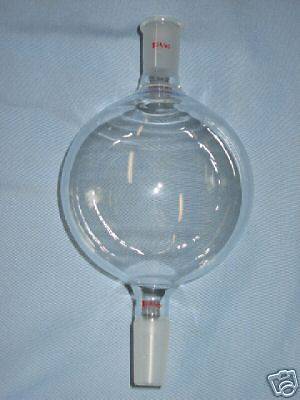
3f45_1.JPG


However, the necks on these are a bit small in diameter.

I was wondering if it might be possible to use a material other than glass?

Or perhaps someone might know of the correct name of the piece.

Many thanks for your help in advanced, everyone.

Smithy
 
Physics news on Phys.org
If one wishes to make a plasma and observe it from the outside, then the vessel probably needs to be ceramic (e.g., glass). Depending on the gas, one could use a two or three neck flask. What gas is one planning on using.

One could look at discharge lamps, e.g., those already filled with a particular gas, for examples.

Inductively coupled plasmas (ICP) are used for material analysis through optical spectroscopy. That is another example.
 
Many thanks for your reply, Astronuc.

I intend on using Helium.

I am also attempting to create the diffused sort of plasma, rather than the filament type. Will having the electrodes close together (in a two necked flask) affect this?

Many thanks again,

Smithy
 
Also, thanks to the admin/mod who moved this to a more appropriate forum. :)
 

Similar threads

Replies
5
Views
398
  • · Replies 3 ·
Replies
3
Views
1K
  • · Replies 4 ·
Replies
4
Views
5K
Replies
4
Views
2K
  • · Replies 4 ·
Replies
4
Views
7K
  • · Replies 54 ·
2
Replies
54
Views
6K
  • · Replies 3 ·
Replies
3
Views
4K
Replies
4
Views
10K
  • · Replies 2 ·
Replies
2
Views
5K
  • · Replies 1 ·
Replies
1
Views
6K