MHB Sum and Product of Real Roots of A Quartic Function

Click For Summary
The discussion focuses on proving inequalities for the sum and product of the real roots of the quartic equation \(x^4 - x^3 - 1 = 0\). It is established that the function is strictly decreasing for \(x < \frac{3}{4}\) and strictly increasing for \(x > \frac{3}{4}\), leading to the conclusion that there are two real roots. Using the Intermediate Value Theorem, the roots are found to lie between \((-1, 0)\) and \((1, 2)\). The analysis concludes that the product of the roots \(q < -\frac{11}{10}\) and the sum of the roots \(p > \frac{6}{11}\), successfully proving the required inequalities. The proof is supported by evaluating the function at specific points to refine the bounds for the roots.
anemone
Gold Member
MHB
POTW Director
Messages
3,851
Reaction score
115
Let $p$ be the sum and $q$ be the product of all real roots of the equation $x^4-x^3-1=0$.

Prove that $q<-\dfrac{11}{10}$ and $p>\dfrac{6}{11}$.
 
Mathematics news on Phys.org
Let $f(x) = x^4-x^3-1$, Now $f^{'}(x) = 4x^3-3x^2 = x^2\cdot (4x-3)$

Now for Max. or Min., $f^{'}(x) = 0\Leftrightarrow x^2\cdot (4x-3) = 0$

So $\displaystyle x = 0\;\;,\frac{3}{4}$ (Here $x= 0 $ is called point of inflection because $f^{''}(x) = 0$)

Now we will check where function is Strictly Increasing and where Strictly decreasing.

So for $\displaystyle x<\frac{3}{4},$ function is strictly decreasing.

and for $\displaystyle x>\frac{3}{4},$ function is strictly Increasing.

and $f(-1) = 1>0$ and $f(0) = -1<0$ and $f(1) = -1$ and $f(2) = 7>0$

So using IMVT, The given equation has only two real roots,

one lie between $\left(-1,0\right)$ and other lie between $\left(1,2\right)$

Now we will find some nearset upper and lower bound for both roots for achieving the given inequality.

but I did not found here (struck here)

Thanks
 
anemone said:
Let $p$ be the sum and $q$ be the product of all real roots of the equation $x^4-x^3-1=0$.

Prove that $q<-\dfrac{11}{10}$ and $p>\dfrac{6}{11}$.

Thanks for participating, jacks and thanks for the thought!

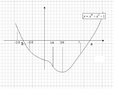
Yes, if we let $y=x^4-x^3-1=0$, the function of $y$ has two real roots based on the first and second derivative tests since

1.

$$\frac{dy}{dx}=x^2(4x-3)$$ and this tells us $y$ increases for $$x>\frac{3}{4}$$ and decreases for $$x<\frac{3}{4}$$ and also, there are two critical points which occur at $x=1$ and $x=\dfrac{3}{4}$

2.

$$\frac{d^2y}{dx^2}=3x(4x-1)$$ and this tells us $x=1$ is an inflexion point and there is a minimum point which occurs at $$x=\frac{3}{4}$$.

Here is the rough sketch of the graph of the function of $y=x^4-x^3-1$.

View attachment 1543

If we let $a, b$ where $a>0$ and $b<0$ to represent the two real roots of the function of $y$, we know we must have

[TABLE="class: grid, width: 500"]
[TR]
[TD]$m<a<n$ and[/TD]
[TD]$-j<b<-k$ where $j,k>0$.[/TD]
[/TR]
[TR]
[TD]where $ab=q<-mk=-\dfrac{11}{10}$ and[/TD]
[TD]$a+b>m-j=\dfrac{6}{11}$.[/TD]
[/TR]
[/TABLE]

And after a few attempts to guess the four values for $m, n, j, k$, we see that one of the possible combinations of them would be

[TABLE="class: grid"]
[TR]
[TD]$f(\dfrac{11}{8})=(\dfrac{11}{8})^4-(\dfrac{11}{8})^3-1=-0.025$

and

$f(\dfrac{7}{5})=(\dfrac{7}{5})^4-(\dfrac{7}{5})^3-1=0.0976$[/TD]
[TD]$f(-\dfrac{73}{88})=(-\dfrac{73}{88})^4-(-\dfrac{73}{88})^3-1=0.04439$

and

$f(-\dfrac{4}{5})=(-\dfrac{4}{5})^4-(-\dfrac{4}{5})^3-1=-0.0784$[/TD]
[/TR]
[TR]
[TD]$\dfrac{11}{8}<a<\dfrac{7}{5}$ and[/TD]
[TD]$-\dfrac{73}{88}<b<-\dfrac{4}{5}$[/TD]
[/TR]
[TR]
[TD]where $ab=q<-mk=-\dfrac{11}{10}$ and[/TD]
[TD]$a+b>m-j=\dfrac{6}{11}$.[/TD]
[/TR]
[/TABLE]

and these give us

$ab=q<-\dfrac{11}{8}\dfrac{4}{5}=-\dfrac{11}{10}$,

$a+b=p>\dfrac{11}{8}-\dfrac{73}{88}=\dfrac{6}{11}$ and hence, we're done with the proof.

By the way, below are the attempts which lead me to the final guess of the all four values of $m, n, j, k$.
[TABLE="class: grid, width: 500"]
[TR]
[TD]$0.9<a<?$

$-?<b<-\dfrac{11}{9}$[/TD]
[TD]$1.2<a<?$

$-?<b<-\dfrac{11}{12}$[/TD]
[/TR]
[/TABLE]
 

Attachments

  • Graph.JPG
    Graph.JPG
    31.4 KB · Views: 111
Here is a little puzzle from the book 100 Geometric Games by Pierre Berloquin. The side of a small square is one meter long and the side of a larger square one and a half meters long. One vertex of the large square is at the center of the small square. The side of the large square cuts two sides of the small square into one- third parts and two-thirds parts. What is the area where the squares overlap?

Similar threads

  • · Replies 1 ·
Replies
1
Views
1K
  • · Replies 1 ·
Replies
1
Views
1K
Replies
4
Views
2K
Replies
4
Views
1K
  • · Replies 2 ·
Replies
2
Views
2K
  • · Replies 1 ·
Replies
1
Views
1K
  • · Replies 1 ·
Replies
1
Views
1K
  • · Replies 1 ·
Replies
1
Views
1K
  • · Replies 3 ·
Replies
3
Views
1K
  • · Replies 1 ·
Replies
1
Views
1K