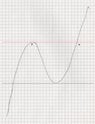
Proof by sketch:
[sp]
For the cubic to have three real roots, the $x$-axis must lie between the two horizontal lines in the sketch. The largest root must therefore be less than (the $x$-coordinate of) the point marked X in the sketch, where the graph crosses the red line.
If the constant term in the polynomial is chosen so that the red line is the $x$-axis, then the largest root will occur at X, and the other two roots will be at Y, where the polynomial has its lower critical point. The critical points are given by the roots of the derivative of the polynomial, which is $3x^2 + 2px + q$. So the lower root is $\frac13\bigl(-p - \sqrt{p^2 - 3q}\bigr).$
The sum of the three roots of the original polynomial is independent of the constant term, and is always equal to $-p$. Therefore $\frac23\bigl(-p - \sqrt{p^2 - 3q}\bigr) + \alpha = -p$, where $\alpha$ is the $x$-coordinate of the point X. Thus $\alpha = \frac13\bigl(-p + 2\sqrt{p^2 - 3q}\bigr)$, as required.[/sp]