Summing Formula Problem [Again]

  • Context:
  • Thread starter Thread starter susanto3311
  • Start date Start date
  • Tags Tags
    Formula
Join the discussion
Registration is free. Ask a follow-up in this thread, or start your own.
2 replies · 2K views
susanto3311
Messages
73
Reaction score
0
hello expert..

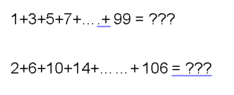
how do make sum formula for this below problem (2 question) :

please, see my attachment picture

thanks in advance..

susanto3311
 

Attachments

  • summation problem.png
    summation problem.png
    1.5 KB · Views: 119
Mathematics news on Phys.org
Hello, susanto3311![

How to make formulas for these sums?

$[1]\;1+3+5+7\cdots+99$

$[2]\;2+6+10+14+\cdots+106$
These two happen to be arithmetic series.

The sum of the first $n$ terms of an arithmetic series
$\quad$is given by: $\:S(n) \;=\;\frac{n}{2}\big[2a + (n-1)d\big]$

$\qquad\text{where: }\:\begin{Bmatrix} a &=& \text{first term} \\ d &=& \text{common difference} \\ n&=& \text{number of terms} \end{Bmatrix}$In [2], we have: $\:a=2,\;d=4,\;n=26$

Therefore: $\:S \:=\:\frac{26}{2}\big[2(2) + 25(4)\big]\:=\:1352$
 
We do ask that people posting questions show their progress so that our helpers know where you are stuck and can offer the best help possible. :D

The sum of the members of a finite arithmetic progression is called an arithmetic series, and is given by:

$$S_n=\frac{n}{2}\left(a_1+a_n\right)$$

To determine $n$, I would think of the terms of the first progression as $2n-1$ and for the second $2(2n-1)$ (and so how will the two sums be related?). Can you proceed?