- 612
- 229
[Superdense coding](http://en.wikipedia.org/wiki/Superdense_coding) is a way to send 2 classical bits by sending only 1 qubit and 'consuming' a previously shared entangled qubit. (Normally you could only send 1 classical bit per qubit.)
My question is: why doesn't this work (or does it?) for sending two qubits packed using a single sent qubit and the pre-entangled qubit?
Here's a quantum circuit that does superdense coding:
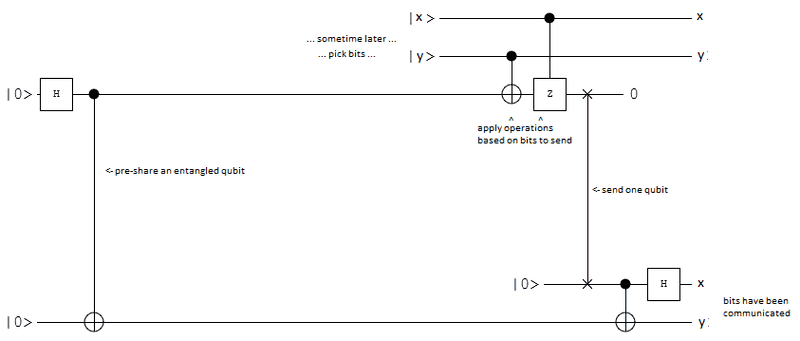
It starts by Alice (top) and Bob (bottom) sharing a bell pair. Then, later, Alice chooses two bits to send. She applies X and Z gates to her half of the pair conditionally based on those bits, then send it. Bob then cnot's it into the half he already had, and Hadamard's it. Now Bob has the two bits Alice chose.
Ignoring the fact that this is amazing because it let's you store bandwidth, shouldn't it also work for qubits instead of just classical bits? From what I can tell, if x and y are in superposition then at the end Alice and Bob are in a superposition where their bits always match. Even if x and y are entangled with some other stuff.
You can experiment with this circuit by going to this online simulator and pasting the following json (Workspace -> Import JSON):
Note that I added a few gates to place the bits into superposition. Notice that if you evaluate the circuit the last two and first two bits always match within the superposition. Does that mean I can consume an entangled qubit to send two entangled qubits as one?
... Maybe it's the fact that the qubits are not communicated, in that they end up entangled instead of (impossibly) cloned?
My question is: why doesn't this work (or does it?) for sending two qubits packed using a single sent qubit and the pre-entangled qubit?
Here's a quantum circuit that does superdense coding:
It starts by Alice (top) and Bob (bottom) sharing a bell pair. Then, later, Alice chooses two bits to send. She applies X and Z gates to her half of the pair conditionally based on those bits, then send it. Bob then cnot's it into the half he already had, and Hadamard's it. Now Bob has the two bits Alice chose.
Ignoring the fact that this is amazing because it let's you store bandwidth, shouldn't it also work for qubits instead of just classical bits? From what I can tell, if x and y are in superposition then at the end Alice and Bob are in a superposition where their bits always match. Even if x and y are entangled with some other stuff.
You can experiment with this circuit by going to this online simulator and pasting the following json (Workspace -> Import JSON):
Code:
{"gates":[],"circuit":[{"type":"h","time":0,"targets":[2],"controls":[]},{"type":"x","time":1,"targets":[8],"controls":[2]},{"type":"h","time":5,"targets":[4],"controls":[]},{"type":"h","time":5,"targets":[0],"controls":[]},{"type":"h","time":5,"targets":[1],"controls":[]},{"type":"x","time":6,"targets":[0],"controls":[4]},{"type":"x","time":12,"targets":[2],"controls":[1]},{"type":"z","time":13,"targets":[2],"controls":[0]},{"type":"swap","time":14,"targets":[2,7],"controls":[]},{"type":"x","time":15,"targets":[8],"controls":[7]},{"type":"h","time":16,"targets":[7],"controls":[]}],"qubits":9,"input":[0,0,0,0,0,0,0,0,0]}Note that I added a few gates to place the bits into superposition. Notice that if you evaluate the circuit the last two and first two bits always match within the superposition. Does that mean I can consume an entangled qubit to send two entangled qubits as one?
... Maybe it's the fact that the qubits are not communicated, in that they end up entangled instead of (impossibly) cloned?