Supporting a trapezoid between two wedges

  • Thread starter Thread starter Tom Hammer
  • Start date Start date
  • Tags Tags
    Trapezoid
Join the discussion
Ask a follow-up here, or get your own question answered by working scientists, mathematicians and engineers — people, not an autocomplete.
Real named experts · corrections over time · the nuance an AI answer skips
5 replies · 1K views
Tom Hammer
Messages
12
Reaction score
2
Homework Statement
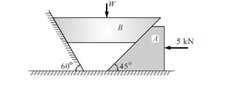
Find the weight W that can be supported by the applied force of 5 kN. Mu = .25 at all surfaces
Relevant Equations
F = mu N, where mu = coefficient of static friction, N = normal force
Let Nr = normal force on the right side of the trapezoid B and Fr = the force of friction on the right side of B.
Let Nl = normal force on the left side of B and Fr = the frictional force on the left surface of B

so Nr = 5 sin45 and Fr = 5 sin45 =
and Nl = 5 sin 60, Fl = 5 sin 30.
 

Attachments
  • 3D280A4F-37D1-426C-9547-6A392149D2CF.jpeg
    3D280A4F-37D1-426C-9547-6A392149D2CF.jpeg
    16.7 KB · Views: 153
Physics news on Phys.org
Yes, thank you. But I am having trouble drawing a force diagram which makes sense at the two surfaces of B.
 
Tom Hammer said:
Yes, thank you. But I am having trouble drawing a force diagram which makes sense at the two surfaces of B.
 
Tom Hammer said:
Yes, thank you. But I am having trouble drawing a force diagram which makes sense at the two surfaces of B.
Not sure why. What forces act on B?
What forces act on A?
If the system slips, can it do so without sliding at all contact surfaces?
 
Reply
  • Like
Likes   Reactions: Lnewqban
Tom Hammer said:
Yes, thank you. But I am having trouble drawing a force diagram which makes sense at the two surfaces of B.
Why do you find it difficult?
Forgetting for a moment about block A, only three forces acting perpendicularly to each of the top and side surfaces of B are needed to keep in equilibrium.
Try a vectorial addition of those forces, which should form a triangle.