Supporting a trapezoid between two wedges

  • Thread starter Tom Hammer
  • Start date
  • Tags Tags
    Trapezoid
5 replies · 1K views · last reply
Tom Hammer
Messages
12
Reaction score
2
Homework Statement
Find the weight W that can be supported by the applied force of 5 kN. Mu = .25 at all surfaces
Relevant Equations
F = mu N, where mu = coefficient of static friction, N = normal force
Let Nr = normal force on the right side of the trapezoid B and Fr = the force of friction on the right side of B.
Let Nl = normal force on the left side of B and Fr = the frictional force on the left surface of B

so Nr = 5 sin45 and Fr = 5 sin45 =
and Nl = 5 sin 60, Fl = 5 sin 30.
 
Attachments
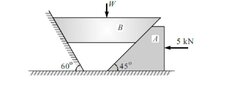
  • Free-body style diagram of a trapezoid block B resting on a wedge A, with weight W pushing down on B, a 5 kN horizontal force pushing left on wedge A, a 60 degree incline on the left of B and a 45 degree incline on the right of A, both on a hatched ground surface.
    3D280A4F-37D1-426C-9547-6A392149D2CF.jpeg
    16.7 KB · Views: 173
Yes, thank you. But I am having trouble drawing a force diagram which makes sense at the two surfaces of B.
 
Tom Hammer said:
Yes, thank you. But I am having trouble drawing a force diagram which makes sense at the two surfaces of B.
 
Tom Hammer said:
Yes, thank you. But I am having trouble drawing a force diagram which makes sense at the two surfaces of B.
Not sure why. What forces act on B?
What forces act on A?
If the system slips, can it do so without sliding at all contact surfaces?
 
Tom Hammer said:
Yes, thank you. But I am having trouble drawing a force diagram which makes sense at the two surfaces of B.
Why do you find it difficult?
Forgetting for a moment about block A, only three forces acting perpendicularly to each of the top and side surfaces of B are needed to keep in equilibrium.
Try a vectorial addition of those forces, which should form a triangle.