Supporting a trapezoid between two wedges

  • Thread starter Thread starter Tom Hammer
  • Start date Start date
  • Tags Tags
    Trapezoid
Click For Summary
SUMMARY

The discussion focuses on analyzing the forces acting on a trapezoid (B) positioned between two wedges. The normal forces are defined as Nr = 5 sin 45° and Nl = 5 sin 60°, while the frictional forces are Fr = 5 sin 45° and Fl = 5 sin 30°. Participants emphasize the importance of drawing accurate force diagrams to visualize the equilibrium of forces acting on both the trapezoid and the wedge (A). The conversation highlights the necessity of vectorial addition to understand the balance of forces effectively.

PREREQUISITES
  • Understanding of normal and frictional forces in physics
  • Knowledge of vector addition and equilibrium concepts
  • Familiarity with force diagrams and free-body diagrams
  • Basic trigonometry, specifically sine functions
NEXT STEPS
  • Study the principles of static equilibrium in mechanics
  • Learn how to construct and interpret free-body diagrams
  • Explore vector addition techniques in physics
  • Investigate the effects of friction on inclined surfaces
USEFUL FOR

Students and professionals in physics, engineering, and mechanics who are looking to deepen their understanding of force interactions in systems involving inclined planes and equilibrium analysis.

Tom Hammer
Messages
12
Reaction score
2
Homework Statement
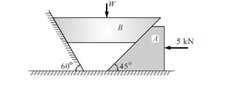
Find the weight W that can be supported by the applied force of 5 kN. Mu = .25 at all surfaces
Relevant Equations
F = mu N, where mu = coefficient of static friction, N = normal force
Let Nr = normal force on the right side of the trapezoid B and Fr = the force of friction on the right side of B.
Let Nl = normal force on the left side of B and Fr = the frictional force on the left surface of B

so Nr = 5 sin45 and Fr = 5 sin45 =
and Nl = 5 sin 60, Fl = 5 sin 30.
 

Attachments
  • 3D280A4F-37D1-426C-9547-6A392149D2CF.jpeg
    3D280A4F-37D1-426C-9547-6A392149D2CF.jpeg
    16.7 KB · Views: 138
Physics news on Phys.org
All surfaces would include the underside of A.
Consider balance of forces on A and balance of forces on B.
 
Yes, thank you. But I am having trouble drawing a force diagram which makes sense at the two surfaces of B.
 
Tom Hammer said:
Yes, thank you. But I am having trouble drawing a force diagram which makes sense at the two surfaces of B.
 
Tom Hammer said:
Yes, thank you. But I am having trouble drawing a force diagram which makes sense at the two surfaces of B.
Not sure why. What forces act on B?
What forces act on A?
If the system slips, can it do so without sliding at all contact surfaces?
 
  • Like
Likes   Reactions: Lnewqban
Tom Hammer said:
Yes, thank you. But I am having trouble drawing a force diagram which makes sense at the two surfaces of B.
Why do you find it difficult?
Forgetting for a moment about block A, only three forces acting perpendicularly to each of the top and side surfaces of B are needed to keep in equilibrium.
Try a vectorial addition of those forces, which should form a triangle.
 

Similar threads

  • · Replies 25 ·
Replies
25
Views
2K
  • · Replies 95 ·
4
Replies
95
Views
6K
  • · Replies 7 ·
Replies
7
Views
2K
Replies
46
Views
5K
  • · Replies 7 ·
Replies
7
Views
4K
  • · Replies 1 ·
Replies
1
Views
2K
  • · Replies 42 ·
2
Replies
42
Views
4K
  • · Replies 4 ·
Replies
4
Views
2K
  • · Replies 2 ·
Replies
2
Views
1K
Replies
1
Views
5K