Supremum Proof Concerning Sqrt[2]

  • Context: MHB 
  • Thread starter Thread starter MI6
  • Start date Start date
  • Tags Tags
    Proof Supremum
Click For Summary
SUMMARY

The proof presented in the discussion establishes that the supremum of the set of positive rational numbers whose squares are less than 2 is equal to the square root of 2, denoted as $\sqrt{2}$. The argument hinges on the properties of irrational numbers and the construction of a rational number, denoted as w, that lies between an irrational number s and s + 1/n. The proof also confirms that the supremum of the set of positive rational numbers less than 2 is indeed 2, but emphasizes that the primary focus is on the relationship between s and $\sqrt{2}$.

PREREQUISITES
  • Understanding of supremum and infimum in real analysis
  • Familiarity with rational and irrational numbers
  • Basic knowledge of limits and sequences
  • Proficiency in mathematical notation and proofs
NEXT STEPS
  • Study the properties of supremum in real analysis
  • Explore the concept of density of rational numbers in the real numbers
  • Learn about the completeness property of the real numbers
  • Investigate proofs involving irrational numbers and their implications in analysis
USEFUL FOR

Mathematicians, students of real analysis, and anyone interested in understanding the properties of rational and irrational numbers, particularly in the context of supremum proofs.

MI6
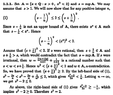
The following is my book's proof that $\sup\left\{x\in\mathbb{Q}:x>0, ~ x^2<2\right\} = \sqrt{2}.$

http://www.mathhelpboards.com/attachment.php?attachmentid=527&d=1356865161

I don't follow the bit where it says "if s were irrational, then w = \frac{\lfloor(n+1)s\rfloor}{n+1}+\frac{1}{n+1}."

Could someone please elaborate on that bit? How does s being irrational imply that?
 

Attachments
  • Untitled.png
    Untitled.png
    31 KB · Views: 152
Last edited by a moderator:
Physics news on Phys.org
all we are trying to do is find SOME rational number between s and s + 1/n.

the claim is that w is one such rational number.

note that since $\lfloor (n+1)s \rfloor < (n+1)s$ (s is NOT an integer, since s is irrational)

$\dfrac{\lfloor (n+1)s \rfloor}{n+1} < s$

so:

$w = \dfrac{\lfloor (n+1)s \rfloor}{n+1} + \dfrac{1}{n+1} < s + \dfrac{1}{n+1}$

on the other hand, we also have:

$(n+1)s - 1 < \lfloor (n+1)s \rfloor$

so:

$s = \dfrac{ns + s - 1}{n+1} + \dfrac{1}{n+1} < \dfrac{\lfloor (n+1)s \rfloor}{n+1} + \dfrac{1}{n+1} = w$

(all we are doing is explicitly finding a rational number between s and s + 1/(n+1)...we need a rational number to use because the set A only has rational members).
 
MI6 said:
The following is my book's proof that $\sup\left\{x\in\mathbb{Q}:x>0, ~ x<2\right\} = 2.$
It is true that $\sup\left\{x\in\mathbb{Q}:x>0, ~ x<2\right\} = 2$, but that is not what the book proves. The result is that if $s = \sup\left\{x\in\mathbb{Q}:x>0, ~ x^2<2\right\}$ then $s^2=2$. Or, to put it another way, $s=\sqrt2$.
 

Similar threads

  • · Replies 15 ·
Replies
15
Views
3K
  • · Replies 4 ·
Replies
4
Views
3K
  • · Replies 2 ·
Replies
2
Views
1K
  • · Replies 2 ·
Replies
2
Views
2K
  • · Replies 4 ·
Replies
4
Views
5K
Replies
2
Views
2K
Replies
2
Views
2K
  • · Replies 3 ·
Replies
3
Views
2K
Replies
2
Views
1K
  • · Replies 2 ·
Replies
2
Views
3K