CGandC
- 326
- 34
- TL;DR
- x
In the following proof:
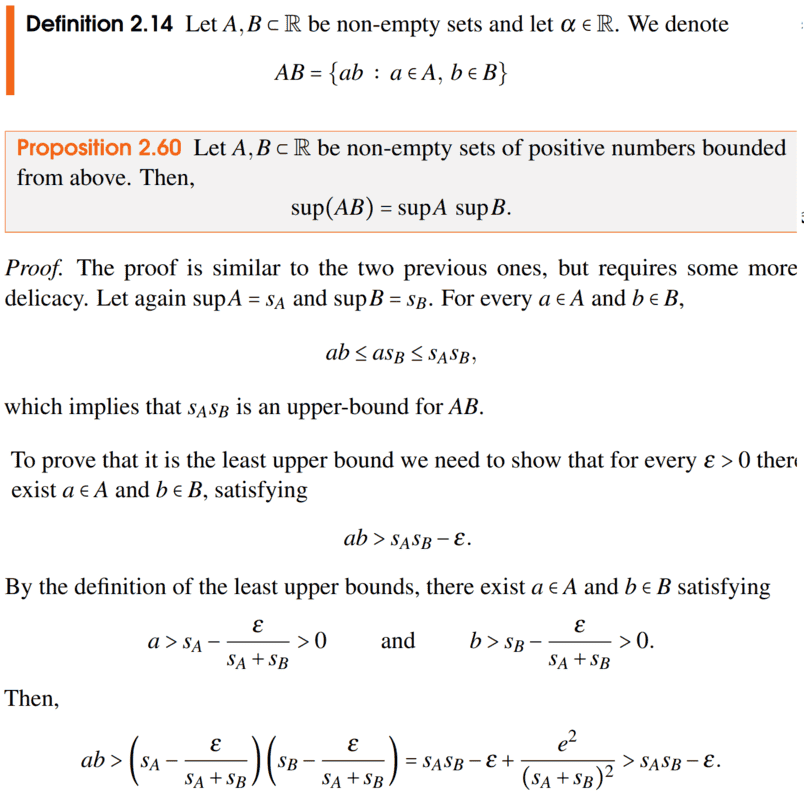
I didn't understand the following part:

Isn't it supposed to be :
## a > s_A - \epsilon >0 ## and ## b > s_B - \epsilon >0 ##
Because to prove that ## s ## is a supremum, we need to prove the following:
For every ## \epsilon > 0 ## there exists ## m \in M ## such that ## m > s - \epsilon ## .
So In my proof, to represent the claim for ## a \in A ## I do the following:
Let ## \epsilon > 0 ## be arbitrary. Define ## m=a ## . Then we need to prove ## a > s_A - \epsilon ## . ( where ## s_A ## is my upper bound for ## A ## )
However, I didn't understand why they wrote ## \frac{\epsilon}{s_A + s_B} ## instead of ## \epsilon ## . They prove ## a > s_A - \frac{\epsilon}{s_A + s_B} ## but I don't understand how they replaced the ## \epsilon ## with ## \frac{\epsilon}{s_A + s_B} ## since the universal quantifier in the proof is on ## \epsilon ## and not on ## \frac{\epsilon}{s_A + s_B} ## . Can you please help me understand why they did this?
Note: I saw this kind of bound variable manipulation appearing also in the following:
## \forall n \in N ( n < s) ## is the same as ## \forall n \in N ( (n+1)<s ) ## ( 'N' is the natural numbers set , 's' is some free variable )
Why is this possible?
I didn't understand the following part:
Isn't it supposed to be :
## a > s_A - \epsilon >0 ## and ## b > s_B - \epsilon >0 ##
Because to prove that ## s ## is a supremum, we need to prove the following:
For every ## \epsilon > 0 ## there exists ## m \in M ## such that ## m > s - \epsilon ## .
So In my proof, to represent the claim for ## a \in A ## I do the following:
Let ## \epsilon > 0 ## be arbitrary. Define ## m=a ## . Then we need to prove ## a > s_A - \epsilon ## . ( where ## s_A ## is my upper bound for ## A ## )
However, I didn't understand why they wrote ## \frac{\epsilon}{s_A + s_B} ## instead of ## \epsilon ## . They prove ## a > s_A - \frac{\epsilon}{s_A + s_B} ## but I don't understand how they replaced the ## \epsilon ## with ## \frac{\epsilon}{s_A + s_B} ## since the universal quantifier in the proof is on ## \epsilon ## and not on ## \frac{\epsilon}{s_A + s_B} ## . Can you please help me understand why they did this?
Note: I saw this kind of bound variable manipulation appearing also in the following:
## \forall n \in N ( n < s) ## is the same as ## \forall n \in N ( (n+1)<s ) ## ( 'N' is the natural numbers set , 's' is some free variable )
Why is this possible?