Tension Problem (Two strings and an object)

  • Thread starter Thread starter AY3
  • Start date Start date
  • Tags Tags
    Strings Tension
Click For Summary
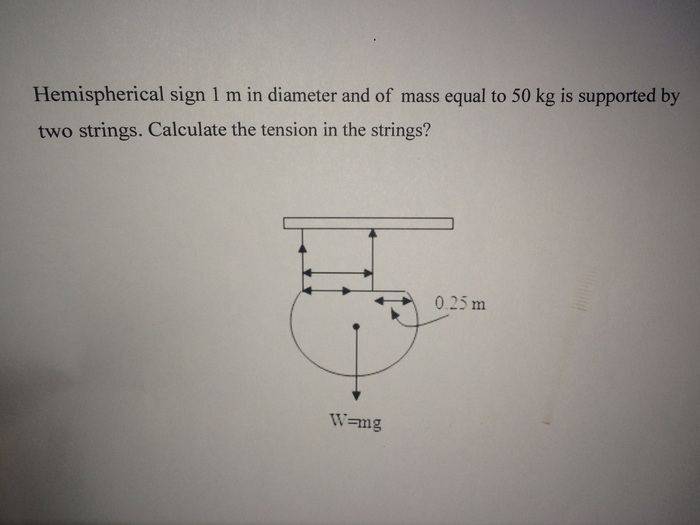
A hemispherical sign with a diameter of 1m and a mass of 50kg is supported by two strings, leading to a tension calculation. The weight of the sign is determined using W = mg. To solve for the tensions in the strings, the equilibrium condition T1 + T2 - W = 0 is established, where T1 and T2 are the tensions in the strings. The torque equation is set up with respect to one of the strings, resulting in T1 = 166.67 N and T2 = 333.33 N. This approach effectively balances the forces and moments acting on the sign.
AY3
Messages
4
Reaction score
0
1. A hemispherical sign in 1m diameter and of mass equal to 50kg is supported by two strings. Calculate the tension in the strings.
2mgtjyu.jpg


2. W = mg


3. I tried to solve it but the only thing I was able to do is knowing the distance between the two strings which is 0.75m, I'm new to physics.
 
Physics news on Phys.org
Hi AY3. http://img96.imageshack.us/img96/5725/red5e5etimes5e5e45e5e25.gif

Identify a point about which you can take moments.
 
Last edited by a moderator:
Do I create an X and Y axes and then do the sin and cos with an angle of 90 degrees?
 
Placing an x and a y-axis on the diagram would be a good first step.

It doesn't matter exactly where you locate them.
 
Last edited:
I solved it, the first step was creating an equation for the summition of force. I called the strings T2 and T2, the equation is T1+T2-W=0 because the object is in equilibrium. I have two unknowns in the equation. So the next step is determining the torque, assuming the point of rotation is T2.
Its equation was (T1*0.75)–(W*0.25)=0
In the end T1=166.67n and by substituting in the first equation T2=333.33n
 
I meant T1 and T2.
 
Thread 'Correct statement about size of wire to produce larger extension'
The answer is (B) but I don't really understand why. Based on formula of Young Modulus: $$x=\frac{FL}{AE}$$ The second wire made of the same material so it means they have same Young Modulus. Larger extension means larger value of ##x## so to get larger value of ##x## we can increase ##F## and ##L## and decrease ##A## I am not sure whether there is change in ##F## for first and second wire so I will just assume ##F## does not change. It leaves (B) and (C) as possible options so why is (C)...

Similar threads

Replies
21
Views
816
Replies
2
Views
1K
  • · Replies 19 ·
Replies
19
Views
5K
  • · Replies 2 ·
Replies
2
Views
1K
  • · Replies 4 ·
Replies
4
Views
4K
  • · Replies 19 ·
Replies
19
Views
3K
Replies
16
Views
2K
  • · Replies 7 ·
Replies
7
Views
4K
  • · Replies 1 ·
Replies
1
Views
3K
  • · Replies 7 ·
Replies
7
Views
3K