Discussion Overview
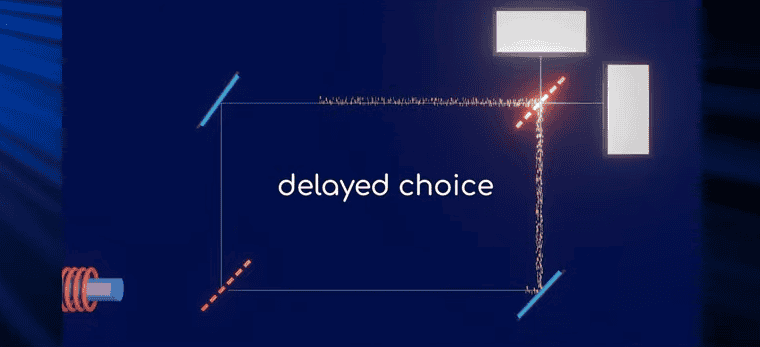
The discussion revolves around the Delayed Choice experiment and the relevance of photon speed in understanding its implications. Participants explore interpretations of the experiment, particularly regarding the nature of time as experienced by photons and its significance in quantum mechanics.
Discussion Character
- Exploratory
- Debate/contested
- Conceptual clarification
- Technical explanation
Main Points Raised
- Some participants suggest that the photon "knows" the outcome of the experiment before it happens, raising questions about the implications of traveling at the speed of light.
- Others argue that it is not meaningful to discuss whether a photon experiences time, emphasizing that this is a common misconception.
- There is a contention regarding the relationship between speed and time, with some asserting that objects traveling at the speed of light have a fundamentally different relationship to time compared to slower objects.
- Some participants propose that the delayed choice experiment's outcomes are not dependent on the speed of light, suggesting that similar results could be obtained with other quantum objects, although practical challenges exist.
- One participant emphasizes that the experiment's design allows for the manipulation of photons without regard to their speed, indicating that the critical variable is not photon speed but rather the quantum mechanics involved.
- There is a discussion about the challenges of conducting similar experiments with massive particles, with some expressing skepticism about the relevance of photon speed in the broader context of quantum mechanics.
Areas of Agreement / Disagreement
Participants express multiple competing views regarding the significance of photon speed in the Delayed Choice experiment. There is no consensus on whether the speed of light is a critical factor in understanding the experiment's results.
Contextual Notes
Participants note that discussions about time and speed in relation to photons are complex and often misunderstood. The implications of these discussions are not fully resolved, and assumptions about the nature of time and speed remain contentious.