The Dirac Equation: Understanding Spinors and Approximations

Click For Summary
SUMMARY

The discussion focuses on the Dirac Equation and its solutions, particularly the manipulation of spinors and approximations. Key equations referenced include (2.75), (2.100), (2.101), (2.111), (2.112), and (2.113). The participants clarify that the expression \((\vec{p} \cdot \sigma)(\vec{p} \cdot \vec{\sigma})\) simplifies to \(\boldsymbol{p}^2\) and emphasize that the analysis is valid up to order \(p^4\), discarding higher-order terms. The cancellation of terms in the derivation of Eq. (2.113) is a critical point of understanding in this discussion.

PREREQUISITES
  • Understanding of the Dirac Equation and its implications in quantum mechanics.
  • Familiarity with spinors and their mathematical representation.
  • Knowledge of operator algebra in quantum physics.
  • Basic grasp of perturbation theory and approximations in quantum mechanics.
NEXT STEPS
  • Study the derivation of the Dirac Equation in detail.
  • Learn about the properties and applications of spinors in quantum mechanics.
  • Explore operator algebra, focusing on the manipulation of quantum operators.
  • Investigate perturbation theory and its role in approximating solutions in quantum systems.
USEFUL FOR

Physicists, graduate students in quantum mechanics, and researchers focusing on relativistic quantum theories will benefit from this discussion, particularly those studying the Dirac Equation and its applications in particle physics.

park
Messages
5
Reaction score
0
TL;DR
dirac equation and it's solution
I'm studying about dirac equation and it's solution.
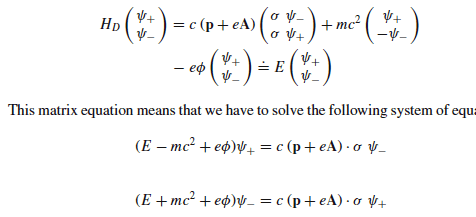
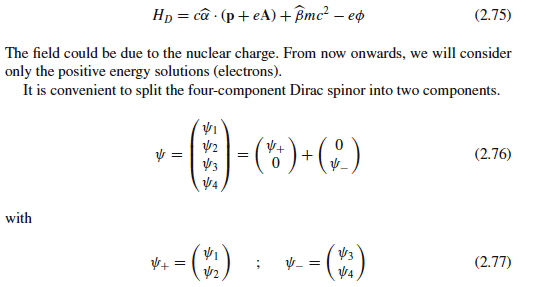
When we starts with the equation (2.75), I can understand that it is possible to set 2 kinds of spinor.
스크린샷 2020-03-31 오후 2.51.18.png

스크린샷 2020-03-31 오후 2.51.39.png

But my question is...
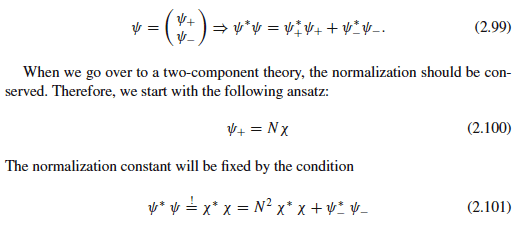
1. After the assumption (2.100), how can we set the equation like (2.101)
스크린샷 2020-03-31 오후 2.52.18.png

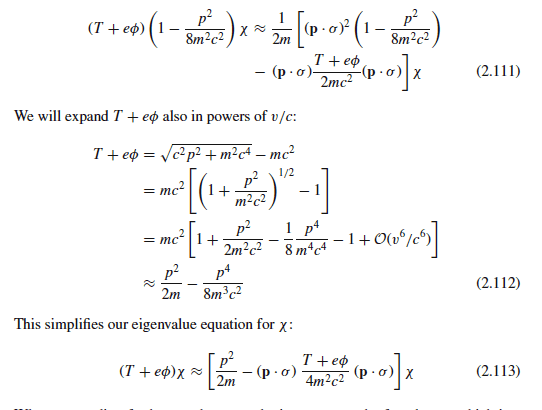
2. I can't get (2.113) from (2.111) using (2.112)... Approximation and operator made me so crazy!
Please help me...
스크린샷 2020-03-31 오후 2.52.50.png
 
Physics news on Phys.org
First step: what is ##(\vec{p} \cdot \sigma) (\vec{p} \cdot \vec{\sigma}) ## equal to?
 
nrqed said:
First step: what is ##(\vec{p} \cdot \sigma) (\vec{p} \cdot \vec{\sigma}) ## equal to?

Equal to ##\boldsymbol{p}^2## !
 
park said:
Equal to ##\boldsymbol{p}^2## !
Right!

Now, the key point is that they work up to order ##p^4##, i.e. they drop all terms of higher order.

So notice that the following term on the left of (2.111) is

$$ (T+e \phi) (-p^2/(8m^2c^2)= -p^4/(16m^3c^2) ~\text{plus terms of order } p^4 \text{ and higher}.$$

This term cancels exactly the term ##- (\vec{p} \cdot \vec{\sigma})^2\, p^2/(16m^3c^2) ## that appears on the right side. This leaves Eq, (2.113), which is valid up to order ##p^4##.
 

Similar threads

  • · Replies 0 ·
Replies
0
Views
968
  • · Replies 1 ·
Replies
1
Views
2K
  • · Replies 1 ·
Replies
1
Views
3K
  • · Replies 7 ·
Replies
7
Views
3K
  • · Replies 40 ·
2
Replies
40
Views
5K
  • · Replies 12 ·
Replies
12
Views
2K
  • · Replies 8 ·
Replies
8
Views
3K
  • · Replies 13 ·
Replies
13
Views
3K
  • · Replies 3 ·
Replies
3
Views
2K
  • · Replies 1 ·
Replies
1
Views
2K