Graduate The Distance between two points in a hypothetical universe

Click For Summary
SUMMARY

The discussion centers on a hypothetical universe where the distance between two points in spacetime is defined by the equation $$ds^2 =−(\phi^2 t^2)dt^2+dx^2+dy^2+dz^2$$, with ##\phi## measured in ##km s^{-2}##. Participants clarify that this metric does not represent Minkowski space and that the universe's expansion is quadratic over time. The conversation also addresses the possibility of deriving a function to calculate the distance from point Q to point P based on a given time interval, emphasizing the distinction between proper distance and luminosity distance.

PREREQUISITES
  • Understanding of spacetime metrics, specifically the line element in general relativity.
  • Familiarity with the concepts of proper distance and luminosity distance in cosmology.
  • Knowledge of the Friedmann-Lemaître-Robertson-Walker (RW) metric and its implications for expanding universes.
  • Basic grasp of the relationship between time and spatial coordinates in a non-Minkowski framework.
NEXT STEPS
  • Research the Friedmann-Lemaître-Robertson-Walker (RW) metric and its applications in cosmology.
  • Study the differences between proper distance and luminosity distance in expanding universes.
  • Explore the implications of quadratic versus linear expansion in cosmological models.
  • Investigate the mathematical derivation of distance functions in non-Minkowski spacetimes.
USEFUL FOR

Physicists, cosmologists, and students of general relativity who are interested in theoretical models of spacetime and the implications of different metrics on distance calculations.

DAirey
Messages
13
Reaction score
0
I have a hypothetical universe where the distance between two points in spacetime is defined as:
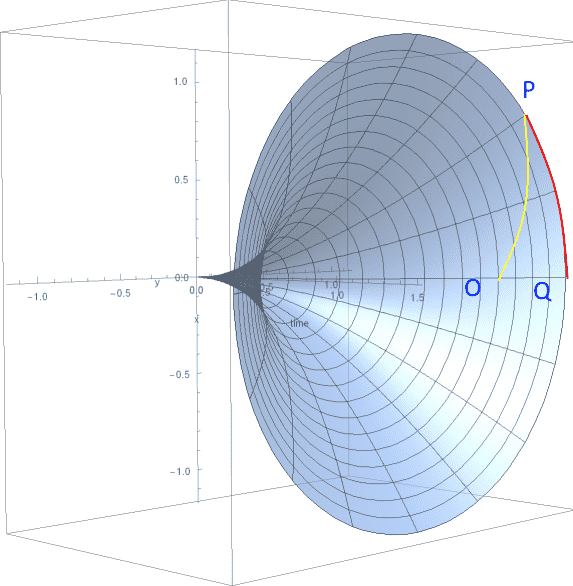
$$ds^2 =−(\phi^2 t^2)dt^2+dx^2+dy^2+dz^2$$Where ##\phi## has units of ##km s^{-2}##. The space in this universe grows quadratically with time (and, as I understand it, probably isn’t Minkowski space). A particle traveling at the speed of causality, c, will follow this contour from point O to point P.
oeEgv.png


Given the time between point O and point Q, is it possible to find the distance from point Q to point P (e.g. does a function exist such that ##f(\Delta t) = d_L##). If so, what is the formula?
 

Attachments

  • oeEgv.png
    oeEgv.png
    40.6 KB · Views: 621
Last edited:
Physics news on Phys.org
What you have written down is just the line element of Minkowski space in different coordinates. Is it what you intended to write or did you intend it to be a RW universe?

DAirey said:
The space in this universe grows quadratically with time (and, as I understand it, probably isn’t Minkowski space).
"Space" is relative and not something that is uniquely defined for a spacetime. It is a concept that belongs to the coordinates. See my PF Insight on the topic. Furthermore, "space" can never be Minkowski space as Minkowski space is a 4-dimensional spacetime.

DAirey said:
Given the time between point O and point Q, is it possible to find the distance from point Q to point P (e.g. does a function exist such that f(Δt)=dLf(Δt)=dLf(\Delta t) = d_L). If so, what is the formula?
Is the question you intended to ask "how can I find the proper distance to the point where the light signal is after a time ##\Delta t## (with the usual caveats on what this means). Note that this is not a luminosity distance (which is what is usually denoted ##d_L##. Also, your figure shows an expanding circle, not an expanding flat space as in your metric (if corrected to be a RW metric).

Edit: Additionally, note that even if you move the scale factor to the spatial part your universe will not grow quadratically. The RW metric scale factors enters squared in the line element and so your universe would grow linearly. Also note that if you move your current scale factor to the spatial oart, then you have a coasting universe, which is again just Minkowski space in different coordinates.
 

Similar threads

  • · Replies 13 ·
Replies
13
Views
3K
  • · Replies 17 ·
Replies
17
Views
5K
  • · Replies 3 ·
Replies
3
Views
3K
  • · Replies 15 ·
Replies
15
Views
2K
  • · Replies 25 ·
Replies
25
Views
2K
Replies
1
Views
2K
  • · Replies 9 ·
Replies
9
Views
15K
  • · Replies 11 ·
Replies
11
Views
2K
  • · Replies 12 ·
Replies
12
Views
4K
  • · Replies 12 ·
Replies
12
Views
3K