Mr LoganC
- 19
- 0
Well, to start, I am actually in my second year of doing my Honors in Physics but am helping a first year student in understanding some of the concepts in her physics class. This question came up, and I myself cannot seem to find a solution to it. I'm quite puzzled about it...
There are 3 boxes, each with separate masses, all touch in a line.
A force of magnitude F pushes horizontally to the right against box 1 and pushes the boxes.
See diagram below:
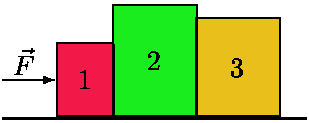
We need to draw a free body diagram, as worded directly from the question, of all of the individual forces acting on the system consisting of boxes 2 and 3 together. Indicate the five forces listed below by choosing from the vectors in the diagram below. If none are present, then "N" is an option.
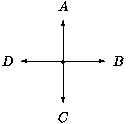
i) box 2 pushing on ground
ii)the applied force pushing on block 1
iii)the applied force pushing on block 2
iv)floor pushing on box 2
v)floor pushing on box 1
Well, we know from Newton's 3rd law that all forces have an action/reaction pair that are equal and opposite in direction. Well also know that not only is the applied horizontal force present, but also the gravitational force.
At first glance it seemed quite simple and straight forward!
i) Box 2 on ground = C from gravitational force
ii) F on block 1 = B
iii) F on block 2 = N because that is not the applied force. That would be F1 on 2
iv)Floor on box 2 = A which is the normal force that the floor pushes back with. (The action/reaction pair of gravity)
v)Floor on box 1 = A. Same logic as previous one.
Needless to say, this did not seem to work. So I tried multiple other combinations taking into account that the directions say that the system consists of boxes 2 and 3 together. I thought that perhaps box 1 was not part of the FBD. I also thought that there may be some confusing bits in the fact that it states some as "boxes" and some as "blocks"
Either way, I can't seem to get it to work. What's worse is that what I thought was fairly simple Newtonian physics, is stopping me in my tracks!
Any insight or perhaps something really simple and back to basics that I am forgetting?
Homework Statement
There are 3 boxes, each with separate masses, all touch in a line.
A force of magnitude F pushes horizontally to the right against box 1 and pushes the boxes.
See diagram below:
We need to draw a free body diagram, as worded directly from the question, of all of the individual forces acting on the system consisting of boxes 2 and 3 together. Indicate the five forces listed below by choosing from the vectors in the diagram below. If none are present, then "N" is an option.
i) box 2 pushing on ground
ii)the applied force pushing on block 1
iii)the applied force pushing on block 2
iv)floor pushing on box 2
v)floor pushing on box 1
Homework Equations
Well, we know from Newton's 3rd law that all forces have an action/reaction pair that are equal and opposite in direction. Well also know that not only is the applied horizontal force present, but also the gravitational force.
The Attempt at a Solution
At first glance it seemed quite simple and straight forward!
i) Box 2 on ground = C from gravitational force
ii) F on block 1 = B
iii) F on block 2 = N because that is not the applied force. That would be F1 on 2
iv)Floor on box 2 = A which is the normal force that the floor pushes back with. (The action/reaction pair of gravity)
v)Floor on box 1 = A. Same logic as previous one.
Needless to say, this did not seem to work. So I tried multiple other combinations taking into account that the directions say that the system consists of boxes 2 and 3 together. I thought that perhaps box 1 was not part of the FBD. I also thought that there may be some confusing bits in the fact that it states some as "boxes" and some as "blocks"
Either way, I can't seem to get it to work. What's worse is that what I thought was fairly simple Newtonian physics, is stopping me in my tracks!
Any insight or perhaps something really simple and back to basics that I am forgetting?
Last edited:

