The limit of the perimeter of a Koch snowflake as s(0) goes to zero

Click For Summary

Discussion Overview

The discussion revolves around the limits of the perimeter of a Koch snowflake as the initial side length \( s \) approaches zero and the implications of this limit as the iteration number \( n \) approaches infinity. Participants explore the mathematical behavior of the perimeter in relation to these limits, considering both intuitive and formal approaches.

Discussion Character

  • Exploratory
  • Mathematical reasoning
  • Debate/contested

Main Points Raised

  • Some participants suggest that for any finite value of \( s \), the perimeter of the Koch snowflake is infinite as \( n \) approaches infinity.
  • Others propose that if \( s \) approaches zero, the perimeter also approaches zero, leading to a discussion about the order of limits and their implications.
  • A participant expresses uncertainty about the relationship between \( s \) and \( n \), questioning whether they should be treated as independent variables or if there is a dependency that needs to be established.
  • Some participants argue that the limits are real numbers, with one asserting that limits should not be treated as procedures, emphasizing the need for clarity on the relationship between \( s \) and \( n \).
  • One participant shares a gut feeling that the limit approaches infinity, drawing a parallel to problems involving delta functions and integrals.
  • Another participant suggests using specific values for \( s \) to gain insight into the limit behavior, referencing the concept of fractals and their dimensions.
  • A clarification is made that \( s \) is the initial side length when \( n = 0 \) and does not vary with \( n \), leading to a conclusion that if \( s = 0 \), the perimeter is zero.
  • Participants discuss the implications of varying \( s \) while keeping \( n \) constant, noting that for \( s > 0 \), the limit of the perimeter as \( n \) approaches infinity remains infinite.

Areas of Agreement / Disagreement

Participants express differing views on the behavior of the perimeter as \( s \) approaches zero and the implications of the limits involved. There is no consensus on how to approach the limits or the relationship between \( s \) and \( n \), indicating a contested discussion.

Contextual Notes

There is a lack of clarity regarding the dependence of \( s \) and \( n \) and how they should be treated in the context of limits. Participants highlight the importance of understanding whether limits are approached independently or if there is a specific relationship that must be defined.

nomadreid
Gold Member
Messages
1,771
Reaction score
255
TL;DR
Letting the original triangle of the iteration that results in the Koch snowflake =s: Taking the limit of the Koch snowflake perimeter as s goes to zero intuitively would be infinity, although at s=0 the perimeter would be zero. I'm not sure how that works as an iterated limit.
On one side, if I have any finite value of s = the side of the original triangle of the Koch snowflake iteration, then the perimeter is infinite, so intuitively
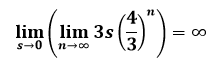
AAAA.PNG

On the other hand, if I looked at the end result first and considered how it got there, then intuitively
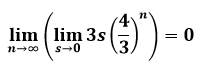
BBBB.PNG

(Obviously at n=infinity and s=0, the perimeter is zero, but I am wondering about the limits)

These are the intuitive answers, but intuition is a lousy guide, so I am not sure how this works out as an iterated limit.
Thanks for any pointers.

(Note: this is not a homework question or part of any course, so if the problem is not well posed, I am the clumsy one.)
 
Physics news on Phys.org
##\lim_{n \to \infty} \left(3s\cdot \left(\dfrac{4}{3}\right)^n\right)=\infty ## and ##\lim_{s \to 0} \left(3s\cdot \left(\dfrac{4}{3}\right)^n\right)=0. ## Now, do whatever is allowed to ##\infty ## and ##0##, e.g. writing ##\lim_{T \to C}## in front of it.What do you really want to know?
 
  • Like
Likes   Reactions: nomadreid
fresh_42 said:
##\lim_{n \to \infty} \left(3s\cdot \left(\dfrac{4}{3}\right)^n\right)=\infty ## and ##\lim_{s \to 0} \left(3s\cdot \left(\dfrac{4}{3}\right)^n\right)=0. ## Now, do whatever is allowed to ##\infty ## and ##0##, e.g. writing ##\lim_{T \to C}## in front of it.What do you really want to know?
First, I am not sure whether your "T" and "C" are just repeating what I wrote, being n, s, 0, infinity... and what you mean by "whatever is allowed". What I would like to know is what would be the area of the Koch snowflake as s tends to zero--- infinity (my guess) or zero. Which order of the limits is the correct way to look at it?
 
The limits are what you have written. They are real numbers, resp. infinite big. Putting another limit in front of it doesn't change that. Limits are no procedures. If you want to establish a procedure, then we need to know what ##n\longmapsto s(n)## or likewise ##s\longmapsto n(s)## is.
 
  • Like
Likes   Reactions: nomadreid
fresh_42 said:
The limits are what you have written. They are real numbers, resp. infinite big. Putting another limit in front of it doesn't change that. Limits are no procedures. If you want to establish a procedure, then we need to know what ##n\longmapsto s(n)## or likewise ##s\longmapsto n(s)## is.
Thanks. If I understand what you are getting at, the answer will depend on whether I treat s and n as independent variables, which order I wish to approach the limit, and if they are dependent variables, what the relationship between s and n would be. This makes sense. Thanks again.
 
Last edited:
My gut feeling $$\infty$$ is the correct limit. It reminded me of a problem I worked on with an approximate delta function near zero, where the sequence to zero at every point, but the integral remained positive.
 
mathman said:
My gut feeling $$\infty$$ is the correct limit. It reminded me of a problem I worked on with an approximate delta function near zero, where the sequence to zero at every point, but the integral remained positive.
Only in the case ##s>0##. No sidelength, no perimeter. It is important to avoid any impression of a limit as a procedure. This is wrong. A limit is a unique, single element of ##\mathbb{R}\cup \{\pm\infty \}.##
 
Last edited:
  • Like
Likes   Reactions: pbuk
Maybe, at least to get a feel, you can use the Log Limit? Or try for specific values of s that may be easy to compute/intuit, like ##s=1/n## Edit: I think @mathman may be right. Reminds me of the whole( paraphrase) " Coastline of Britain has infinite length) topic, where when you make your resolution/yardstick increasingly smaller, the perimeter goes to ##\infty ##.
 
Since the Koch curve is a fractal it may give a good context to also look at how limits are used for calculating fractal dimension rather than "just" settling with integer dimension limits that goes towards infinity or zero.
 
  • Like
Likes   Reactions: jim mcnamara and WWGD
  • #10
There is some confusion here: ## s ## is the initial side length when ## n = 0 ##, it does not vary with ## n ##. So we don't need to consider ## \lim_{s \to 0} ##, we can just plug ## s = 0 ## into the equation and every term becomes 0.

Alternatively, use the iterative equation for the perimeter ## P_{n+1} = \frac 4 3 P_n ##. You can see that if ## s = 0, P_0 = 3 s = 0 ## and every iteration has zero perimeter.
 
Last edited:
  • Like
Likes   Reactions: fresh_42
  • #11
pbuk said:
So we don't need to consider lims→0, we can just plug s=0 into the equation and every term becomes 0.
The question was about the limit as one varied the initial side length; that is,
s=1 ⇒limitn→∞perimeter of snowflake =∞
s=1/2 ⇒limitn→∞perimeter of snowflake =∞
s=1/4 ⇒limitn→∞perimeter of snowflake =∞
...
s>0 ⇒limitn→∞perimeter of snowflake =∞

At s=0, of course, the perimeter =0, but no one assumes continuity, so the limit and the value attained need not be the same value.
 

Similar threads

  • · Replies 30 ·
2
Replies
30
Views
3K
  • · Replies 1 ·
Replies
1
Views
2K
  • · Replies 4 ·
Replies
4
Views
2K
  • · Replies 9 ·
Replies
9
Views
2K
  • · Replies 53 ·
2
Replies
53
Views
6K
Replies
6
Views
2K
  • · Replies 2 ·
Replies
2
Views
2K
  • · Replies 7 ·
Replies
7
Views
2K
  • · Replies 2 ·
Replies
2
Views
3K
  • · Replies 40 ·
2
Replies
40
Views
4K