The phenomena of Siphons - Directional check valve prevents siponing

  • Thread starter Thread starter Steven Bolgiano
  • Start date Start date
  • Tags Tags
    Phenomena Valve
Join the discussion
Registration is free. Ask a follow-up in this thread, or start your own.
2 replies · 3K views
Steven Bolgiano
Messages
53
Reaction score
6
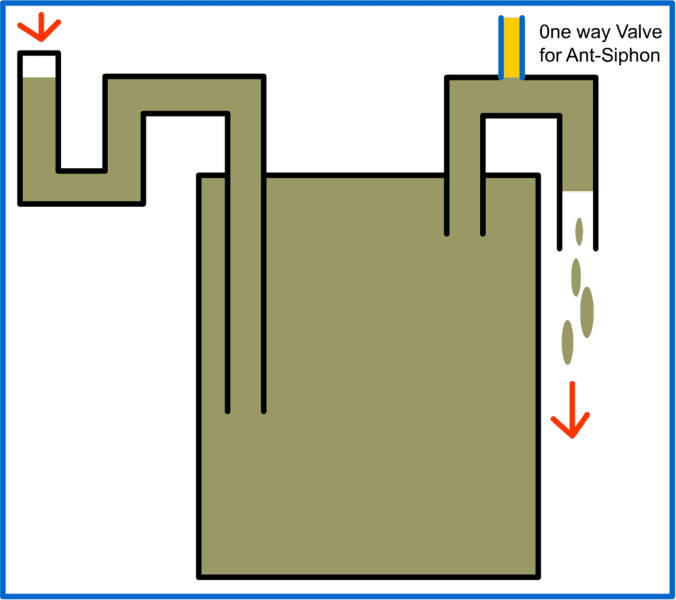
I have in a prototype model, a pipe connected from one tank of liquid to another holding tank (at a lower a lower elevation). Its a biodigester, so the way it works is when liquid is added to tank #1, an equal amount is displaced through the pipe,
Ant-Siphon.png
Ant-Siphon.png
Ant-Siphon.png
into the lower level holding tank, #2. The concern is preventing a siphon situation where after the liquid displaces through the connecting pipe, it continues to draw liquid.

A check valve in the pipe line should prevent this. But I've gone stupid on two points:

1) Which way does the check valve go? My instinct say since vacuum pressure is involved, the check valve should be placed to allow outside air into the pipe.

2) What is a definitive description of how siphons work and more importantly, WHY a siphon works?
s.
 

Attachments

  • Ant-Siphon.png
    Ant-Siphon.png
    5.9 KB · Views: 1,559
Last edited by a moderator:
Physics news on Phys.org
Steven Bolgiano said:
I have in a prototype model, a pipe connected from one tank of liquid to another holding tank (at a lower a lower elevation). Its a biodigester, so the way it works is when liquid is added to tank #1, an equal amount is displaced through the pipe, View attachment 223064 View attachment 223064 View attachment 223064 into the lower level holding tank, #2. The concern is preventing a siphon situation where after the liquid displaces through the connecting pipe, it continues to draw liquid.

A check valve in the pipe line should prevent this. But I've gone stupid on two points:

1) Which way does the check valve go? My instinct say since vacuum pressure is involved, the check valve should be placed to allow outside air into the pipe.

2) What is a definitive description of how siphons work and more importantly, WHY a siphon works?
s.
You are correct on point 1. Letting air into the pipe will prevent siphoning.
Siphoning occurs when the end of the outlet pipe is below the fluid level in the tank and a flow through the pipe is established. When that happens, the potential energy of the fluid leaving the end of the pipe is less than the potential energy plus pressure of the fluid (plus a little bit of kinetic energy) in the tank. But the Bernoulli principle says that the total energy is the same at any point in the system, so the difference is kinetic energy of the fluid leaving the pipe. For an incompressible fluid the rate of flow is constant throughout the system, so the flow at the end of the pipe has to be matched by the flow in the middle of the pipe. As @Chestermiller pointed out in a thread yesterday, this explanation is for a steady state system - one in which the fluid levels and flows remain constant. Otherwise, the explanation gets more complicated.
 
  • Like
Likes   Reactions: berkeman
brilliant. Thanks!
s.