The physics of protecting fruit plants from freezing

Click For Summary
SUMMARY

Fruit growers protect crops from freezing temperatures by spraying water on plants, which freezes and releases heat, helping to maintain the temperature of the fruit. This method is effective for crops like strawberries that can withstand temperatures down to freezing (0° C) but not below. The freezing water delays the cooling of the fruit by absorbing heat from the surroundings, allowing the fruit's fluids, which have a lower freezing point than pure water, to remain liquid longer. Ultimately, this technique is about delaying the freezing process rather than directly warming the fruit.

PREREQUISITES
  • Understanding of latent heat and phase changes
  • Knowledge of plant physiology, particularly in relation to freezing temperatures
  • Familiarity with the effects of sugar solutions on freezing points
  • Basic principles of thermodynamics related to heat transfer
NEXT STEPS
  • Research the effects of water spraying on different fruit crops during frost events
  • Explore advanced techniques for frost protection in agriculture
  • Learn about the thermodynamic properties of sugar solutions in plant fluids
  • Investigate the impact of ambient temperature on fruit freezing survival rates
USEFUL FOR

Agricultural scientists, fruit growers, horticulturists, and anyone involved in crop management and frost protection strategies.

Maxo
Messages
160
Reaction score
1
Fruit growers sometimes protect their crops by spraying them with water when overnight temperatures are expected to drop below freezing. Some fruit crops, like the strawberries in the figure, can withstand temperatures down to freezing (0° C), but not below freezing. When water is sprayed on the plants, it can freeze and release heat, some of which goes into warming the plant.
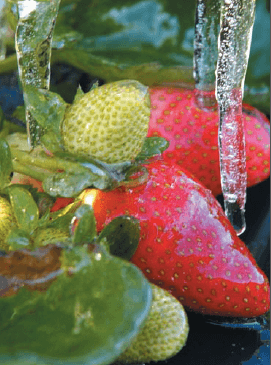
image.png


So when the water freezes it released heat which warms the fruits. But what about when the ice melts? Doesn't that mean it then takes heat from the fruit, thereby making the fruits colder?
 
Science news on Phys.org
Saying that freezing water releases the heat that warms up the fruit is incorrect. What is happening is that if the temperature drops down, heat is transferred from the fruit to the surroundings. If the fruit is covered with water, heat transferred to the surroundings will first come from the water and from the latent heat of freezing water. Hopefully that will take long enough to let the fruit survive through the night.
 
The fluids in the fruit (sugar solutions etc.) will have a lower freezing point than pure water. The water will freeze 'first' and, if there is enough of it, the latent heat released as it freezes will delay any further drop in temperature and the fruit fluids will remain liquid until the surrounding air warms up again in the morning. So it's not so much a matter of 'warming' the fruit - it's more a delay in cooling that's achieved.
The action of the water is only to delay the freezing if the ambient air is much below zero C.

And, yes, there will be a delay in warming up again - but that will not matter if there is 1kW per msq falling on it from the morning sun.
 

Similar threads

  • · Replies 16 ·
Replies
16
Views
6K
  • · Replies 10 ·
Replies
10
Views
3K
  • · Replies 8 ·
Replies
8
Views
8K
  • · Replies 4 ·
Replies
4
Views
5K
  • · Replies 5 ·
Replies
5
Views
8K
  • · Replies 4 ·
Replies
4
Views
2K
  • · Replies 9 ·
Replies
9
Views
4K
Replies
12
Views
3K
  • · Replies 13 ·
Replies
13
Views
7K
  • · Replies 1 ·
Replies
1
Views
2K