The prospect of getting into a physics Master's program

  • Topic: Admissions 
  • Thread starter Thread starter CreamyLasagna
  • Start date Start date
Join the discussion
Registration is free. Ask a follow-up in this thread, or start your own.
5 replies · 461 views
CreamyLasagna
Messages
2
Reaction score
0
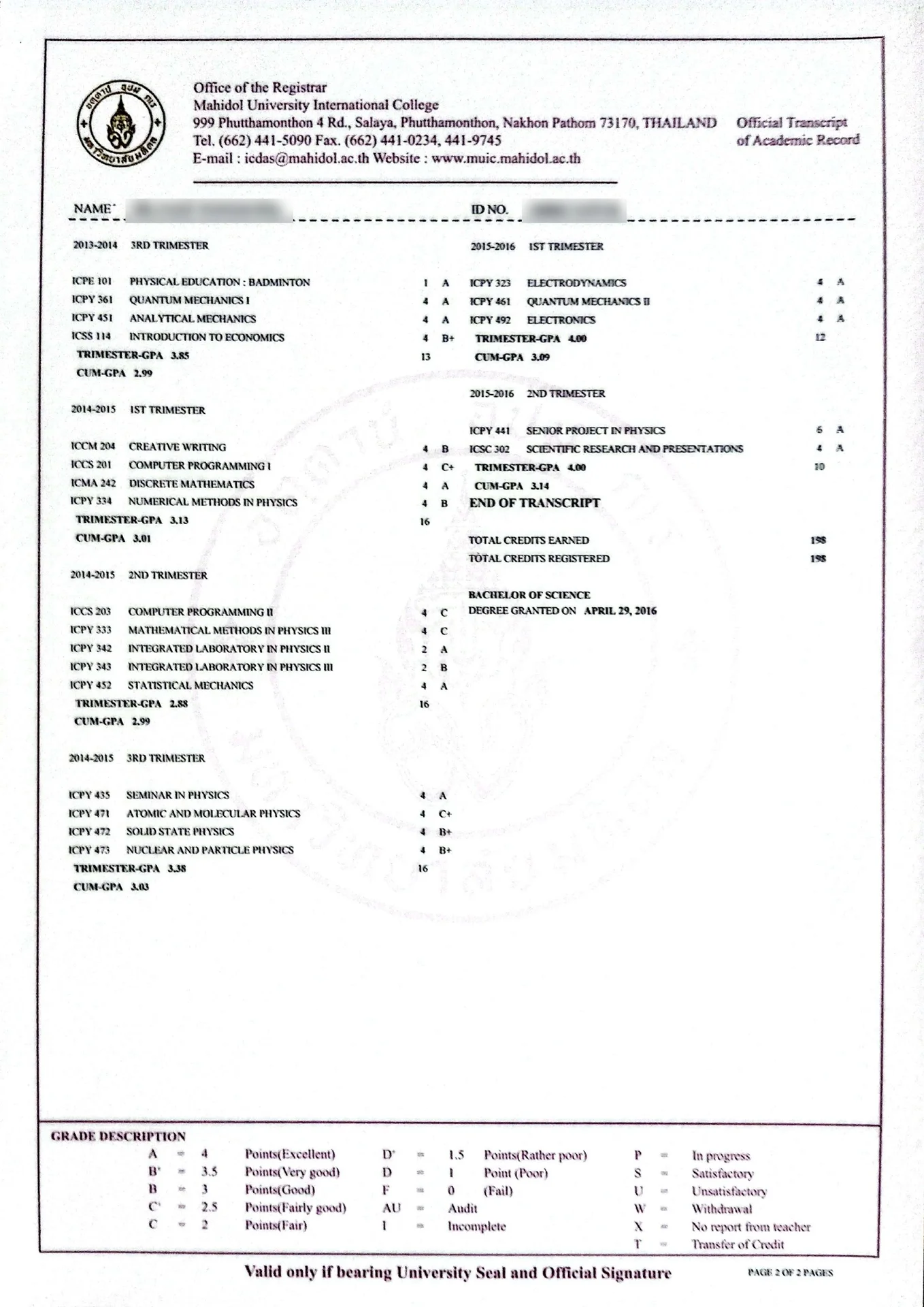
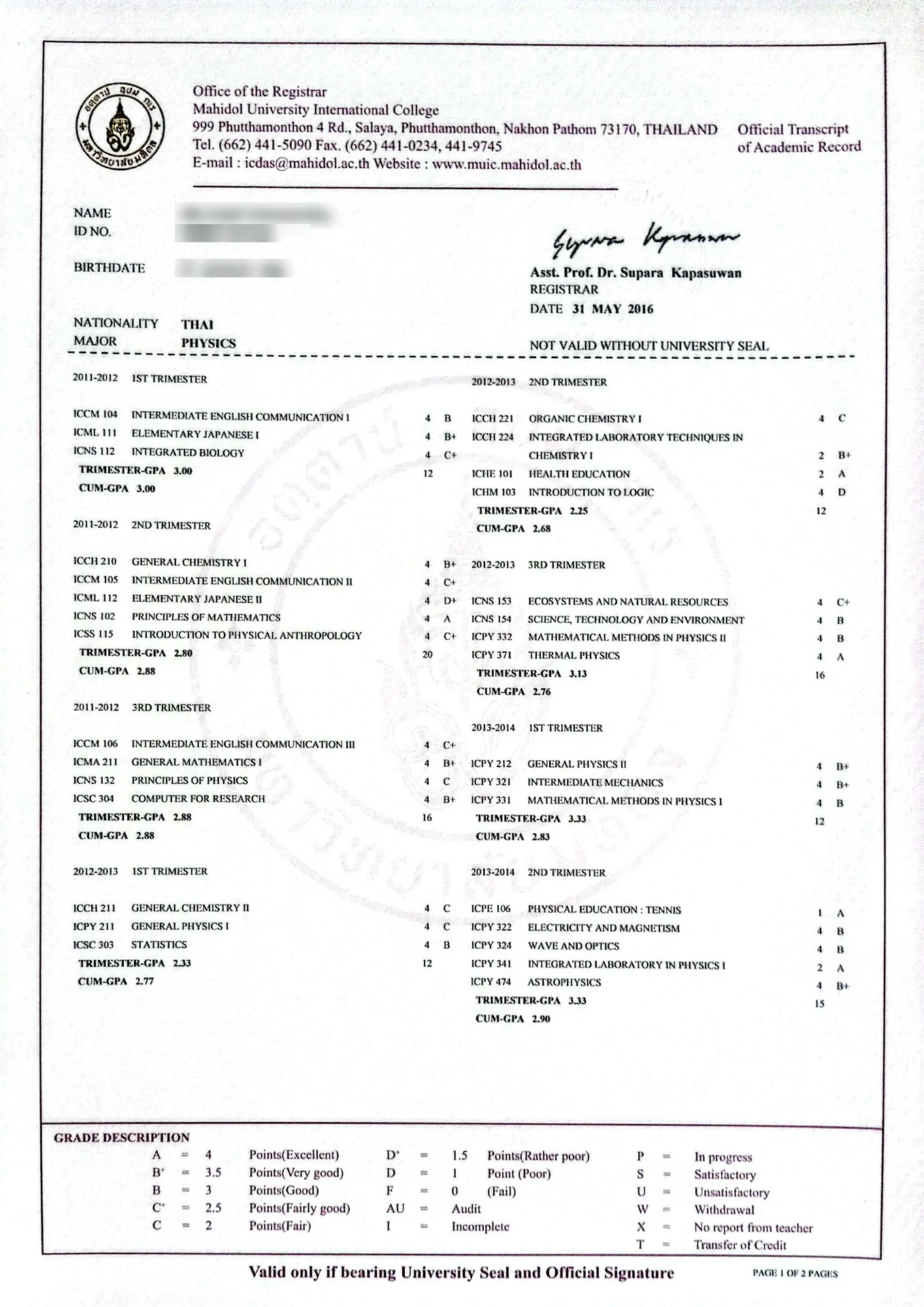
Hello! I have a bachelor's degree in physics, and I want to continue my study. However, my gpa is only 3.14 with my major gpa 3.44. I have a C in Mathematical Method in Physics III and a C+ in Atomic Physics. I was a chemistry major before I switched to physics during my second year. What is the prospect of me being admitted to a Master's degree program? I have attached my academic transcript for your reference.
Transcript_Name_Blurred_page-1.webp
Transcript_Name_Blurred_page-2.webp
 
Physics news on Phys.org
If you were here in the USA my opinion is that your prospects would be good.

But I also think you're getting ahead of yourself. Do a deep dive into what your goals and prospects would be once you have the degree. Kinda like going swimming before you know what the water is like.
 
Herman Trivilino said:
Do a deep dive into what your goals and prospects would be once you have the degree.
But he says he has his BS now...

EDIT/ADD -- Oh, you probably mean once he earns the MS degree.
 
Last edited:
  • Like
Likes   Reactions: Herman Trivilino
@CreamyLasagna . Well, you got your BS degree in Thailand. Where are you planning to apply for your Master's? Also in Thailand? If so, you'd get get better guidance from someone local (perhaps professors at your previous university?). Also, your transcript shows that you got your degree 10+ yrs ago. What have you done in the interim? Has your coursework gone stale? Do you need refreshers before starting grad school?
 
CrysPhys said:
@CreamyLasagna . Well, you got your BS degree in Thailand. Where are you planning to apply for your Master's? Also in Thailand? If so, you'd get get better guidance from someone local (perhaps professors at your previous university?). Also, your transcript shows that you got your degree 10+ yrs ago. What have you done in the interim? Has your coursework gone stale? Do you need refreshers before starting grad school?
I plan to apply in the United States. I am a tutor at the moment and I constantly reviewing what I have learned during college. One thing I am worried about is my grades for Mathematical Method in Physics III and Atomic and Molecular Physics which are C and C+ respectively. I asked the same question on reddit and I got a response saying that these grade would be a red flag for the admission board. I don't know whether this is a dealbreaker or not.
 
CreamyLasagna said:
I plan to apply in the United States.

* You need to do your homework on physics graduate programs. In the US, they are different from those in many other countries, in which you complete your Bachelor's, apply for a terminal/standalone Master's, and (after you complete your Master's) then apply for a PhD if you choose to. In the US, you typically complete your Bachelor's, and then apply for a PhD if you choose to. The US PhD programs meld the Master's and PhD programs offerred in other countries. But the key point is that many US universities (especially the ones with the top physics programs) don't even offer a terminal/standalone Master's in Physics program for you to apply to. There are exceptions, though, if you search hard enough.

* There is also the issue of funding. In the US, if you are admitted to a PhD Physics program by a university that really wants you, you will be fully funded: tuition waiver and a stipend to cover basic living expenses. Funding is initially provided by teaching assistantships (most common), research assistantships (in some universities these are not available until you pass your quals; but some universities do provide them for new students), fellowships (for top students they really, really want), scholarships, or some combination of the above. Once you start research, you are typically (exceptions apply) supported by a research assistantship.

I don't know the state of current funding, particularly for foreign students (a lot of turmoil under current federal government policies); perhaps others can chime in on that.

If you do find a terminal/standalone terminal Master's, you will likely have to pay your own way (perhaps there are exceptions if you search hard enough; I don't know).

* So we loop back to the questions posted in Reply #2: Why do you want to get a Master's and what do you plan to do afterwards? Added to those, do you have the means to pay your own way? You should address those issues first. There is a wide range of universities in the US, ranging from mediocre to top-notch. The question of whether you can get admitted will depend on how good a program you want (or will settle for) and whether you can pay your own way.
 
Last edited: