The Q factor of the nuclear reaction problem?

Click For Summary
SUMMARY

The discussion centers on deriving the second equation from the Q factor in nuclear reactions. The user successfully applied the substitution ##\sqrt{\epsilon '}=x## to transform the Q factor equation into a quadratic equation. This substitution was crucial for ensuring the units were consistent, as it required placing Q under the radical. The solution was confirmed to be effective, leading to a resolution of the user's query.

PREREQUISITES
  • Understanding of nuclear reactions and Q factor calculations
  • Familiarity with conservation of energy and momentum principles
  • Basic knowledge of quadratic equations
  • Proficiency in mathematical substitutions and manipulations
NEXT STEPS
  • Study the derivation of the Q factor in nuclear physics
  • Learn about the implications of energy conservation in nuclear interactions
  • Explore quadratic equations and their applications in physics
  • Investigate advanced mathematical techniques for solving complex equations
USEFUL FOR

Students and professionals in nuclear physics, physicists working on nuclear interactions, and anyone interested in advanced mathematical problem-solving techniques in physics.

patric44
Messages
308
Reaction score
40
Homework Statement
i have a problem deriving the following equation involving the Q factor and the energies of the residual nucleus and the outgoing particle in a nuclear reaction ?
Relevant Equations
the equation is attached
after using the conservation of energy and momentum for a nuclear interaction i arrived to the following equation for the q factor as the book did
, but can't get my head around deriving the second equation from the Q equation ?
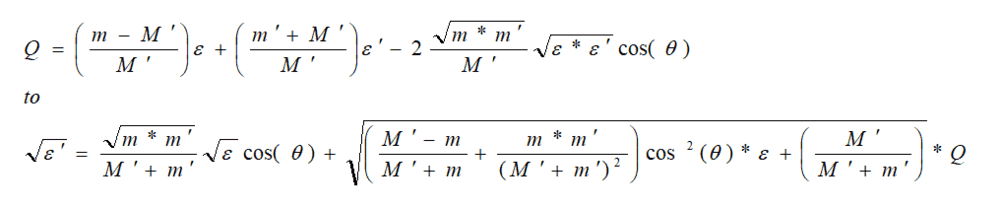
equation.png

i will appreciate any help .
thanks
 
Physics news on Phys.org
Have you tried the substitution ##\sqrt{\epsilon '}=x##? That should give you a quadratic equation in ##x##. I have not done it, but that's what I would try first.

Edit: It looks like ##Q## must be under the radical to make the units come out right.
 
Last edited:
kuruman said:
Have you tried the substitution ##\sqrt{\epsilon '}=x##? That should give you a quadratic equation in ##x##. I have not done it, but that's what I would try first.

Edit: It looks like ##Q## must be under the radical to make the units come out right.
thanks a lot it worked :smile:
 

Similar threads

Replies
8
Views
2K
  • · Replies 5 ·
Replies
5
Views
2K
Replies
1
Views
2K
  • · Replies 3 ·
Replies
3
Views
2K
  • · Replies 1 ·
Replies
1
Views
2K
  • · Replies 21 ·
Replies
21
Views
2K
  • · Replies 2 ·
Replies
2
Views
4K
  • · Replies 1 ·
Replies
1
Views
717
  • · Replies 2 ·
Replies
2
Views
2K
Replies
12
Views
3K