The Set of Borel Sets .... Axler Pages 28-29 .... ....

  • Context: MHB 
  • Thread starter Thread starter Math Amateur
  • Start date Start date
  • Tags Tags
    Set Sets
Click For Summary
SUMMARY

The discussion centers on the properties of Borel sets as outlined in Sheldon Axler's "Measure, Integration & Real Analysis." Participants clarify that the set of all intersections of open sets is not a Borel set because it fails to be closed under countable unions. Additionally, the set of all countable unions of countable intersections of open subsets of ℝ is not a Borel set due to its lack of closure under countable intersections. The concept of $G_\delta$ sets is introduced, illustrating that while the rational numbers are Borel sets, they do not qualify as $G_\delta$ sets.

PREREQUISITES
  • Understanding of Borel sets and their properties
  • Familiarity with $\sigma$-algebras in measure theory
  • Knowledge of $G_\delta$ sets and their significance
  • Basic concepts of real analysis, particularly open sets and intersections
NEXT STEPS
  • Study the properties of $\sigma$-algebras in depth
  • Learn about the construction and implications of $G_\delta$ sets
  • Explore examples of sets that are Borel but not $G_\delta$
  • Investigate the hierarchy of set classes beyond Borel sets
USEFUL FOR

Mathematicians, students of real analysis, and anyone interested in the foundational aspects of measure theory and set theory.

Math Amateur
Gold Member
MHB
Messages
3,920
Reaction score
48
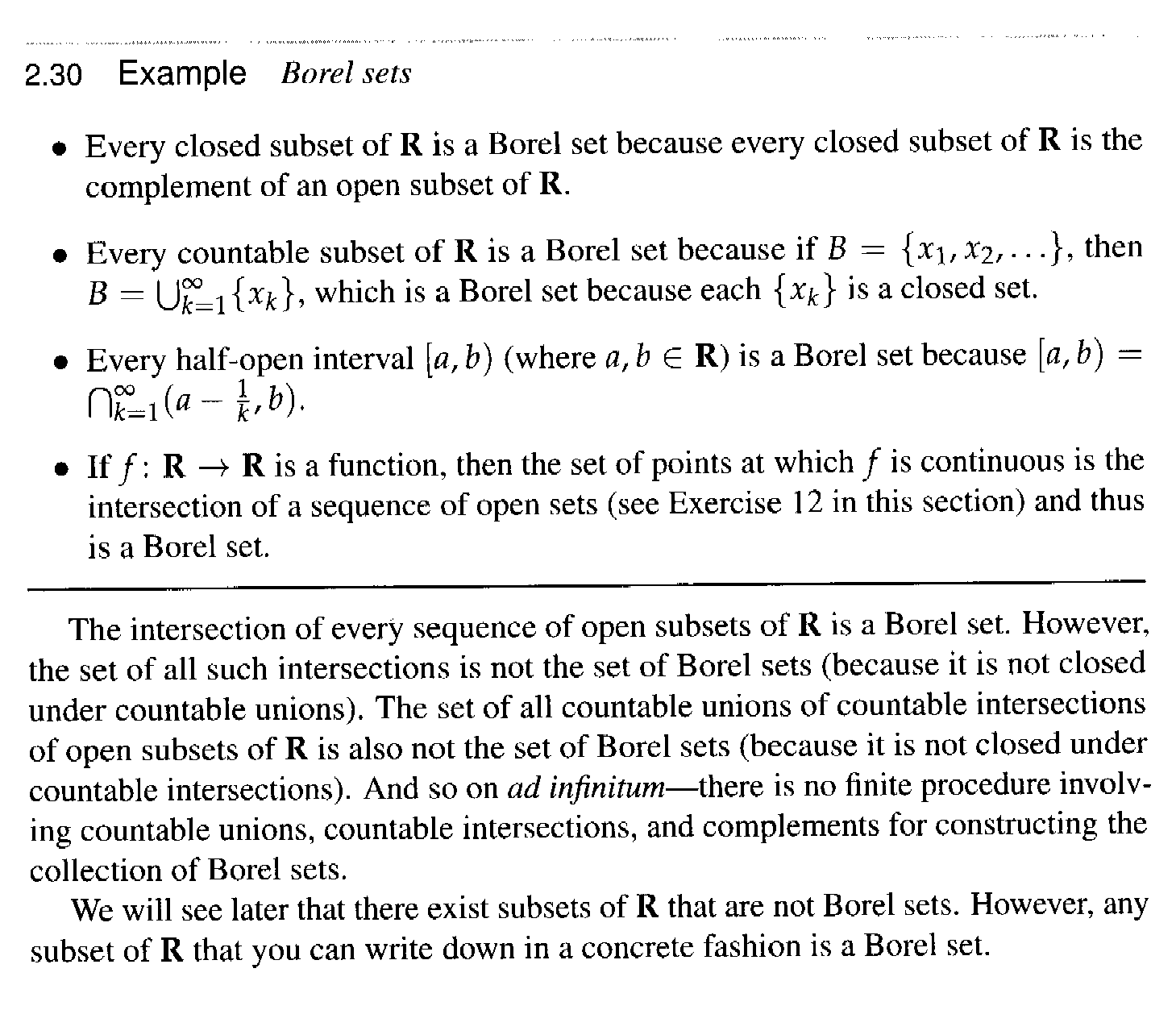
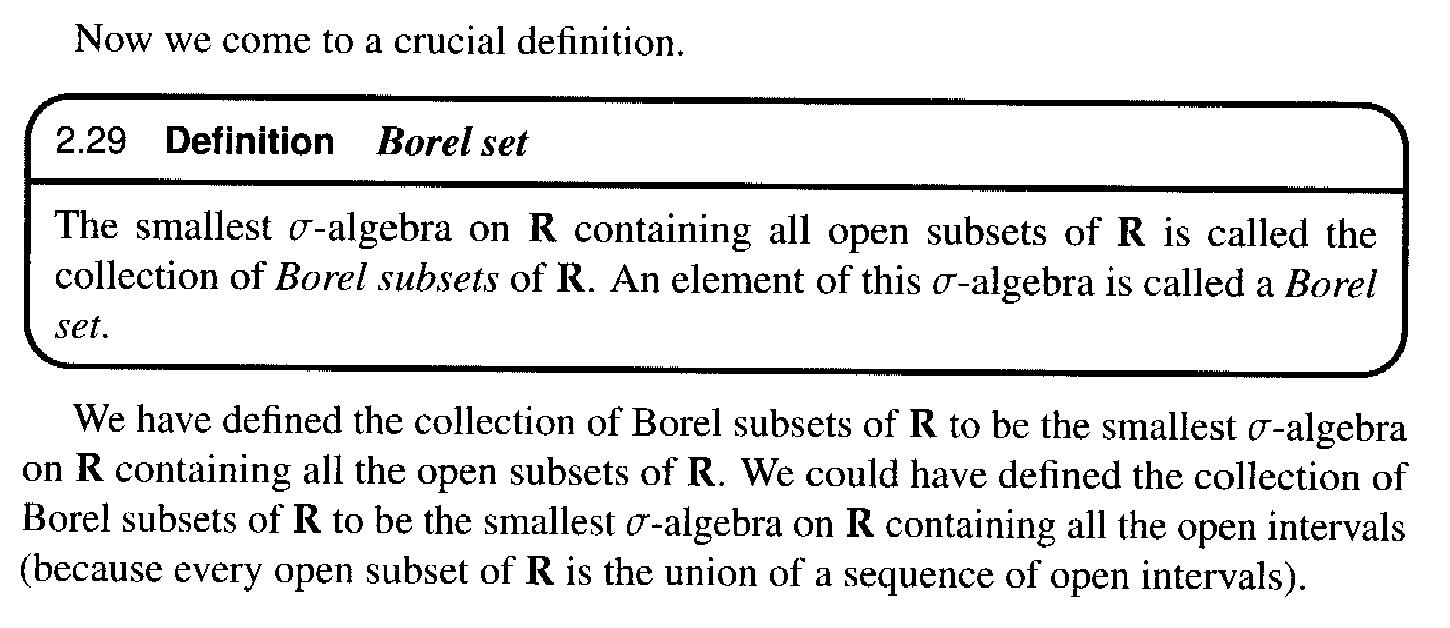
I am reading Sheldon Axler's book: Measure, Integration & Real Analysis ... and I am focused on Chapter 2: Measures ...

I need help in order to fully understand the set of Borel sets ... ...

The relevant text reads as follows:
Axler - 1 - Borel Sets ... PART 1 ... .png

Axler - 2 - Borel Sets ... PART 2 ... .png

My questions related to the above text are as follows:QUESTION 1

In the above text by Axler we read the following:

" ... ... However, the set of all such intersections is not the set of Borel sets (because it is not closed under countable unions). ... ..."Can someone please explain why exactly that the set of all such intersections is not the set of Borel sets ... ? Why exactly is such a set not closed under countable unions and why is this relevant?
QUESTION 2

In the above text by Axler we read the following:

" ... ... The set of all countable unions of countable intersections of open subsets of $\mathbb{R}$ is also not the set of Borel sets (because it is not closed under countable intersections). ... ... "Can someone please explain why exactly that the set of all countable unions of countable intersections of open subsets of $\mathbb{R}$ is not the set of Borel sets ... ? Why exactly is such a set not closed under countable intersections and why is this relevant?
Help with the above two questions will be much appreciated ...

Peter
 
Physics news on Phys.org
WARNING! This question leads into difficult territory.

The Borel sets form a $\sigma$-algebra. So every countable union, and every countable intersection, of Borel sets is a Borel set. You might hope that, starting with the open sets, then adding all countable intersections of open sets, then all countable unions of those sets, then all countable intersections ... , and so on, you might be able to generate all Borel sets. But that is not so. It turns out the there is an infinite hierarchy of larger and larger classes of sets formed in that way.

A countable intersection of open sets is known as a $G_\delta$ set. For example, a set consisting of a single point is a $G_\delta$ set. Since the set of rational numbers $\Bbb{Q}$ is countable, $\Bbb{Q}$ is a countable union of Borel sets and is therefore a Borel set. But $\Bbb{Q}$ is not a $G_\delta$ set (as shown in that Wikipedia link). After that, the examples get rapidly more complicated. The set of all $x$ for which $$\lim_{n\to\infty}\sin(n!\pi x) = 0$$ is a countable union of $G_\delta$ sets but is not itself a $G_\delta$ set (see here). That answers your Question 1.

I do not think that Sheldon Axler is expecting you to construct such examples yourself.
 
Opalg said:
WARNING! This question leads into difficult territory.

The Borel sets form a $\sigma$-algebra. So every countable union, and every countable intersection, of Borel sets is a Borel set. You might hope that, starting with the open sets, then adding all countable intersections of open sets, then all countable unions of those sets, then all countable intersections ... , and so on, you might be able to generate all Borel sets. But that is not so. It turns out the there is an infinite hierarchy of larger and larger classes of sets formed in that way.

A countable intersection of open sets is known as a $G_\delta$ set. For example, a set consisting of a single point is a $G_\delta$ set. Since the set of rational numbers $\Bbb{Q}$ is countable, $\Bbb{Q}$ is a countable union of Borel sets and is therefore a Borel set. But $\Bbb{Q}$ is not a $G_\delta$ set (as shown in that Wikipedia link). After that, the examples get rapidly more complicated. The set of all $x$ for which $$\lim_{n\to\infty}\sin(n!\pi x) = 0$$ is a countable union of $G_\delta$ sets but is not itself a $G_\delta$ set (see here). That answers your Question 1.

I do not think that Sheldon Axler is expecting you to construct such examples yourself.
Thanks Opalg ...

Still reflecting on what you have written ...

But ... could you help a bit further ...

You write:

" ... ... A countable intersection of open sets is known as a $G_\delta$ set. For example, a set consisting of a single point is a $G_\delta$ set. ... "

Could you please demonstrate how/why a set consisting of a single point is a $G_\delta$ set. ...EDIT ...

It's OK ... we have

$\{x\}= \bigcap_{n=1}^\infty(x-1/n, x+1/n)$ ...

So $\{x\}$ is a $G_\delta$ set ...

Peter
 
Last edited:

Similar threads

  • · Replies 2 ·
Replies
2
Views
4K
  • · Replies 2 ·
Replies
2
Views
1K
  • · Replies 1 ·
Replies
1
Views
2K
  • · Replies 2 ·
Replies
2
Views
2K
  • · Replies 5 ·
Replies
5
Views
4K
  • · Replies 5 ·
Replies
5
Views
2K
  • · Replies 2 ·
Replies
2
Views
1K
  • · Replies 2 ·
Replies
2
Views
3K
  • · Replies 3 ·
Replies
3
Views
2K
  • · Replies 2 ·
Replies
2
Views
2K