The sum of 1-2+3-4+5 , and divergence

  • Context: Undergrad 
  • Thread starter Thread starter asd1249jf
  • Start date Start date
  • Tags Tags
    Divergence Sum
Click For Summary

Discussion Overview

The discussion revolves around the sum of the series 1-2+3-4+5..., exploring its divergence and the claim that it can be assigned a value of 1/4 through various summation methods. Participants examine the implications of divergent series and the validity of obtaining fractional results from natural numbers.

Discussion Character

  • Debate/contested
  • Mathematical reasoning
  • Conceptual clarification

Main Points Raised

  • Some participants express confusion about how a series of natural numbers can yield a fraction, questioning the validity of the result 1/4 when the series diverges.
  • Others mention alternative summation methods, such as Ramanujan summation, which can assign finite values to divergent series, including the claim that 1+2+3+... equals -1/12 in certain contexts.
  • A formal approach is presented that involves analytic continuation, suggesting that the series can be evaluated to yield 1/4 under specific conditions.
  • Some participants argue that the formal approaches leading to 1/4 seem unrealistic and challenge the concept of obtaining a fraction from an infinite series of integers.
  • Discussion includes Borel resummation as another method to derive the value of 1/4 from the series.
  • Concerns are raised about the philosophical implications of infinity and the nature of summation, with some participants asserting that infinite processes cannot yield finite results.

Areas of Agreement / Disagreement

Participants generally disagree on the validity of assigning a finite value to the divergent series, with multiple competing views on the interpretation and implications of various summation methods. The discussion remains unresolved regarding the legitimacy of these approaches.

Contextual Notes

Limitations include the dependence on definitions of convergence and divergence, as well as the unresolved nature of the mathematical steps involved in the alternative summation methods discussed.

asd1249jf
The sum of 1-2+3-4+5..., and divergence

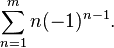
The sum of 1-2+3-4+5..., which can be written as
eafb2ac8a2afdfc37622ebf3898f7d50.png


Diverges for m = infinity, yet there are postulates that this is equal to \frac{1}{4}.

First, I don't understand how you can obtain a fraction out of a natural numbers if they are consecutively added, regardless of if the number is positive or negative.

Second, I don't understand how this is equal to 1/4, when the infinite series diverges. Can anyone help me understand this postulate?
 
Physics news on Phys.org
there was a another post dealing with what might be a similar issue - the harmonic series converging to -1/12 or something like that. (search for ramanujan summation)

The limit of partial sums here does not exist as the even partial sums goto negative infinity and the odd partial sums go2 infinity, so by using the theory of infinite series one typically learns in calculus/analysis classes, this definitely diverges.
 
Yes the thread Sid talks about is in fact my own. There are different methods of summation, and the most common one is defined as the limit of partial sums, which in this case it certainly diverges. However they have other methods of 'summation' which assign values to series that are divergent. Sometimes in physical instances, one needs to sum all the natural numbers, but expects a finite answer on finite grounds! It turns out that Ramanajan summation, a different method, assigns a value to it, -1/12, and it actually turns out to be a very nice answer within string theory because of the number of dimensions.

Anyway, There are other 'alternative' methods of summation, and some are actually quite good because for convergent series, they yield the same value as the regular limit of partial sums definition. So read up on different summation methods, some come to mind so as Caesaro, Ramanajan or Pade summations.
 
Formal approach:
1-2x+3x^2-4x^3+...=d/dx(-1+x-x^2+x^3-x^4+...)=d/dx(-1/(1+x))=1/(1+x)^2.

The above formalism holds for |x|<1. However, using analytic continuation (pole is at -1) we can evaluate it at x=1 and get 1/4.
 
l46kok said:
First, I don't understand how you can obtain a fraction out of a natural numbers if they are consecutively added, regardless of if the number is positive or negative.

Second, I don't understand how this is equal to 1/4, when the infinite series diverges. Can anyone help me understand this postulate?
In string theory, there's a summation of modes which amounts to 1+2+3+4+... Using regularization, it's computed to be -1/12.

That, just like your series, is computed by taking a function which 'works' for a given range and making it valid within the entire complex plane (analytic continuation). Here and there there will be poles, where the quantity is infinite but even there (like Zeta(-1) = 1+2+3+... = infinity) you can compute results by considering the value of the pole at that point.

Often, it turns out that the motivation for your summation (like the modes in string theory) is actually a little more elaborate than your initial naive assumptions and you can make your use of analytic continuation and poles rigorous.
 
Borel resummation:

\sum_{n=1}^{\infty}(-1)^{n+1}n=\sum_{n=1}^{\infty}(-1)^{n+1}\frac{n}{n!}\int_{0}^{\infty}dx x^{n}\exp\left(-x\right)=\int_{0}^{\infty}dx x\exp\left(-x\right)\sum_{n=0}^{\infty}(-1)^{n}\frac{x^{n}}{n!}=\int_{0}^{\infty}dx x\exp\left(-2x\right)=\frac{1}{4}
 
I don't understand, the formal approaches I've seen so far may indeed give 1/4, but realistically, that is impossible. How do you obtain a fraction out of a continuous addition/substraction of pure integers? Analytically, it's impossible.
 
The alternative forms of summation are summing the terms in different ways than just adding and subtracting, it a way its giving the average value of the partial sums, even if the partial sums don't converge.
 
l46kok said:
I don't understand, the formal approaches I've seen so far may indeed give 1/4, but realistically, that is impossible. How do you obtain a fraction out of a continuous addition/substraction of pure integers? Analytically, it's impossible.

This never makes any sense.
i.e a finite sequence {1,2,3,4,5,6,7,..., n} are integers for all n integers. If we let n goes to infinity, why is infinity not integer? Again, infinite is a concept. We force it to have a meaning that is not possible in reality. Nothing is infinitely small or large.
 
Last edited:

Similar threads

  • · Replies 5 ·
Replies
5
Views
3K
  • · Replies 14 ·
Replies
14
Views
2K
  • · Replies 20 ·
Replies
20
Views
3K
  • · Replies 6 ·
Replies
6
Views
2K
  • · Replies 3 ·
Replies
3
Views
2K
  • · Replies 37 ·
2
Replies
37
Views
5K
  • · Replies 2 ·
Replies
2
Views
2K
  • · Replies 0 ·
Replies
0
Views
3K
  • · Replies 10 ·
Replies
10
Views
4K
  • · Replies 7 ·
Replies
7
Views
3K