Thermal radiation inside a cooler

Click For Summary
SUMMARY

This discussion focuses on the effectiveness of foil liners in maintaining low temperatures within packaging during transit, particularly for food items. The calculations presented utilize an emissivity of 0.05 and consider both conduction and radiation, with a specific example yielding a radiation value of 4 watts. The conversation highlights the importance of temperature differences, suggesting that using the outside surface temperature of the package rather than the internal air temperature can significantly impact thermal performance. Additionally, the discussion references practical experiments with aluminum foil and insulation layers, emphasizing the need for a multi-layer approach to optimize thermal retention.

PREREQUISITES
  • Understanding of thermal conduction and radiation principles
  • Familiarity with emissivity and its impact on heat transfer
  • Basic knowledge of thermodynamic principles related to insulation
  • Experience with mathematical modeling of thermal systems
NEXT STEPS
  • Research the impact of emissivity on thermal radiation calculations
  • Explore advanced insulation materials and their thermal properties
  • Learn about multi-layer insulation techniques in packaging design
  • Investigate the effects of environmental factors, such as sunlight, on thermal performance
USEFUL FOR

Packaging engineers, thermal management specialists, and anyone involved in the design of temperature-sensitive shipping solutions will benefit from this discussion.

pks
I am trying to calculate how much a foil liner helps keep the inside of a package cool. I have calculated the rate of conduction but am now concerned with radiation.
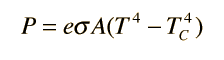
stef3.gif

Above is the equation I am using. The emissivity for the material is 0.05, the area is 1 m^2, the outside air temp is 295 degree K, the air temp inside the package is 280 degrees K. This gives a value of 4 watts. Is using the air temp an over simplification or should I be using the outside surface temp of the package? I am trying to create a mathematical model that is as close as possible. Is there anything else I should be looking at?

Thanks in advance.
 
Last edited by a moderator:
Science news on Phys.org
Your calculation is reasonably good. Is it simply a single layer of foil, or do you have a layer of insulation right below that? If the outside temperature of the foil liner (which is the number you put in for ## T_C ##) is at a temperature closer to 295 K, rather than at 280 K, it would aid considerably in keeping the inside cool, both from a radiation standpoint, as well as from thermal conduction. Meanwhile, I presume the package is not sitting in direct sunlight. Even some indirect sunlight could cause the numbers to go up.
 
I am testing several different materials like foam and bubble wrap with a foil coating. The foil will face outward toward the heat so it should be warmer. The package in testing won't be in direct sunlight but in real world it will at times. So there's nothing else to consider besides conduction and radiation then? Thanks for your response.
 
Based on your title it sounds like you want to wrap something that is already in a cooler with foil. In that case, the temperature difference is approximately zero and the radiation therefore also approximately zero.
 
  • Like
Likes   Reactions: Charles Link
russ_watters said:
Based on your title it sounds like you want to wrap something that is already in a cooler with foil. In that case, the temperature difference is approximately zero and the radiation therefore also approximately zero.

I am determining the effectiveness of foil coatings on foam and different products and how they keep packaging contents like food cool during transit. Sorry for the confusion in the title.
 
One time in college in a chemistry laboratory exercise on calorimetry, we did an experiment where we wrapped the system (in a glass bottle) in aluminum foil to insulate it from radiative heat transfer and observed the results. We still had considerable heat getting into the system. One of my classmates was clever and, as I recall, he put a layer of cotton around the layer of aluminum foil, and then put on a second layer of foil. He slowed the amount of heat that got into the system considerably. ## \\ ## In the case of thermos bottle design, I think some of the better ones use two layers of glass with silver coating with a vacuum in between them.
 
Charles Link said:
One time in college in a chemistry laboratory exercise on calorimetry, we did an experiment where we wrapped the system (in a glass bottle) in aluminum foil to insulate it from radiative heat transfer and observed the results. We still had considerable heat getting into the system. One of my classmates was clever and, as I recall, he put a layer of cotton around the layer of aluminum foil, and then put on a second layer of foil. He slowed the amount of heat that got into the system considerably. ## \\ ## In the case of thermos bottle design, I think some of the better ones use two layers of glass with silver coating with a vacuum in between them.
From what I have read so far that's because foil won't stop thermal conduction, just radiation. I'm going to have either a layer of cardboard, then foil, then foam or foil, then cardboard, then foam. I think foil on the outermost layer will work the best. It's just a little harder to make because you need two separate packaging pieces.
 

Similar threads

  • · Replies 2 ·
Replies
2
Views
2K
  • · Replies 3 ·
Replies
3
Views
3K
  • · Replies 8 ·
Replies
8
Views
3K
  • · Replies 23 ·
Replies
23
Views
2K
  • · Replies 11 ·
Replies
11
Views
3K
  • · Replies 2 ·
Replies
2
Views
2K
  • · Replies 16 ·
Replies
16
Views
14K
  • · Replies 5 ·
Replies
5
Views
2K
  • · Replies 14 ·
Replies
14
Views
3K
  • · Replies 26 ·
Replies
26
Views
3K