Three charges arranged in equilateral triangle

Click For Summary
SUMMARY

The discussion focuses on calculating the electric potential at point P due to three charges arranged in an equilateral triangle and determining the speed of a fourth charge when released from that point. The electric potential at point P was calculated to be 68.482 kV using the formula U = kq/r. For the fourth charge of 6.73 μC, the speed when it moves infinitely far away was derived using conservation of energy principles, resulting in a speed of 5392.538 m/s. The discussion emphasizes the importance of understanding electric potential energy and boundary conditions in physics problems.

PREREQUISITES
  • Understanding of electric potential and electric fields
  • Familiarity with conservation of energy principles in physics
  • Knowledge of vector calculations in electric fields
  • Basic concepts of charge and mass in electrostatics
NEXT STEPS
  • Study the derivation of electric potential from point charges
  • Learn about conservation of energy in electrostatics
  • Explore vector addition in electric fields and potentials
  • Investigate the effects of charge mass on motion in electric fields
USEFUL FOR

Students and professionals in physics, particularly those studying electrostatics, electrical engineering, and anyone interested in understanding electric potential and energy conservation in charged systems.

FlipStyle1308
Messages
264
Reaction score
0
The three charges are held in place below. L = 1.40 m.
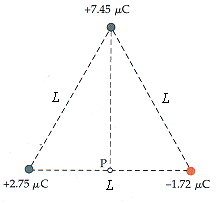
20-24alt.gif

(a) Find the electric potential at point P.
(b) Suppose that a fourth charge, with a charge of 6.73 μC and a mass of 4.71 g, is released from rest at point P. What is the speed of the fourth charge when it has moved infinitely far away from the other three charges?

For part (a), I am pretty sure that I use the equation U = kqoq/r, but don't know what to do next.
 
Physics news on Phys.org
I would start by calculating the electric field at P (remember that the electric field is a vector so you need the vector form) from there you should be able to do the problem.
 
So I use E = - V/r, right? How do I calculate this? I have to add values based on each charge, right? I don't know how to do this.
 
The geometry is deafening. Think 1/r^2.
 
Does this mean E = -V/r^2?
 
Bump! I just correctly calculated the electric potential at point P to be 68.482 kV. How do I solve part (b)?
 
Last edited:
I'm still stuck, is anyone able to help me figure out this last part of the question? Thanks.
 
If you know the potential at P, then you know the fourth charge's PE at P. You also know V at infinity, then use conservation of energy.
 
So the electric potential at point P = (1/2)mv^2, v = 5392.538 m/s? Do I need to incorporate the 6.73 x 10^-6 C at all?
 
Last edited:
  • #10
Yes, the potential energy is given by PE=qV.Then set that equal to 1/2 mv^2. Sorry if I wasn't clear on that.
 
  • #11
Okay, thanks!
 
  • #12
As Tomsk pointed out, establishing the global energy potential is the right place to start. It's all about entropy. Good explanation Tomsk. This is the guiding principle in almost all physics problems - define the boundary conditions.
 

Similar threads

Replies
5
Views
4K
Replies
17
Views
2K
Replies
5
Views
2K
  • · Replies 3 ·
Replies
3
Views
6K
  • · Replies 1 ·
Replies
1
Views
3K
  • · Replies 5 ·
Replies
5
Views
5K
Replies
6
Views
2K
Replies
15
Views
10K
  • · Replies 5 ·
Replies
5
Views
2K
Replies
5
Views
6K