Three charges attached to the vertices of a triangle

  • Thread starter Thread starter LCSphysicist
  • Start date Start date
  • Tags Tags
    Charges Triangle
Click For Summary

Homework Help Overview

The discussion revolves around the arrangement of three charges at the vertices of a triangle and the exploration of potential positions for a fourth charge where the net force is zero. The participants are examining the conditions under which such positions may exist, particularly in relation to the symmetry of the charge configuration.

Discussion Character

  • Exploratory, Assumption checking, Conceptual clarification

Approaches and Questions Raised

  • Some participants question whether a position for the fourth charge exists outside the symmetry axis and express a desire to avoid numerical methods. Others suggest that mathematical analysis is necessary to gain insight into the problem. There is also discussion about the implications of the charge polarity of the fourth ion and its effect on the existence of null force points.

Discussion Status

The conversation is ongoing, with participants exploring different interpretations of the problem. Some have sketched field lines and proposed the existence of saddle points, while others emphasize the need for mathematical reasoning. There is no explicit consensus on the number of null force points or the significance of the test ion's charge polarity.

Contextual Notes

Participants note that the original question does not specify the charge of the fourth ion or the number of null force points, leading to various interpretations and assumptions about the problem setup.

LCSphysicist
Messages
644
Reaction score
163
Homework Statement
Two positive ions and one negative ion are fixed at the vertices of
an equilateral triangle. Where can a fourth ion be placed, along the
symmetry axis of the setup, so that the force on it will be zero? Is
there more than one such place? You will need to solve something
numerically.
Relevant Equations
Coulomb's Law would be enough.
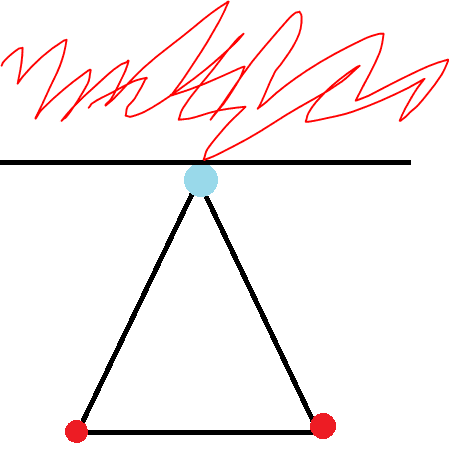
Actually we find the two position in the axis very easily, but, what am trying to find is if exist such position (Being the charge of the ions equal) away from the symmetry axis, but i really don't want to try find it numerically, it would be a disaster.
The only conclusion i got is, if such position exist, it should be somewhere in the red region of the figure:
1598718243200.png

The blue charge is negative
The red positive.

There is a way to prove if exist or not this position? Without the math would arise?
 
Physics news on Phys.org
You will need to use math.

Solving a similar example problem, with the algebra and trig being performed on symbols (saving the numerical substitution for the last step), may provide you with the insight you need for this homework problem.

See this solution, and don't just read it. Instead work it out on paper.
https://www.ux1.eiu.edu/~cfadd/1360/23EFields/Ch23Hmwk/23.17.html
 
  • Like
Likes   Reactions: LCSphysicist
I sketched the field lines. It seems to me there can only be the two saddle points.
 
  • Like
Likes   Reactions: LCSphysicist
Note that the question does not specify the sign of the "test" ion. It simply calls it "a fourth ion". It also doesn't ask for how many null force points exist, only if there is more than one.

Presumably, given the geometry of the setup, there must be at least one such point for a given test ion. So if there are two choices of charge polarity for the test ion, there must be at least two such points...
 
  • Skeptical
Likes   Reactions: hutchphd
gneill said:
Note that the question does not specify the sign of the "test" ion. It simply calls it "a fourth ion". It also doesn't ask for how many null force points exist, only if there is more than one.

Presumably, given the geometry of the setup, there must be at least one such point for a given test ion. So if there are two choices of charge polarity for the test ion, there must be at least two such points...
I don't see how the polarity of the test ion matters. A zero field is a zero field.

Assuming all three charges have the same magnitude, there will will always be a saddle point in the potential near the midpoint between the two like charges, just a little further away than that from the third charge, and another on the far side of that third charge, roughly twice as far from the like charges as from the third charge.

For each of the combinations of of one charge and one saddle point, there is a unique field line connecting them. Using the diagram layout, there is a field line from the lower left charge to each saddle point, and a straight field line from each of those to the top charge. Together, these lines bound roughly a semicircle. Inside that, all field lines run from the lower left charge to the top charge. This leaves no possibility of another saddle point in that region.
Etc.
 
  • Like
Likes   Reactions: CPW and hutchphd

Similar threads

  • · Replies 1 ·
Replies
1
Views
1K
Replies
21
Views
2K
Replies
11
Views
4K
Replies
5
Views
2K
  • · Replies 3 ·
Replies
3
Views
3K
  • · Replies 11 ·
Replies
11
Views
2K
  • · Replies 5 ·
Replies
5
Views
5K
  • · Replies 2 ·
Replies
2
Views
2K
Replies
8
Views
3K
  • · Replies 3 ·
Replies
3
Views
10K