Time Dependent Sinusoidal Perturbation Energy Conservation

Click For Summary
SUMMARY

The discussion centers on the transition probability formula for quantum states under time-dependent sinusoidal perturbations, specifically the equation $$P_{a \to b} = \frac{|V_{ab}|^2}{\hbar^2} \frac{\sin^2[(\omega - \omega_0) t]}{(\omega - \omega_0)^2}$$ as presented in Griffiths' "Introduction to QM". Participants clarify that this formula represents the transition probability between fixed states ##a## and ##b##, even when the driving frequency ##\omega## differs from the system's natural frequency ##\omega_0##. The non-zero transition probability for frequencies not equal to ##\omega_0## is attributed to the time-dependent nature of the perturbation, allowing energy conservation to be temporarily violated.

PREREQUISITES
  • Understanding of quantum mechanics principles, particularly transition probabilities.
  • Familiarity with perturbation theory in quantum mechanics.
  • Knowledge of Fourier transforms and their application in quantum systems.
  • Basic grasp of energy conservation in quantum transitions.
NEXT STEPS
  • Study the implications of time-dependent perturbations in quantum mechanics.
  • Learn about the adiabatic switching method and its role in transition rates.
  • Explore the concept of Fourier transforms in the context of quantum state transitions.
  • Investigate the relationship between driving frequency and transition probabilities in quantum systems.
USEFUL FOR

Quantum physicists, graduate students in quantum mechanics, and researchers exploring time-dependent perturbation theory and transition probabilities in quantum systems.

Samama Fahim
Messages
52
Reaction score
4
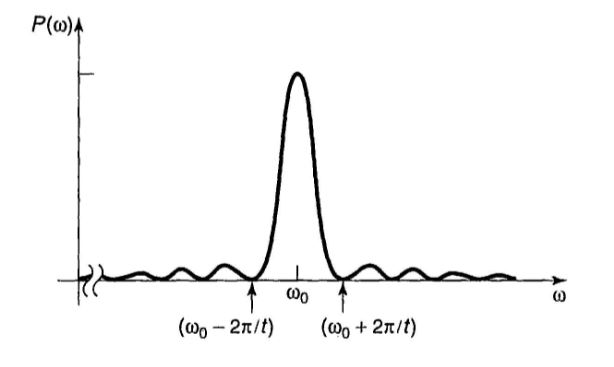
The transition probability -- the probability that a particle which started out in the state ##\psi_a## will be found, at time ##t##, in the state ##\psi_b## -- is

$$P_{a \to b} = \frac{|V_{ab}|}{\hbar^2} \frac{sin^2[(\omega_0 - \omega)t/2]}{(\omega_0 - \omega^2}.$$
dava.JPG


(Griffiths, Introduction to QM, p. 346)

Questions:
1) Does ##P_{a \to b}## represent transition probability or transition probability density? In the figure above, ##P## is plotted as a function of driving frequency. If ##P(\omega)## represents probability density (i.e. probability per unit frequency interval) then the area under this curve should be the total probability. Otherwise, the plot just gives us probabilities for transitions between the fixed states ##a## and ##b## for different sinusoidal perturbation frequencies ##\omega##. Which is correct?

2) From the figure we can see that there is a non-zero transition probability for driving frequencies not equal to ##\omega_0##. This would correspond, for example, to photons having energies less than ##\hbar \omega_0## provoking transitions that require energy ##\hbar \omega_0##. Why is that?
 
Physics news on Phys.org
The formula should read
$$P_{a \rightarrow b}=\frac{|V_{ab}|^2}{\hbar^2} \frac{\sin^2[(\omega-\omega_0) t]}{(\omega-\omega_0)^2}.$$
It is the transition probability at time ##t## to find the system in the energy eigenstate ##b## (of the unperturbed system) when it was in energy eigenstate ##a## at time ##t=0##.

Energy is not conserved here, because the perturbation is time dependent. Thus there's some probability for transitions where ##\omega \neq \omega_0##, but note that for ##t \rightarrow \infty## you'll get a corresponding energy-conserving ##\delta## distribution. That then describes, with the correct adiabatic-switching regulator applied, the transition rate (!) (average transition probability per unit time) for transitions between asymptotic free states, where the perturbative interaction is switched on and off adiabatically.
 
  • Like
Likes   Reactions: Samama Fahim
vanhees71 said:
The formula should read
$$P_{a \rightarrow b}=\frac{|V_{ab}|^2}{\hbar^2} \frac{\sin^2[(\omega-\omega_0) t]}{(\omega-\omega_0)^2}.$$
It is the transition probability at time ##t## to find the system in the energy eigenstate ##b## (of the unperturbed system) when it was in energy eigenstate ##a## at time ##t=0##.

Energy is not conserved here, because the perturbation is time dependent. Thus there's some probability for transitions where ##\omega \neq \omega_0##, but note that for ##t \rightarrow \infty## you'll get a corresponding energy-conserving ##\delta## distribution. That then describes, with the correct adiabatic-switching regulator applied, the transition rate (!) (average transition probability per unit time) for transitions between asymptotic free states, where the perturbative interaction is switched on and off adiabatically.
Does this formula give the probability for transition between fixed states ##a## and ##b##?
 
  • Like
Likes   Reactions: vanhees71
vanhees71 said:
The formula should read
$$P_{a \rightarrow b}=\frac{|V_{ab}|^2}{\hbar^2} \frac{\sin^2[(\omega-\omega_0) t]}{(\omega-\omega_0)^2}.$$
It is the transition probability at time ##t## to find the system in the energy eigenstate ##b## (of the unperturbed system) when it was in energy eigenstate ##a## at time ##t=0##.

Energy is not conserved here, because the perturbation is time dependent. Thus there's some probability for transitions where ##\omega \neq \omega_0##, but note that for ##t \rightarrow \infty## you'll get a corresponding energy-conserving ##\delta## distribution. That then describes, with the correct adiabatic-switching regulator applied, the transition rate (!) (average transition probability per unit time) for transitions between asymptotic free states, where the perturbative interaction is switched on and off adiabatically.
Maybe if the electron gets energy ##\hbar \omega < \hbar \omega_0## for a long time, it is able to make the transition from ##a## to ##b##. Is that why the probability for such transitions is non-zero?
 
vanhees71 said:
The formula should read
$$P_{a \rightarrow b}=\frac{|V_{ab}|^2}{\hbar^2} \frac{\sin^2[(\omega-\omega_0) t]}{(\omega-\omega_0)^2}.$$
It is the transition probability at time ##t## to find the system in the energy eigenstate ##b## (of the unperturbed system) when it was in energy eigenstate ##a## at time ##t=0##.

Energy is not conserved here, because the perturbation is time dependent. Thus there's some probability for transitions where ##\omega \neq \omega_0##, but note that for ##t \rightarrow \infty## you'll get a corresponding energy-conserving ##\delta## distribution. That then describes, with the correct adiabatic-switching regulator applied, the transition rate (!) (average transition probability per unit time) for transitions between asymptotic free states, where the perturbative interaction is switched on and off adiabatically.
The problem here is not whether the Hamiltonian is conserved. How is it possible for photons of energy less than the energy between the states ##a## and ##b## to provoke transitions between these states?
 
Even if the frequency for t>0 is fixed, if you do a Fourier transform of the whole time dependence of the electric field, it will contain all frequencies. You simply don't have monochromatic photons, if the wavetrain is not infinitely long.
 
  • Like
Likes   Reactions: Samama Fahim and vanhees71
DrDu said:
Even if the frequency for t>0 is fixed, if you do a Fourier transform of the whole time dependence of the electric field, it will contain all frequencies. You simply don't have monochromatic photons, if the wavetrain is not infinitely long.
The plot shows how ##P(\omega)##, i.e., the probability of transition from a fixed state ##a## to a fixed state ##b## changes with ##\omega##, the driving frequency. If that is correct, then it should be possible for a given driving frequency ##\omega < \omega_0## to provoke a transition between the states ##a## and ##b##, which would require ##\hbar \omega_0##. But as you say, even this ##\omega < \omega_0## can be "broken up" into all sorts of frequencies that will provide the required transition energy ##\hbar \omega_0##. Is that correct?
 

Similar threads

  • · Replies 1 ·
Replies
1
Views
2K
  • · Replies 7 ·
Replies
7
Views
2K
  • · Replies 2 ·
Replies
2
Views
1K
  • · Replies 1 ·
Replies
1
Views
1K
  • · Replies 15 ·
Replies
15
Views
3K
Replies
3
Views
2K
  • · Replies 1 ·
Replies
1
Views
979
  • · Replies 10 ·
Replies
10
Views
2K
  • · Replies 2 ·
Replies
2
Views
2K
  • · Replies 2 ·
Replies
2
Views
2K