Time evolution of an expectation value

Click For Summary
SUMMARY

The discussion centers on deriving the time evolution of an expectation value in quantum mechanics, specifically using the Schrödinger equation, ##i\hbar \partial_t \psi = \widehat H \psi##. Participants debate the implications of setting ##\hbar = c = 1##, a common practice in high-energy physics, and its impact on clarity versus mathematical rigor. The conversation also touches on the use of linear algebra notation for quantum states and the treatment of operators like ##\partial_t##. Ultimately, the consensus is that while constants can obscure relationships, they are essential for displaying classical limits.

PREREQUISITES
  • Understanding of the Schrödinger equation in quantum mechanics
  • Familiarity with linear algebra notation in quantum states
  • Knowledge of Hermitian operators and their properties
  • Concept of natural units in high-energy physics
NEXT STEPS
  • Study the derivation of expectation values in quantum mechanics
  • Learn about the implications of using natural units in physics
  • Explore the properties of Hermitian operators in quantum mechanics
  • Investigate the role of dimensional analysis in theoretical physics
USEFUL FOR

Students and professionals in quantum mechanics, physicists working in high-energy contexts, and anyone interested in the mathematical foundations of quantum theory.

jaurandt
Messages
24
Reaction score
0
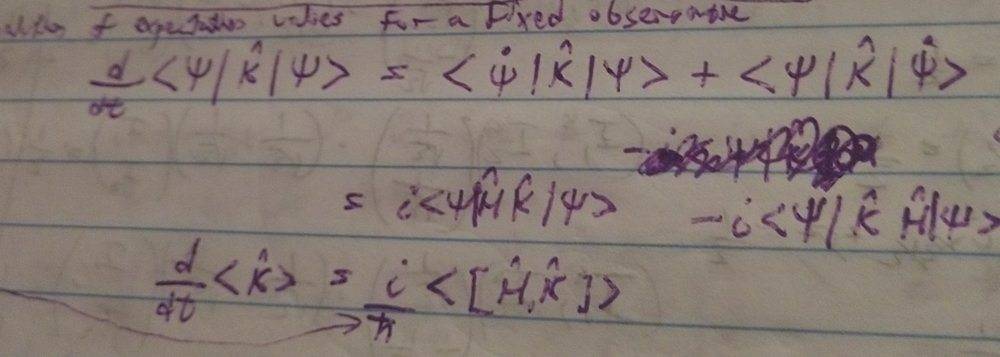
Watching Dr. Susskind show how to find the time evolution of the average of an observable K, he writes:
241199


I can not for the life of me figure out he derived it, and he also did something which I found terribly annoying throughout which is set hbar to 1, so after steps you lose where the hbar goes. Can anyone help me figure out how this is derived?
 
Physics news on Phys.org
Apply on the left the product rule twice and use twice the Schrödinger equation ##i\hbar \partial_t \psi = \widehat H \psi##.
 
A. Neumaier said:
Apply on the left the product rule twice and use twice the Schrödinger equation ##i\hbar \partial_t \psi = \widehat H \psi##.

Thanks for your reply. That much I do understand, but what I don't understand is how doing that could ever produce a -i since H is obviously Hermitian and can act on either side...
 
Setting ##\hbar = c = 1## is standard unit convention in high-energy physics. It is just a matter of what unit system you choose to work in and natural units are by far the most convenient. You can always go back to a unit system where this is not the case by using dimensional analysis to insert the appropriate powers of ##\hbar## and ##c##.
 
  • Like
Likes   Reactions: PeroK
jaurandt said:
Thanks for your reply. That much I do understand, but what I don't understand is how doing that could ever produce a -i since H is obviously Hermitian and can act on either side...
But bras are conjugated, hence on the bra side, ##1/i=-i## becomes ##i##.
 
A. Neumaier said:
But bras are conjugated, hence on the bra side, ##1/i=-i## becomes ##i##.

So I am wrong in saying
(i)(hbar)d/dt<psi| = <psi|H ? I'm sorry I'm brand new to this forum and I don't know how to create the symbols.
 
Orodruin said:
Setting ##\hbar = c = 1## is standard unit convention in high-energy physics. It is just a matter of what unit system you choose to work in and natural units are by far the most convenient. You can always go back to a unit system where this is not the case by using dimensional analysis to insert the appropriate powers of ##\hbar## and ##c##.

Maybe it'll come more naturally to me eventually, but dimensional analysis seems to confuse me more than just leaving in the constants.
 
jaurandt said:
I don't know how to create the symbols.
Use standard latex but with two hash signs in place of single dollars (but keep double dollars). You can look at how I did it by clicking on the reply button of my post.
jaurandt said:
So I am wrong in saying(i)(hbar)d/dt<psi| = <psi|H ?
Yes. It is easiest to see if you use linear algebra notation, i.e., ##\psi=|\psi\rangle## (viewed as a column vector) and ##\psi^*=\langle\psi|## (viewed as the conjugate transposed row vector). Then $$i\hbar \partial_t \psi^*=-(i\hbar \partial_t \psi)^*=-(H\psi)^*=-\psi^*H.$$
 
  • Like
Likes   Reactions: Orodruin
jaurandt said:
Maybe it'll come more naturally to me eventually, but dimensional analysis seems to confuse me more than just leaving in the constants.
After getting used to it, leaving the constants will just annoy you to the extreme as they add nothing of value to the physics and just act to obscure the mathematical relationships.
 
  • #10
Orodruin said:
After getting used to it, leaving the constants will just annoy you to the extreme as they add nothing of value to the physics and just act to obscure the mathematical relationships.
I don't agree. After 28 years of doing quantum mechanics I still like to write them each time (and am pleased if others do so, too). It displays the classical limit ##\hbar\to 0## and the nonrelativistic limit ##c^{-1}\to 0## very naturally. Writing ##\iota:=i/\hbar## and ##x_0=ct## in the formulas is almost as easy as writing ##i## and ##x_0=t## preserves the units.
 
  • Like
Likes   Reactions: DrClaude
  • #11
A. Neumaier said:
I don't agree. After 28 years of doing quantum mechanics I still like to write them each time (and am pleased if others do so, too). It displays the classical limit ##\hbar\to 0## and the nonrelativistic limit ##c^{-1}\to 0## very naturally. Writing ##\iota:=i/\hbar## and ##x_0=ct## in the formulas is almost as easy as writing ##i## and ##x_0=t## preserves the units.
To each his (or her) own. To me, it is just clutter. Typically the non-relativistic and classical limits can be considered in other ways that do not involve ##c## or ##\hbar## and are more physical. Using ##c## or ##\hbar## is just a proxy.
 
  • #12
A. Neumaier said:
Use standard latex but with two hash signs in place of single dollars (but keep double dollars). You can look at how I did it by clicking on the reply button of my post.

Yes. It is easiest to see if you use linear algebra notation, i.e., ##\psi=|\psi\rangle## (viewed as a column vector) and ##\psi^*=\langle\psi|## (viewed as the conjugate transposed row vector). Then $$i\hbar \partial_t \psi^*=-(i\hbar \partial_t \psi)^*=-(H\psi)^*=-\psi^*H.$$

First of all, I agree with your most recent posts about the constants. And I just started my own course of study on QM about 2 months ago. Very rigorously I may add, as I spend almost all of my time doing it.

Second, your math implies that the adjoint of $$\partial_t$$ is $$\partial_t$$

Is this correct? Basically, I just wasn't conjugating i for the bra form? In other words

H|psi> = (i)(hbar)(d/dt)|psi>

Corresponds to

<psi|H = <psi|(d/dt)(hbar)(-i)

Is this correct?
 
  • #13
jaurandt said:
Your math implies that the adjoint of $$\partial_t$$ is $$\partial_t$$

Is this correct?
No. ##\partial_t ## is not an operator acting on the Hilbert space but on the t-dependence of the state. Its adjoint is not defined in this context.
 
  • Like
Likes   Reactions: dextercioby

Similar threads

  • · Replies 1 ·
Replies
1
Views
2K
  • · Replies 2 ·
Replies
2
Views
2K
  • · Replies 3 ·
Replies
3
Views
2K
  • · Replies 8 ·
Replies
8
Views
2K
  • · Replies 3 ·
Replies
3
Views
1K
  • · Replies 20 ·
Replies
20
Views
4K
  • · Replies 3 ·
Replies
3
Views
1K
  • · Replies 1 ·
Replies
1
Views
1K
  • · Replies 134 ·
5
Replies
134
Views
11K
  • · Replies 18 ·
Replies
18
Views
4K