Undergrad Time evolution of the electromagnetic wavefunction on a lattice

Click For Summary
SUMMARY

The forum discussion centers on the time evolution of the electromagnetic wavefunction on a lattice, specifically using Maxwell's equations and finite difference time domain (FDTD) methods. The update rules for the electric and magnetic fields are provided, demonstrating that certain initial conditions yield no time evolution, while others lead to instability. The conversation highlights the challenges of predicting behavior in complex systems and suggests that finite element analysis is a suitable approach for studying stability conditions in such equations.

PREREQUISITES
  • Understanding of Maxwell's equations and their application in electromagnetism.
  • Familiarity with finite difference time domain (FDTD) methods, specifically Yee's method.
  • Knowledge of finite element analysis techniques for stability analysis.
  • Basic grasp of Navier-Stokes equations and their application in fluid dynamics.
NEXT STEPS
  • Research the application of FDTD methods in electromagnetic simulations.
  • Explore finite element analysis techniques for stability analysis in complex systems.
  • Study the Navier-Stokes equations and their numerical solutions, particularly regarding stability issues.
  • Investigate advanced modeling techniques in fluid dynamics using the Navier-Stokes equations.
USEFUL FOR

This discussion is beneficial for physicists, computational scientists, and engineers involved in electromagnetic simulations, fluid dynamics, and numerical analysis of complex systems.

James1238765
Messages
120
Reaction score
8
TL;DR
Why does this time evolution of the electromagnetic wavefunction diverges?
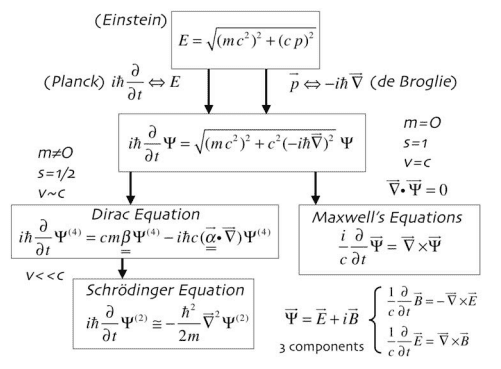
The Maxwell wavefunction of a photon is given in [here] as follows:
87635242.png

Because the curl operation mixes 3 different components, this wavefunction only works for a minimum of 3 space dimensions, with each grid point having 6 component numbers ##{E^1, E^2, E^3, B^1, B^2, B^3}##, and with the following update rules:

$$ E_{x,y,z}^1 = E_{x,y,z}^1 + B_{x,y+1,z}^3 - B_{x,y,z}^3 - B_{x,y,z+1}^2 + B_{x,y,z}^2$$
$$ E_{x,y,z}^2 = E_{x,y,z}^2 + B_{x,y,z+1}^1 - B_{x,y,z}^1 - B_{x+1,y,z}^3 + B_{x,y,z}^3$$
$$ E_{x,y,z}^3 = E_{x,y,z}^3 + B_{x+1,y,z}^2 - B_{x,y,z}^2 - B_{x,y+1,z}^1 + B_{x,y,z}^1$$
$$ B_{x,y,z}^1 = B_{x,y,z}^1 - E_{x,y+1,z}^3 + E_{x,y,z}^3 + E_{x,y,z+1}^2 - E_{x,y,z}^2$$
$$ B_{x,y,z}^2 = B_{x,y,z}^2 - E_{x,y,z+1}^1 + E_{x,y,z}^1 + E_{x+1,y,z}^3 - E_{x,y,z}^3$$
$$ B_{x,y,z}^3 = B_{x,y,z}^3 - E_{x+1,y,z}^2 + E_{x,y,z}^2 + E_{x,y+1,z}^1 - E_{x,y,z}^1$$

corresponding to ##\frac{dE}{dt} = \nabla x B## and ##\frac{dB}{dt} = - \nabla x E##

The complicated time evolution due to the mixing of the 6 components over time gives rise to complex behavior, which are not intuitive to predict.

1.
Setting E1 = 1 over all ##[x,y,z]## points in the 3 dimensional grid, and setting all other components E2, E3, B1, B2, B3 = 0 all over the grid, we obtain:
234523452.gif


with no time evolution of any components throughout the grid.

2.
Setting E1 = ##sin (\frac{x}{width}2\pi) ## over all [x,y,z] points in the grid, and setting all other components to 0, we obtain:
234523452.gif


still without time evolution.

3.
Setting Ei = ##sin (\frac{i}{width}2\pi) ## for all the 6 components:
23452345.gif


still produces no time evolution! The curl operation is rather finicky.

4.
Setting E1 = ##sin (\frac{x+y+z}{width}2\pi) ## and ## E2, E3, E4, E5, E6 = 0 ## everywhere:
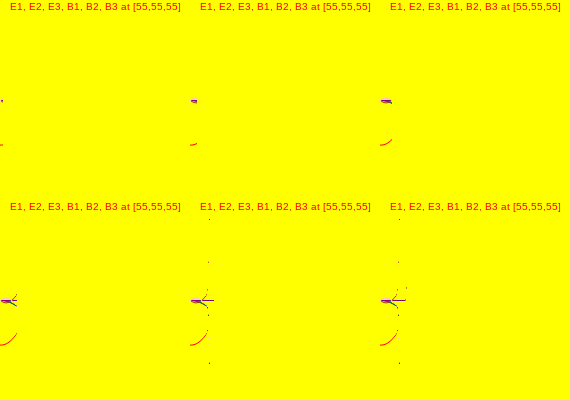
224352.gif


finally produces a time evolution.

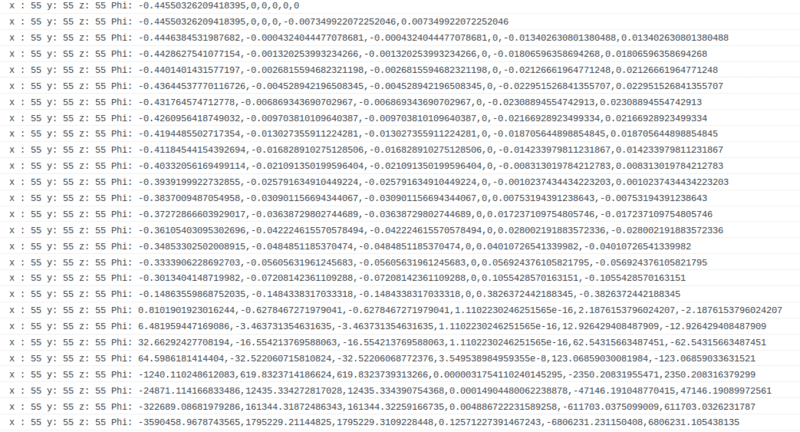
However the time evolution explodes partway, as shown in the chart, and the numerical data below.
23452345.png


I am unsure why this happens, because the update rules involve only additions (with no multiplications or other fancy operations)?
 
Last edited:
Mathematics news on Phys.org
I have my doubts about the maxwell wavefunction of the photon idea, but for Maxwell’s equations just from poking around the web, people seem to use FDTD (also called Yee’s method) for the discretization which staggers E and H in time and space.
 
  • Like
Likes James1238765
@Frabjous thank you. i am interested in these multi-dimensional cross relationships between lattice grid components over time. In the 8-components Dirac equation, a similar looking complicated time evolution relationship also exists between the individual components.

Is there a name for the mathematical branch that can analyze the behavior over time of these kind of self interacting components?
 
Sorry, I have not been exposed to that. My generic advice is that these are really ugly equations to solve in general. You need to get specific about the problem you are trying to solve and then try to find a technique. As you discovered above, stability conditions can kill you.
 
I would call this finite element analysis. FYI.... Folks usually don't start by solving eight component fields in four+ dimensions. Perhaps a more measured approach would serve you better?
 
@hutchphd I am familiar with the discretization and computation aspects using finite elements. Can finite elements methods also analyze for instance which initial conditions with be stable over time and which will not, *without doing the computation*? Can you link to which method in finite elements allows us to do this?
 
No I cannot. These are not easy and only rarely yield to clever analytic manipulation Nobel prizes have been sometimes involved.
 
@hutchphd thank you. You seem to hint towards the Navier Stokes wave, so while at it I translated the usual equations into the same notation as above for future reference. There are 3 velocity component numbers ##\{u, v, w\}## in the 3 dimensional Navier Stokes grid ##[x, y, z]##:

$$ \frac{du}{dt} = \frac{d^2u}{dx^2} + \frac{d^2u}{dy^2} + \frac{d^2u}{dz^2} - u\frac{du}{dx} - v\frac{du}{dy} - w\frac{du}{dz}$$
$$ \frac{dv}{dt} = \frac{d^2v}{dx^2} + \frac{d^2v}{dy^2} + \frac{d^2v}{dz^2} - u\frac{dv}{dx} - v\frac{dv}{dy} - w\frac{dv}{dz}$$
$$ \frac{dw}{dt} = \frac{d^2w}{dx^2} + \frac{d^2w}{dy^2} + \frac{d^2w}{dz^2} - u\frac{dw}{dx} - v\frac{dw}{dy} - w\frac{dw}{dz}$$

discretized into:

1. The u velocity component update:
$$\Phi_{x,y,z}^u = \Phi_{x,y,z}^u + \Phi_{x+1,y,z}^u - 2\Phi_{x,y,z}^u + \Phi_{x-1,y,z}^u + \Phi_{x,y+1,z}^u - 2\Phi_{x,y,z}^u + \Phi_{x,y-1,z}^u$$
$$+\Phi_{x,y,z+1}^u - 2\Phi_{x,y,z}^u + \Phi_{x,y,z-1}^u -\Phi_{x,y,z}^u (\Phi_{x+1,y,z}^u - \Phi_{x,y,z}^u) $$
$$-\Phi_{x,y,z}^v(\Phi_{x,y+1,z}^u - \Phi_{x,y,z}^u) -\Phi_{x,y,z}^w(\Phi_{x,y,z+1}^u - \Phi_{x,y,z}^u)$$

2. The v velocity component update:
$$\Phi_{x,y,z}^v = \Phi_{x,y,z}^v + \Phi_{x+1,y,z}^v - 2\Phi_{x,y,z}^v + \Phi_{x-1,y,z}^v +
\Phi_{x,y+1,z}^v - 2\Phi_{x,y,z}^v + \Phi_{x,y-1,z}^v$$
$$+\Phi_{x,y,z+1}^v - 2\Phi_{x,y,z}^v + \Phi_{x,y,z-1}^v -\Phi_{x,y,z}^u (\Phi_{x+1,y,z}^v - \Phi_{x,y,z}^v) $$
$$- \Phi_{x,y,z}^v(\Phi_{x,y+1,z}^v - \Phi_{x,y,z}^v) -\Phi_{x,y,z}^w(\Phi_{x,y,z+1}^v - \Phi_{x,y,z}^v)$$

3. The w velocity component update:
$$\Phi_{x,y,z}^w = \Phi_{x,y,z}^w + \Phi_{x+1,y,z}^w - 2\Phi_{x,y,z}^w + \Phi_{x-1,y,z}^w +\Phi_{x,y+1,z}^w - 2\Phi_{x,y,z}^w + \Phi_{x,y-1,z}^w $$
$$+\Phi_{x,y,z+1}^w - 2\Phi_{x,y,z}^w + \Phi_{x,y,z-1}^w -\Phi_{x,y,z}^u (\Phi_{x+1,y,z}^w - \Phi_{x,y,z}^w) $$
$$
-\Phi_{x,y,z}^v(\Phi_{x,y+1,z}^w - \Phi_{x,y,z}^w) -\Phi_{x,y,z}^w(\Phi_{x,y,z+1}^w - \Phi_{x,y,z}^w)$$

Yes, I can see the Nobels and Fields and Millennial Prizes lining up if anyone manages to analyze *that* thing.
 
Last edited:
No hint intended
 
  • #10
Here are a few resulting models based on the Navier Stokes wave:

1. The divergence encountered in the original post is likely due to known instability in the numerically computed

$$ \Phi_{x+1} - 2\Phi_{x} + \Phi_{x-1}$$

when done iteratively. An alternative method called Gauss-Seidel should be used to compute the same quantity.

2. A similar form of the Navier Stokes equations for density (in 2 dimensions) is:

$$ \frac{d\rho}{dt} = \frac{d^2\rho}{dx^2} + \frac{d^2\rho}{dy^2} - u\frac{d\rho}{dx} - v\frac{d\rho}{dy} + Source$$

Using only the diffusion part ##\frac{d^2\rho}{dx^2} + \frac{d^2\rho}{dy^2}##, we obtain:

2342234623.gif


3. Adding adjection ## - u\frac{d\rho}{dx} - v\frac{d\rho}{dy} ## to the previous model, we obtain:

2435234525.gif


4. Adding sources of density through ##Source## to the previous model, we obtain:

2938453265.gif


5. Adding nonlinear vector diffusion evolution to the velocity field, plus advection based on a secondary "velocity-of-velocity" field, plus external sources of velocity, in addition to as previously evolving the density field, we get:

234956827345.gif


A lot more modeling seems possible with familiarity and expertise in fluid modeling using Navier Stokes equations.

6. The Millennium Problem description for Navier Stokes seems to be about analytic solutions to the equations and their properties:

91827341698245.png
 

Similar threads

  • · Replies 1 ·
Replies
1
Views
2K
  • · Replies 25 ·
Replies
25
Views
3K
  • · Replies 3 ·
Replies
3
Views
2K
  • · Replies 10 ·
Replies
10
Views
2K
  • · Replies 8 ·
Replies
8
Views
1K
  • · Replies 10 ·
Replies
10
Views
611
  • · Replies 2 ·
Replies
2
Views
2K
  • · Replies 1 ·
Replies
1
Views
2K
  • · Replies 9 ·
Replies
9
Views
984
  • · Replies 1 ·
Replies
1
Views
2K