Time Series: stationary AR(1) -> MA(infinity)

Click For Summary

Discussion Overview

The discussion revolves around the relationship between stationary AR(1) models and their representation as MA(infinity) processes. Participants are exploring the mathematical proof and the implications of limits involved in the transformation, particularly focusing on the behavior of terms as they approach infinity.

Discussion Character

  • Technical explanation
  • Mathematical reasoning
  • Debate/contested

Main Points Raised

  • One participant expresses confusion about the disappearance of the term Yt-m in the proof transitioning from AR(1) to MA(infinity).
  • Another participant suggests that the limit being taken is as φ approaches infinity, prompting a question about the behavior of φ^m in that limit.
  • A different viewpoint indicates that the limit should be as m approaches infinity, noting that φ^m approaches 0, but raises concerns about the behavior of Yt-m, suggesting an indeterminate form may arise.
  • Further clarification is provided regarding the probabilistic nature of the terms involved, asserting that under certain conditions, the limit of φ^m Yt-m approaches 0 almost surely, contingent on the properties of the random variable Yt-m.

Areas of Agreement / Disagreement

Participants do not reach a consensus on the interpretation of the limits involved in the proof. There are competing views on how to approach the limits and the implications of the random variable Yt-m.

Contextual Notes

There are unresolved assumptions regarding the behavior of random variables in the context of limits, and the discussion highlights the need for additional information about the properties of Yt-m to fully understand the implications of the proof.

kingwinner
Messages
1,266
Reaction score
0
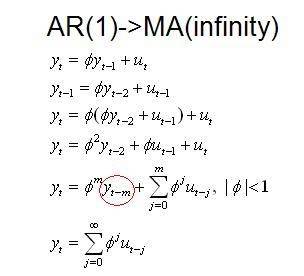
Theorem:
A stationary AR(1) model can be expressed in terms of MA(infinity).

Proof:
stat5.JPG


Now I don't understand how they get from the second last line to the last line. Where did the term Yt-m go?

I understand you can keep doing the substitution iteratively, but you always have to end up with a "Y" term no matter how many times you do it, but on the last line of the proof there is no "Y" term, so it magically disappared? I'm really confused.

Hopefully someone can explain this (in simple terms if possible). Thank you!
 
Physics news on Phys.org
They're taking the limit as \phi goes to infinity. What happens to \phi^m in that limit?
 
I think it's the limit as m->∞.

As m->∞,
φm ->0
BUT you also have to look at what happens to the other term, right? What if Yt-m->∞? Then we have indeterminate form 0*∞, and we just can't conclude that the product->0.
(Also, another complication is that Yt-m is a random variable, so I'm not sure if all of these make sense or not.)
 
kingwinner said:
I think it's the limit as m->∞.
You're right -- sorry.

As m->∞,
φm ->0
BUT you also have to look at what happens to the other term, right? What if Yt-m->∞? Then we have indeterminate form 0*∞, and we just can't conclude that the product->0.

(Also, another complication is that Yt-m is a random variable, so I'm not sure if all of these make sense or not.)
I'll take those two complications in reverse order. First, the equation will in general be true "almost surely", meaning with probability 1. It may be possible for \phi^m y_{t-m} to approach a constant or diverge, but this happens with probability 0. Second, you have to know SOMETHING about the y's. If this is the same book that your random walk problem came from, maybe they left out essential information. But the key fact is there in the word "stationary". It takes a little work to prove it, but If y is a decently-behaved RV (i.e., has a CDF) and is stationary and |\phi|<1, then \lim_{m\to\infty}\phi^m y_{t-m}=0 almost surely.
 

Similar threads

  • · Replies 10 ·
Replies
10
Views
3K
  • · Replies 14 ·
Replies
14
Views
3K
  • · Replies 1 ·
Replies
1
Views
1K
  • · Replies 1 ·
Replies
1
Views
1K
  • · Replies 7 ·
Replies
7
Views
5K
  • · Replies 3 ·
Replies
3
Views
2K
  • · Replies 3 ·
Replies
3
Views
5K
  • · Replies 2 ·
Replies
2
Views
3K
  • · Replies 3 ·
Replies
3
Views
2K
  • · Replies 10 ·
Replies
10
Views
3K