annie1
- 6
- 0
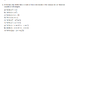
The discussion revolves around understanding quantifiers in mathematical statements, specifically how to express truth values and the necessity of providing counterexamples. Participants explore the implications of statements involving integers and the conditions under which they can be deemed true or false.
Participants express differing views on whether a complete answer requires only a true or false designation or if counterexamples are necessary. The discussion remains unresolved regarding the best approach to expressing answers related to quantifiers.
Participants demonstrate varying levels of understanding regarding the translation of statements and the requirements for expressing truth values, indicating potential gaps in foundational knowledge.