To find the amplitude of a mass on an elastic string

Click For Summary

Homework Help Overview

The discussion revolves around a problem involving simple harmonic motion (SHM) of a mass on an elastic string, specifically focusing on determining the amplitude and the timing of the mass's position during its oscillation. The original poster mentions an amplitude of (5/4)L and attempts to calculate the time at which the mass reaches specific positions in its motion.

Discussion Character

  • Exploratory, Conceptual clarification, Mathematical reasoning, Problem interpretation, Assumption checking

Approaches and Questions Raised

  • Participants explore the relationship between the amplitude and the time at which the mass reaches certain positions. The original poster uses trigonometric functions to express the motion and attempts to derive time values for specific positions. Some participants suggest reconsidering the initial conditions and the phase angle in the SHM equations.

Discussion Status

There is ongoing exploration of the problem with participants providing hints and suggestions for correcting the approach. Some participants have noted discrepancies in the original poster's calculations and assumptions, particularly regarding the phase angle and the initial position of the mass. The discussion is productive, with participants engaging in clarifying the setup and reasoning through the problem.

Contextual Notes

Participants are working under the constraints of the problem as presented, including the specific values for amplitude and gravitational effects. There is a focus on ensuring that the mathematical representation aligns with the physical motion described.

gnits
Messages
137
Reaction score
46
Homework Statement
To find the amplitude of a mass oscillating on an elastic string
Relevant Equations
F=ma
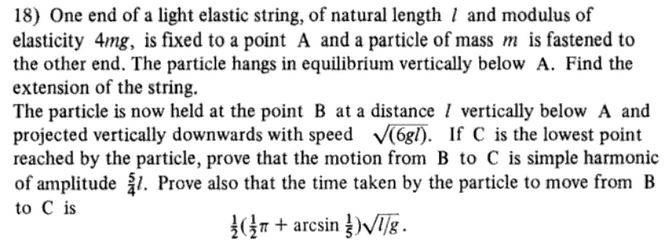
Could I please ask for help with the following:
18.JPG


It's the final part I am having problems with.

So at this point we know we have SHM of amplitude (5/4)L

Now, using x = a cos(nt) ----- where we now know that n = sqrt(4g/L)

we can find the time at which x has any value.

So for exmaple, when x first equals (5/4)L we have:

(5/4)L = (5/4)L * cos( sqrt(4g/L) t ) which leads to t = 0, as expected.

Now, to find when x first arrives at C is to find when x first has a value of -(5/4)L giving:

-(5/4)L = (5/4)L * cos( sqrt(4g/L) * t1 ) which leads to:

t1 = (PI/4)*sqrt(L/g)

Similarly, to find when x first equals L/4 (i.e. when the mass is first at B) we can use:

L/4 = (5/4)L * cos( sqrt(4g/L) * t2) which leads to:

t2 = sqrt(L/g) * arccos(1/5)

and so time taken to move from B to C is:

t1 - t2 = (1/2) * ((PI/2) - arccos(1/5)) * sqrt(L/g)

which is not quite the desired answer.

Thanks for any help,
Mitch.
 
Physics news on Phys.org
At ##t =0## the mass is at ##B##, which is not at an amplitude of ##5l/4##. I think you have to calculate where in the SHM cycle the motion starts.

Hint: you should be looking at motion of the form ##A\sin(\omega t + \phi)##.
 
Last edited:
PS I just checked through this and get the book answer.
 
Thanks for your suggestion, that really helped. So I've almost get there but I have sign out, can you spot my error?

So I use ##x=A\sin(\omega t + \phi)##

And we have that ##A=\frac{5l}{4}## and ##\omega=\sqrt{\frac{4g}{l}}##

In order to have ##x=\frac{l}{4}## when t = 0 we need to have ##\phi=arcsin(\frac{1}{5})##

So to find time to C we need to solve:

##sin(\sqrt{\frac{4g}{l}}t+arcsin(\frac{1}{5}))=1##

which leads to:

##t=\frac{1}{2}(\frac{\pi}{2}-arcsin(\frac{1}{5}))*\sqrt{\frac{l}{g}}##

and I have a minus instead of a plus. Thanks for any help.
 
If ##x(0) = \frac l 4##, then what is ##x## when the mass is at ##C##?

In fact, perhaps think more carefully about taking ##x(0) = \frac l 4## in the first place!
 
I see, at C, ##x=-\frac{5l}{4}## (I had not used the negative)

This would lead to:

##sin(\sqrt{\frac{4g}{l}}t+arcsin(\frac{1}{5}))=-1##

and so

##\sqrt{\frac{4g}{l}}t+arcsin(\frac{1}{5})=-\frac{\pi}{2}##

and so:

##t=\frac{1}{2}(-\frac{\pi}{2}-arcsin(\frac{1}{5}))*\sqrt{\frac{l}{g}}##

Sorry if I'm missing something obvious, but I'm still off.
 
gnits said:
I see, at C, ##x=-\frac{5l}{4}## (I had not used the negative)

This would lead to:

##sin(\sqrt{\frac{4g}{l}}t+arcsin(\frac{1}{5}))=-1##

and so

##\sqrt{\frac{4g}{l}}t+arcsin(\frac{1}{5})=-\frac{\pi}{2}##

and so:

##t=\frac{1}{2}(-\frac{\pi}{2}-arcsin(\frac{1}{5}))*\sqrt{\frac{l}{g}}##

Sorry if I'm missing something obvious, but I'm still off.

##x(0) = \frac l 4## doesn't fit with taking the ##\phi## you got. If you differentiate your equation you find that the mass is moving away from equilibrium at ##t =0##.

You could fix this by taking a different ##\phi## - note that more than one ##\phi## gives the same value of the trig functions. In any case, you need a different ##\phi## to get the correct position and velocity for the motion at ##t = 0##.

Taking ##x(0) = -\frac l 4## and ##C## as ##+\frac{5l}{4}## is perhaps the simplest approach.
 
OK, that's very helpful indeed. I had not been looking at the direction of the velocity. Thanks very much for all your help. I'll work through it all agian to be sure to understand it fully.
 

Similar threads

  • · Replies 7 ·
Replies
7
Views
3K
Replies
17
Views
2K
Replies
40
Views
3K
Replies
1
Views
1K
Replies
28
Views
2K
  • · Replies 6 ·
Replies
6
Views
2K
Replies
1
Views
4K
Replies
10
Views
3K
  • · Replies 3 ·
Replies
3
Views
1K
Replies
1
Views
1K