gnits
- 137
- 46
- Homework Statement
- To find the time for which a vessel is in range of guns
- Relevant Equations
- d=st
Could I please ask for help with the following question (the second part):
A cruiser sailing due north at 24 km/h sights a destroyer 48 km due east sailiing at 56 km/h on a course (360-a) degress where cos(a)=11/14.
Show that the destroyer's course realtive to the cruiser is on a bearing of 300 degrees and find the relative speed.
If the cruiser's guns have a maximum reange of 30 km and both ships maintain course and speed, find for how long the destoyer will be within range.
I've done the first part and agree with the book's answer:
Let ##V_{DC}## be the velocity of the destroyer realtive to the cruiser then my (and the book's) answer is:
##V_{DC_x}=-20\sqrt{3}## and ##V_{DC_y}=20##
So, here's my answer to the second part and I disagree with the book answer of 56 minutes.
Let ##r_C ## be the position vector of the cruiser and ##r_D## be the position vector of the destroyer, both relative to the cruiser's starting position, then:
(let i be the unit vector in the direction of east and j the unit vector in the direction of north and t be time)
##r_C=24tj## and ##r_D=(48-20\sqrt{3}t)i+20tj##
and so the position vector of the destroyer relative to the cruiser is:
##r_{DC}=(48-20\sqrt{3}t)i-4j##
And so the square of the distance between the vessels is:
##D^2=(48-20\sqrt{3}t)^2+16t^2##
And so we need to solve:
##(48-20\sqrt{3}t)^2+16t^2 <900##
To check, I put this into Wolfram Alpha and get:
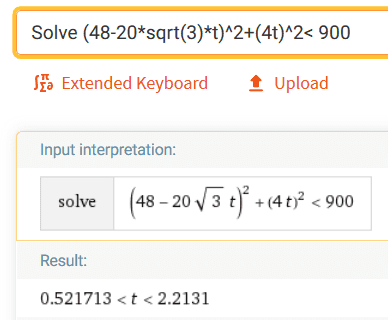
And that gives a time of approx 2.21 - 0.52 = 1.69 hours which is not the book answer,
Can anyone show me my mistake?
Thanks,
Mitch.
A cruiser sailing due north at 24 km/h sights a destroyer 48 km due east sailiing at 56 km/h on a course (360-a) degress where cos(a)=11/14.
Show that the destroyer's course realtive to the cruiser is on a bearing of 300 degrees and find the relative speed.
If the cruiser's guns have a maximum reange of 30 km and both ships maintain course and speed, find for how long the destoyer will be within range.
I've done the first part and agree with the book's answer:
Let ##V_{DC}## be the velocity of the destroyer realtive to the cruiser then my (and the book's) answer is:
##V_{DC_x}=-20\sqrt{3}## and ##V_{DC_y}=20##
So, here's my answer to the second part and I disagree with the book answer of 56 minutes.
Let ##r_C ## be the position vector of the cruiser and ##r_D## be the position vector of the destroyer, both relative to the cruiser's starting position, then:
(let i be the unit vector in the direction of east and j the unit vector in the direction of north and t be time)
##r_C=24tj## and ##r_D=(48-20\sqrt{3}t)i+20tj##
and so the position vector of the destroyer relative to the cruiser is:
##r_{DC}=(48-20\sqrt{3}t)i-4j##
And so the square of the distance between the vessels is:
##D^2=(48-20\sqrt{3}t)^2+16t^2##
And so we need to solve:
##(48-20\sqrt{3}t)^2+16t^2 <900##
To check, I put this into Wolfram Alpha and get:
And that gives a time of approx 2.21 - 0.52 = 1.69 hours which is not the book answer,
Can anyone show me my mistake?
Thanks,
Mitch.