To prove that Cauchy sequence

2 replies · 2K views · last reply
ozkan12
Messages
145
Reaction score
0
View attachment 4866View attachment 4867View attachment 4868View attachment 4859View attachment 4860View attachment 4861View attachment 4862View attachment 4863View attachment 4864View attachment 4865View attachment 4869

My Questions:

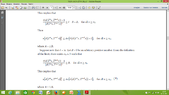
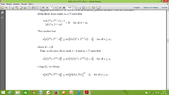
1) İn both sides of inequality of (*) why we use "n", that is, why we do multiplication with "n" ?

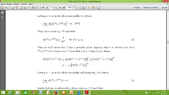
2) in (**) by Letting $n\to\infty$ we obtain $\lim_{{n}\to{\infty}} n\left[d\left({T}^{n}x,{T}^{n+1}x\right)\right]{}^{r}=0$ How this happened ?

3) Since, $\lim_{{n}\to{\infty}} n\left[d\left({T}^{n}x,{T}^{n+1}x\right)\right]{}^{r}=0$ there exists ${n}_{1}\in\Bbb{N}$ such that $d\left({T}^{n}x, {T}^{n+1}x\right)\le\frac{1}{{n}^{\frac{1}{r}}}$... How we can write this ?
Also, why we use number $\frac{1}{{n}^{\frac{1}{r}}}$ ?

Please can you give an answer to my questions ? Thank you for your attention..
 
Attachments
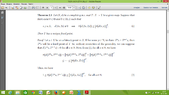
  • Screenshot of a PDF page showing Theorem 2.1 on a complete generalized metric space: a contractive condition with theta and k in (0,1) implies a unique fixed point, followed by its proof and inequalities (1) and (2).
    4.png
    51.9 KB · Views: 149
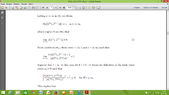
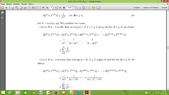
  • Printed page from a journal article showing the limit n to infinity of theta(d(T^n x, T^(n+1) x)) equal to 1, leading to limit of d(T^n x, T^(n+1) x) = 0 (equation 3), and the condition on the limit of (theta(d) - 1)/d^r equal to l.
    5.png
    42.8 KB · Views: 150
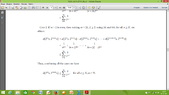
  • Screenshot of a PDF page showing two cases of a limit argument: a bound with ell minus B equal to B for n at least n0, then n times d(T^n x, T^(n+1) x)^r at most A n times (theta(d) minus 1), where A = 1/B, followed by the case ell = infinity.
    6.png
    43.4 KB · Views: 159
  • Printed page from a math paper showing inequalities: from theta(d(T^n x, T^{n+1} x)) - 1 over d(T^n x, T^{n+1} x)^r >= B for n >= n0, deriving n d(T^n x, T^{n+1} x)^r <= A n (theta(...) - 1) with A = 1/B, then the bound with theta(d(x,Tx))^{kn} - 1.
    7.png
    42.6 KB · Views: 151
  • Page from a mathematics paper showing a limit statement lim n[d(T^n x, T^(n+1) x)]^r = 0 labelled (**), an inequality (4) bounding d(T^n x, T^(n+1) x) by 1/n^(1/r) for n at least n_1, and a chain of inequalities (5) involving theta and k.
    8.png
    48 KB · Views: 163
  • Page 4 of a PDF showing inequality (6) d(T^n x, T^(n+2) x) <= 1/n^(1/r) for n >= n2, then Case 1 for odd m with a chain of distance bounds summed to a series, and Case 2 for even m.
    9.png
    44.7 KB · Views: 146
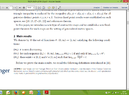
  • Handwritten-style typeset proof excerpt, Case 2 for even m = 2L: chain of inequalities bounding d(T^n x, T^(n+m) x) by sums of 1/i^(1/r) from i = n to infinity, concluding for all n >= N and m in N.
    10.png
    37.9 KB · Views: 155
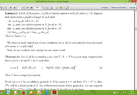
  • Screenshot of a PDF page showing Section 2 'Main results': definition of the set Theta of functions theta from (0, infinity) to (1, infinity) with conditions (Theta 1) non-decreasing, (Theta 2) lim theta(t_n) = 1 iff t_n tends to 0+, and (Theta 3) limit as t tends to 0+ of (theta(t) - 1)/t^r equals l.
    1.png
    54.5 KB · Views: 153
  • Screenshot of a PDF page showing Definitions 2.1 to 2.4 and the start of Lemma 2.1 on generalized metric spaces: a g.m.s. with conditions on d, convergence d(x_n, x) to 0, Cauchy sequences, and completeness.
    2.png
    61.2 KB · Views: 154
  • Screenshot of a PDF page showing Lemma 2.1 on Cauchy sequences in a generalized metric space, followed by Theorem 2.1, a contraction-type fixed point theorem with inequality (1), and the start of its proof.
    3.png
    58.4 KB · Views: 141
  • Journal page 5 of 8 showing text: From the convergence of the series sum over i of 1/i^(1/r) (since 1/r > 1), T^n x is a Cauchy sequence, followed by displayed inequalities involving d(Tx, Ty) and d(x, y).
    11.png
    50.4 KB · Views: 154
ozkan12 said:
My Questions:

1) İn both sides of inequality of (*) why we use "n", that is, why we do multiplication with "n" ?

2) in (**) by Letting $n\to\infty$ we obtain $\lim_{{n}\to{\infty}} n\left[d\left({T}^{n}x,{T}^{n+1}x\right)\right]{}^{r}=0$ How this happened ?

I'm not at all sure I buy it, myself. It's not clear at all from, say, the $(\Theta_3)$ condition that $\theta^{k^n}$ goes to $1$ faster than $n\to\infty$, which is certainly what you'd need to conclude (**). I could buy, from the $(\Theta_3)$ condition, that
$$\lim_{n\to\infty}n^r \left(\theta^{n^k}-1\right)=\ell,$$
where $0<r<1$, but as we don't seem to have much control over the size of $\ell$, I'm not sure that helps us much.

Hang on: I think it might be a typo. I think you could conclude that IF:
$$\lim_{n\to\infty}[d(T^nx,T^{n+1}x)]^r=0,$$
THEN there exists an $n_1>0$ such that for all $n>n_1$, you have
$$d(T^nx,T^{n+1}x)\le \frac{1}{n^{1/r}}.$$
Isn't that pretty close to the definition of convergence? Our $\varepsilon$ is just written in this fancy way. I could be wrong, but I think this works.

3) Since, $\lim_{{n}\to{\infty}} n\left[d\left({T}^{n}x,{T}^{n+1}x\right)\right]{}^{r}=0$ there exists ${n}_{1}\in\Bbb{N}$ such that $d\left({T}^{n}x, {T}^{n+1}x\right)\le\frac{1}{{n}^{\frac{1}{r}}}$... How we can write this ?
Also, why we use number $\frac{1}{{n}^{\frac{1}{r}}}$ ?

Please can you give an answer to my questions ? Thank you for your attention..

I think the author wants to be able to do the sums at the very end of the proof, and this form of $\varepsilon$ let's him do that.
 
Dear Ackbach

İn your post, I think these definitions close to definition of convergence but this carry very special conditions...But I didnt understand why we choose $\varepsilon$ in this way ? Because this is very special, I think that can we take $\varepsilon$ different from this ? This article is hard for me :)