"To the power of" (powers in division have to be subtracted)

  • Thread starter Thread starter chriscarson
  • Start date Start date
  • Tags Tags
    Division Power
Click For Summary
SUMMARY

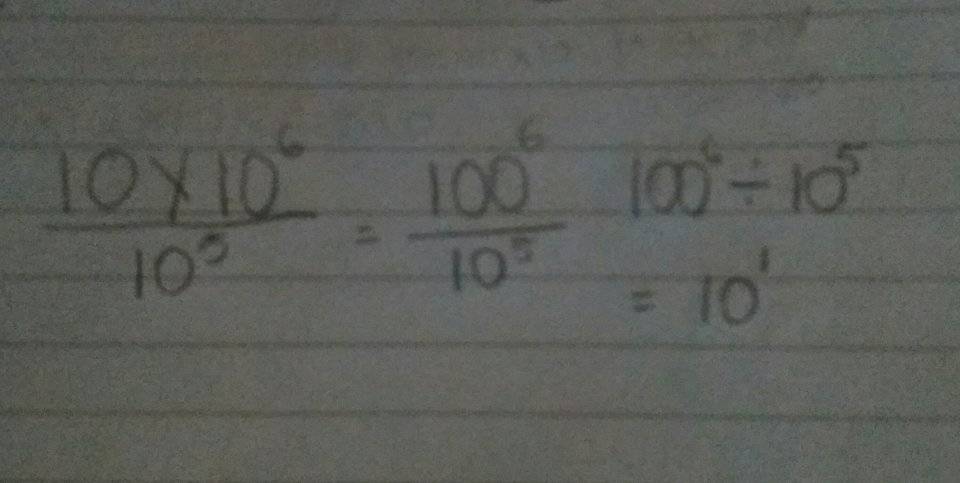
The discussion focuses on the mathematical principle that when multiplying powers with the same base, the exponents are added, as expressed in the formula 10^m × 10^n = 10^{m+n}. Participants clarify that 10 × 10^6 equals 10^7, not 100^6. The importance of the order of operations, specifically the PEMDAS/BEDMAS rules, is emphasized to avoid common mistakes in calculations involving exponents and multiplication. Additionally, the concept of negative exponents is introduced, reinforcing the understanding of division in terms of subtraction of exponents.

PREREQUISITES
  • Understanding of exponentiation rules, specifically 10^m × 10^n = 10^{m+n}
  • Familiarity with the order of operations (PEMDAS/BEDMAS)
  • Basic knowledge of negative exponents and their implications
  • Ability to perform longhand calculations with powers of ten
NEXT STEPS
  • Study the properties of exponents, including negative and zero exponents
  • Practice problems involving multiplication and division of powers with the same base
  • Explore the applications of scientific notation in real-world contexts
  • Learn about logarithms and their relationship to exponents
USEFUL FOR

Students, educators, and anyone looking to strengthen their understanding of exponentiation and its applications in mathematics and science.
chriscarson
Messages
197
Reaction score
26
Homework Statement
can t figure out how to do this with out a calculator
Relevant Equations
powers in division have to be subtracted
Our teacher said that powers in division have to be subtracted when the same base , but still , I am not getting the right answer.
106507736_895349104293122_1419857438884051582_n.jpg
 
Last edited by a moderator:
Physics news on Phys.org
well you have a big mistake here it is not ##10\times 10^6=100^6## it is rather ##10\times 10^6=10^7##. To see this write ##10^6## as ##10\times10\times10\times10\times10\times10##. Generally it is ##10^m\times10^n=10^{m+n}##
 
  • Like
Likes   Reactions: chriscarson
One problem is that:

##10 \times 10^6 \ne 100^6##

Why not try doing the problem in longhand and check each step?

You start with ##\frac{10 \times 10^6}{10^5}## on one side of the page and ##\frac{10 \times 1,000,000}{100,000}## on the other side of the page.

Work through it both ways to see what is going on at each step.
 
  • Like
Likes   Reactions: chriscarson
Delta2 said:
well you have a big mistake here it is not ##10\times 10^6=100^6## it is rather ##10\times 10^6=10^7##. To see this write ##10^6## as ##10\times10\times10\times10\times10\times10##. Generally it is ##10^m\times10^n=10^{m+n}##

yeah that s true , I knew how 10 s you have to make but I asked if there is a short way to do by memory
 
The rules of precedence (PEMDAS or BEDMAS) call for exponentiation to be performed before multiplication or division. So it is interpreted as$$10 \times (10^6)$$ rather than as $$(10 \times 10)^6$$.

PEMDAS = Parentheses, Exponentiation, Multiplication/Division, Addition/Subtraction
BEDMAS = Brackets, Exponentiation, Division/Multiplication, Addition/Subtraction.
 
  • Like
Likes   Reactions: chriscarson
PeroK said:
One problem is that:

##10 \times 10^6 \ne 100^6##

Why not try doing the problem in longhand and check each step?

You start with ##\frac{10 \times 10^6}{10^5}## on one side of the page and ##\frac{10 \times 1,000,000}{100,000}## on the other side of the page.

Work through it both ways to see what is going on at each step.

this is shorter though , but still you need to make a big sum , but it s better for sure
 
jbriggs444 said:
The rules of precedence (PEMDAS or BEDMAS) call for exponentiation to be performed before multiplication or division. So it is interpreted as$$10 \times (10^6)$$ rather than as $$(10 \times 10)^6$$.

PEMDAS = Parentheses, Exponentiation, Multiplication/Division, Addition/Subtraction
BEDMAS = Brackets, Exponentiation, Division/Multiplication, Addition/Subtraction.

Yes not because I remembered that but the multiplication I was doing first .
 
now I remember something like this
105598305_1409660259242980_1485819579724760932_n.png
 
  • Like
Likes   Reactions: PeroK
chriscarson said:
yeah that s true , I knew how 10 s you have to make but I asked if there is a short way to do by memory
the short way is that ##10^m\times 10^n=10^{m+n}## Just apply this for ##m=1,n=6##.
 
  • Like
Likes   Reactions: chriscarson
  • #10
Delta2 said:
the short way is that ##10^m\times 10^n=10^{m+n}## Just apply this for ##m=1,n=6##.

so when there is no power the power is 1 ?
 
  • Like
Likes   Reactions: jbriggs444
  • #11
chriscarson said:
so when there is no power the power is 1 ?
yes. It is ##10^1=10##
 
  • Like
Likes   Reactions: chriscarson
  • #12
oh that s what I didn t know ,
 
  • Like
Likes   Reactions: Delta2
  • #13
THANKS ALL OF YOU AGAIN
 
  • #14
chriscarson said:
this is shorter though , but still you need to make a big sum , but it s better for sure
"make a big sum"? No. I think you may be doing something wrong.
6+1=7 gives ##10 * 10^6 = 10^7##. Then 7-5=2 gives ##\frac {10^7} {10^5} = 10^2 = 100##. So you should never have to deal with any "big sum".
 
  • Like
Likes   Reactions: chriscarson
  • #15
FactChecker said:
"make a big sum"? No. I think you may be doing something wrong.
6+1=7 gives ##10 * 10^6 = 10^7##. Then 7-5=2 gives ##\frac {10^7} {10^5} = 10^2 = 100##. So you should never have to deal with any "big sum".

oh that s what exactly I was looking for , thanks the others helped me too in a way to understand what this means.

so easy for you with a high IQ :oldsmile:
 
  • #16
chriscarson said:
oh that s what I didn t know ,
##10^0 = 1## is the tricky one. That's the one you have to remember!

The other way to look at this is:
$$10 \times 10^6 = 10 \times (10 \times 10 \times 10 \times 10 \times 10 \times 10) = 10^7$$
And:
$$\frac{10^7}{10^5} = \frac{10 \times 10 \times 10 \times 10 \times 10 \times 10 \times 10}{ 10 \times 10 \times 10 \times 10 \times 10} = 10 \times 10 = 10^2$$
In the main step, we are cancelling five 10's on the bottom with five 10's on the top. That's where the "subtraction" rule comes from: ##7 - 5 = 2##.
 
  • Like
Likes   Reactions: chriscarson
  • #17
PeroK said:
##10^0 = 1## is the tricky one. That's the one you have to remember!

The other way to look at this is:
$$10 \times 10^6 = 10 \times (10 \times 10 \times 10 \times 10 \times 10 \times 10) = 10^7$$
And:
$$\frac{10^7}{10^5} = \frac{10 \times 10 \times 10 \times 10 \times 10 \times 10 \times 10}{ 10 \times 10 \times 10 \times 10 \times 10} = 10 \times 10 = 10^2$$
In the main step, we are cancelling five 10's on the bottom with five 10's on the top. That's where the "subtraction" rule comes from: ##7 - 5 = 2##.

and also it confused me that 10 when is in the power of 2 for example , the 0 with the 1 in the value of 10 is one of the two zeros you need to have , I thought you had to add another two zeros .
 
  • #19
chriscarson said:
and also it confused me that 10 when is in the power of 2 for example , the 0 with the 1 in the value of 10 is one of the two zeros you need to have , I thought you had to add another two zeros .

##10^2 = 10 \times 10 = 100##. In the same way that ##9^2 = 9 \times 9 = 81##.

Saying ##10^n## is a "one followed by ##n## zeroes" is true, but that's not the underlying rule.
 
  • Like
Likes   Reactions: chriscarson
  • #20
etotheipi said:
These might be useful

https://mathinsight.org/exponentiation_basic_rules
https://www.uea.ac.uk/documents/6207125/8183824/steps+into+numeracy+powers+of+10+and+standard+form.pdf

oh thanks , I notice that many of them they have same bases that s what was like to search in youtube was. and then I have all sort of them with -, decimals etc like this
106089067_717410508825549_4706151525018830391_n.png
 
  • #21
PeroK said:
##10^2 = 10 \times 10 = 100##. In the same way that ##9^2 = 9 \times 9 = 81##.

Saying ##10^n## is a "one followed by ##n## zeroes" is true, but that's not the underlying rule.

I followed the rule of the decimal where is it and I thought in that case of 10 is behind the zero than add 2 spaces

so when is 10 ,20, 30 . etc is different
 
  • #22
106210018_975597616214873_968385605320074011_n.jpg


for example now it doesn t work for me 7 - 9
 
  • #23
PeroK said:
##10^2 = 10 \times 10 = 100##. In the same way that ##9^2 = 9 \times 9 = 81##.

Saying ##10^n## is a "one followed by ##n## zeroes" is true, but that's not the underlying rule.

so I had a bit of a good reason
 
  • #24
chriscarson said:
View attachment 265329

for example now it doesn t work for me 7 - 9
What do you mean it doesn't work for you, you haven't been introduced to negative numbers? or you don't know that ##10^{-n}=\frac{1}{10^n}##
 
  • Like
Likes   Reactions: chriscarson
  • #25
chriscarson said:
so I had a bit of a good reason
Yes, but just be careful not to write ##9^2 = 99##. That's the thing to avoid.
 
  • Like
Likes   Reactions: chriscarson
  • #26
chriscarson said:
View attachment 265329

for example now it doesn t work for me 7 - 9
This is the same, except the number on the denominator is bigger. So, you get:
$$\frac{10^7}{10^9} = 10^{-2} = \frac{1}{10^2} = \frac 1 {100}$$
Note that the last three expressions all mean exactly the same thing.
 
  • Like
Likes   Reactions: chriscarson and Delta2
  • #27
PeroK said:
This is the same, except the number on the denominator is bigger. So, you get:
$$\frac{10^7}{10^9} = 10^{-2} = \frac{1}{10^2} = \frac 1 {100}$$
Note that the last three expressions all mean exactly the same thing.

that s a good explanation , I have to remember it now. Thanks
 
  • #28
Delta2 said:
What do you mean it doesn't work for you, you haven't been introduced to negative numbers? or you don't know that ##10^{-n}=\frac{1}{10^n}##

I was introduced but was nt sure were they can be used or sometimes forget the mechanisim.
 
  • Like
Likes   Reactions: Delta2
  • #29
PeroK said:
Yes, but just be careful not to write ##9^2 = 99##. That's the thing to avoid.

ok, at least I am sure that 9 to the power of 2 is 9x9.
 
  • #30
chriscarson said:
that s a good explanation , I have to remember it now. Thanks

You could also note that it's consistent with the properties you already know. ##x^n x^{-n} = x^{n-n} = x^0 = 1##, so divide through by ##x^n## and you see ##x^{-n} = \frac{1}{x^n}##.

But N.B. AFAIK ##x^0 := 1## and ##x^{-n} := \frac{1}{x^n}## are definitions, and the exponent laws can be proven by induction. So the first sentence is deriving it backwards :wink:
 
  • Like
Likes   Reactions: chriscarson and Delta2

Similar threads

Replies
19
Views
2K
Replies
3
Views
2K
  • · Replies 9 ·
Replies
9
Views
2K
  • · Replies 7 ·
Replies
7
Views
2K
  • · Replies 6 ·
Replies
6
Views
2K
  • · Replies 2 ·
Replies
2
Views
2K
  • · Replies 8 ·
Replies
8
Views
2K
  • · Replies 11 ·
Replies
11
Views
3K
  • · Replies 5 ·
Replies
5
Views
2K
  • · Replies 18 ·
Replies
18
Views
13K