D.S.Beyer
- 50
- 2
Lets think about how spacetime curvature has changed since the early universe. In the beginning, (close to the beginning that is), everything was hydrogen (sort of). That hydrogen was more or less homogenous save a few little places, that would, after billions of years, would become stars and galaxies.
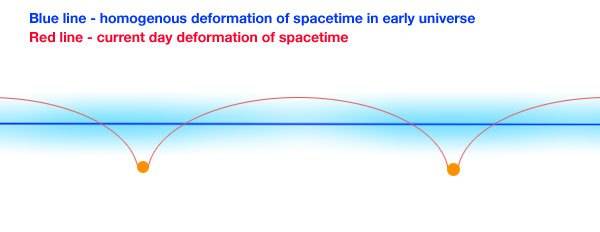
The spacetime deformation of the homogenous hydrogen was slight but it was also everywhere. As the hydrogen began its life toward stars and galaxies it condensed in places and left other places. And so spacetime deformation 'grew' in places the hydrogen condensed and 'lessened' in areas the hydrogen left.
What can say about the gravitational length contraction of these areas? The simple act of condensation of matter leads to areas of both contraction near mass and dilation between the condensing areas. Which would translate visually as the areas of mass moving away from each other, would it not? What Doppler or Red Shift effects does gravitational length contraction and dilation have?
Also can we say that relative to now, here on earth, in the milkyway, that time in the early universe was passing much more quickly? How does this relate to the inflationary epoch, where everything seemed to move faster than light to get where it is today? Does the faster time balance the faster than light expansion?
Thoughts?
The spacetime deformation of the homogenous hydrogen was slight but it was also everywhere. As the hydrogen began its life toward stars and galaxies it condensed in places and left other places. And so spacetime deformation 'grew' in places the hydrogen condensed and 'lessened' in areas the hydrogen left.
What can say about the gravitational length contraction of these areas? The simple act of condensation of matter leads to areas of both contraction near mass and dilation between the condensing areas. Which would translate visually as the areas of mass moving away from each other, would it not? What Doppler or Red Shift effects does gravitational length contraction and dilation have?
Also can we say that relative to now, here on earth, in the milkyway, that time in the early universe was passing much more quickly? How does this relate to the inflationary epoch, where everything seemed to move faster than light to get where it is today? Does the faster time balance the faster than light expansion?
Thoughts?